“We must build dykes of courage to hold back the floods of fear.”
Martin Luther King, Jr.
Investment Perspective We had an excellent first quarter for our equity based strategies, both defensive and traditional with gains as high as 17% (net) for our best performing strategy. This was accomplished despite widespread investor fears that continued to prevail from last year. For the most part, our strategies outperformed their respective benchmarks, and we believe we accomplished this while taking less risk, using no leverage, * and maintaining the utmost transparency. Our bond portfolios tracked at least as well as their respective benchmarks despite most bonds offering little return and not much value (in our opinion). Our private equity and real asset investments appear to be making progress as well.
Of great importance in being able to accomplish solid results despite ongoing fear, is deploying one’s liquid net worth in a prudent asset allocation. One’s carefully constructed asset allocation among our investment baskets in security; defensive equity; traditional equities; and private investments is the building of our dykes of courage. The floods of fear come daily from the many economic, geopolitical, and political challenges that we face. Our asset allocation seeks to protect us from the emotional decisions that investors often make that tend to hurt their performance.
* Only our Sterling Stamos strategies invest in funds that use leverage.
Our explanation for the first quarter’s significant gains stems from a catch up to reflect last year’s earnings growth, and the somewhat reduced fear emanating from last year’s economic, political and natural disasters. The Japanese earthquake and related events, our budget debacle and subsequent credit downgrade, predictions of a Lehman-like financial meltdown in Europe,
and a projected double- dip recession were digested/dealt with/or just didn’t happen. Of course some challenges including structural and growing deficits, unacceptable levels of unemployment and anemic domestic growth need to be addressed with reasonable fiscal policy. But that will have to wait until after the election given the selfish nature of our politicians.
We at FLI believe that the economy is somewhat better than many pundits believe based on the financial strength of American business and the resilience and prudence of the American consumer. This is in spite of politicians who have chosen to bicker rather than promulgate constructive fiscal policies relating to addressing budget deficits, overdue tax reform, and impending difficulties with Social Security, Medicaid, and Medicare. This paralysis has contributed to a continued level of high unemployment as existing businesses are slow to deploy capital and hire new employees as there remains too much uncertainty. And overzealous government regulation in many industries including energy have hampered growth initiatives and subsequent job growth.
The unfortunate reality is that we face significant uncertainty from both unknown tax and healthcare policy which severely impact the domestic economy. Tax rates for almost all Americans are set to increase the first of the year as payroll taxes go back up and the Bush tax cuts expire. In addition, our new health care law is being challenged by 26 states before the Supreme Court. Their decision will impact virtually all Americans and most businesses. And by the way, imbedded in this new health care law are tax increases on all forms of investment income. The net result could be a huge headwind to the consumer and business depending on what happens at year-end (we believe some compromise will be made lessening the tax blow).
Meanwhile China’s growth is still strong but somewhat slower than recent quarters. Europe’s debt and banking issues are being dealt with but it is in a modest recession (thus far) resulting from austerity and tax increases (there is a lesson here). The good news is that the powers in Europe are looking to avoid a Lehman-like event. So far so good – and even headlines about Greece, Italy, Spain and Portugal don’t really move our markets as much as they had. However, we continue to be concerned that steps taken to this point are still a temporary fix and include anti-growth austerity. This could present issues down the road. Other eopolitical hotspots in the Middle East could bring back volatility, especially efforts to stop Iran’s nuclear undertaking.
The good news is the S&P 500 and other benchmarks are at much higher levels than three years ago, but not record levels. However earnings are higher for companies and we believe share prices therefore are more reasonable. This is especially the case given the historically low interest rates being paid on bonds. Corporate balance sheets are much stronger; however the pace of expected earnings growth has slowed. Dividend growth is robust and our Dividend Growth strategy yield is more than fifty percent greater than the ten year Treasury! Thus we remain comfortable in advising clients to have prudent but reasonable allocations to our defensive and traditional equity strategies. Too much money is in money market funds and bond strategies which we believe will provide negative real returns (after inflation) and will suffer losses if interest rates increase. Skepticism about the market’s gains and ongoing fear continues to cause
this outflow from stocks into bonds and cash. This we believe, as contrarians, is a positive factor.
Commodities are hard to call given the uncertainty of global growth. Gold remains more of an insurance hedge against inflation and global conflict now that financial collapse seems off the table. Real estate, if not overly levered and financed at longer term low interest rates while sporting a good cash on cash return, could be a worthwhile investment (not so easy to find, but we are looking). Private equity also is attractive if you’re willing to endure long periods of illiquidity (you are generally paid for waiting).
The proverbial wall of worry described above should also include high energy costs and a housing market that continues to sputter along (we believe it will get better in the next year). Both particularly hurt the consumer who is still deleveraging. So why do we remain defensively optimistic? The answer is cash, fear, and progress.
The individual and corporate cash on the sidelines, both here and abroad, will ultimately find its way into investment, dividend increases, share buybacks, and acquisition activity. This will bode well for good stocks. The media-driven fear seems to be giving way to the animal instinct of greed. Apple at $600 and paying a dividend, Facebook going public at a hundred billion dollar valuation and old Big Blue (IBM) hitting $200 per share have made those risk takers richer. Given what we believe to be reasonable valuations for both Apple and IBM, even my older relatives would make that risk-on trade. Yet many remain on the sidelines still contemplating an entry point. They will slowly but surely commit as other asset classes provide little or no value and that also will be good for the markets. Despite the legitimate real life concerns that exist, progress is being made by companies in terms of earnings growth, market share gains and product innovation. And even politicians both here and abroad are starting to deal with structural issues that must be solved.
So stay disciplined and nimble by allowing us to work with you on a prudent asset allocation. In the current environment we generally recommend an asset allocation that emphasizes defensive equities, so volatility and fear doesn’t shake you out of the equity markets. In addition, at this juncture we believe that our defensive equity strategies provide better value and yield than most bonds. At the same time you will also have a better chance to make a real return (after inflation) on your core capital. The balance of security (bonds and absolute return) on one side and traditional equities (growth, value and diversified) on the other side of defensive equities should give you a pathway to reasonable long term returns while taking on the level of risk you are comfortable with. Meanwhile you can watch events unfold on our wall of worry with fewer sleepless nights.
You will see from the results in the next section that having been diversified among our allocation baskets of security, defensive equity and traditional equities paid off handsomely this quarter while permitting you to sleep at night. We can’t let fear dictate a policy of accepting below inflation returns.
Best regards,
Robert D. Rosenthal
Chairman and
Chief Executive Officer
Ralph F. Palleschi
President and
Chief Operating Officer
*The forecast provided above is based on the reasonable beliefs of First Long Island Investors, LLC and is not a guarantee of future performance. Actual results may differ materially. Past performance statistics may not be indicative of future results.
Disclaimer: The views expressed are the views of Robert D. Rosenthal and Ralph F. Palleschi through the period ending March 31, 2012, and are subject to change at any time based on market and other conditions. This is not an offer or solicitation for the purchase or sale of any security and should not be construed as such. References to specific securities and issuers are for illustrative purposes only and are not intended to be, and should not be interpreted as, recommendations to purchase or sell such securities.
Content may not be reproduced, distributed or transmitted, in whole or in portion, by any means, without written permission from First Long Island Investors, LLC. Copyright © 2012 by First Long Island Investors, LLC. All rights reserved.
“The economy depends about as much on economists as the weather does on weather forecasters.”
Jean Paul Kauffmann
Investment Perspective
The fourth quarter of 2011 saw equity markets significantly rebound from the sharp downturn experienced in the third quarter. The entire year was a troubling and difficult one for investors as volatility from economic, geopolitical, and natural disasters interfered with rational investing. These factors prevented stock prices from reflecting significantly higher earnings achieved by
many companies in the U.S. and around the world. In fact, there was an unusually high correlation between the stock market performance of companies whose businesses performed well and those that didn’t. Thus higher earnings from better performing companies were cast aside from a valuation standpoint as fear and uncertainty spread by the media dominated investors. Specifically the uncertainty of the European debt crisis, the Arab Spring, and the horrific natural disaster in Japan from an earthquake and tsunami plagued investors on almost a daily basis. Couple this with dysfunction in Washington and an unprecedented downgrade of U.S. debt, and we found ourselves in an ugly environment with outflows from equity markets
and inflows to cash and bonds.
One result from the above factors was the proliferation of dire economic forecasts from many notable economists. Predictions of another Lehman-type financial crisis initiated in Europe, a double-dip recession, and an imminent attack on Iran surfaced on a regular basis adding to the uncertainty and fear of investors. Well, thus far the economists have been wrong to a large extent. The U.S. has not gone into recession, although growth remains painfully slow. Employment has steadily improved, although still leaving millions unemployed and underemployed. Europe continues to kick the can down the road with its efforts to bolster the Euro and the besieged economies of Greece, Italy and Spain. Despite political paralysis, our government is still functioning and we as a nation have survived our first credit downgrade (it was no shock that France and other European countries were downgraded in January). So, as a global economy, we are doing somewhat better than that which was suggested by many economists just six months ago. Well, their predictions made for some interesting reading, although it sometimes bordered on fiction. Economists weren’t able to predict much of what the real economy was. And that is why we focus on the fundamentals and don’t listen to weather forecasters as well.
The confluence of these factors led to a tough year for different strategies. Most equity-based hedge funds did quite poorly with negative results as correlations were too high amongst stocks. Longer duration high quality municipal, treasury, and corporate bonds did reasonably well as did our fixed income portfolios. Most traditional equity strategies suffered modest losses, failing to
achieve a flat benchmark return. Our defensive equity strategy, dividend growth, had a great year achieving a 12% net return. Other of our traditional equity strategies suffered modest losses. Foreign equity strategies did poorly as the international benchmarks declined from ten to twenty percent, falling in sympathy with the angst in Europe and fears of a hard landing in China. Thus it was a difficult investment environment in which our strategies did alright on balance, led by Dividend Growth.
While it is true that many economists got it wrong last year, we remain optimistic but cautious ahead of continued uncertainty. We take solace in knowing that American domiciled businesses (especially large ones) have solid balance sheets with significant amounts of cash. This is a good position to be in and gives these companies the flexibility to possibly raise dividends, buy back
shares, and make opportunistic acquisitions. Interest rates remain incredibly low as mandated by monetary actions taken by the Fed recognizing weaker than desired economic growth, a still declining housing market, and a benign inflation outlook. This will save bond investors for the time being who have extended out too far in maturity, but provides weak yields that in many cases are below the inflation rate. Thus those investors remaining in cash and those holding bonds are getting a negative real return after inflation. Those investors who have stretched maturities to grab yield will be punished if rates start to increase sometime in the future (we believe they will increase in the future).
Equity valuations remain attractive in our opinion. Projected S&P 500 earnings of about $100 for 2012 (a modest growth from 2011) makes the general market seem somewhat undervalued. We believe that, over time, this asset class will generate investor inflows for the first time in years. This could lead to multiple expansion and meaningful appreciation. However, investors should
always be choosy in selecting companies to invest in. We see many companies that are reasonably growing and represent real value in our opinion. Others might not fare as well in this more difficult and slow growing economy. Accordingly, we believe that our defensive equity strategies, including Dividend Growth, are key sound strategies for the current uncertain environment. Our dividend growth strategy should benefit from what we believe will be another year where its dividends should grow by 8% or more. This strategy continues to garner investor interest because of its above average yield and steadily growing income stream. Thus we believe these two defensive equity strategies are ideally suited to prosper in the current uncertain economic and geopolitical environment.
Our traditional equity strategies are also seemingly in a good place given both valuation and significant earnings improvement forecasted for 2012. These strategies will particularly benefit if the European debt crisis has some resolution as this has been a major overhang. In any event, the headlines from Europe no longer generate the panic they did last year, and our domestic banks are actually seeing some lending opportunities in Europe. Valuations are reasonably compelling for traditional equities and while earnings growth on average appears modest, less uncertainty than last year should help these strategies appreciate. We also believe that our seasoned managers have identified those companies that can prosper in the growing global economy as well as those capable of making market share gains.
On balance, we remain cautiously optimistic as the forecasted disasters last year didn’t materialize and the global economy continues to slowly improve. However, given continuing policy uncertainty both domestically and internationally, we believe that asset allocations for our clients should be biased on the defensive side. Defensive equity strategies make sense while fixed income offers unreasonably low returns. We would not add to them at this time unless one is willing to accept a negative real return on an after tax basis for most quality bond offerings. Finally, for those who can withstand illiquidity, private equity also seems attractive given the need for capital in the small to middle market companies where credit is still hard to come by. We remain committed to the strategy of reasonable diversification.
As always, we stand ready to assist you with your asset allocation in these difficult times. Our goal remains preservation of capital with appreciation above the rate of inflation while minimizing risk through greater emphasis of defensive equity strategies and overall diversification. And yes, we know this will help you sleep at night as well. Please call upon us.
Best regards,
Robert D. Rosenthal
Chairman and
Chief Executive Officer
Ralph F. Palleschi
President and
Chief Operating Officer
RDR/lsb
* The forecast provided above is based on the reasonable beliefs of First Long Island Investors, LLC and is not a guarantee of future performance. Actual results may differ materially. Past performance statistics may not be indicative of future results.
Disclaimer: The views expressed are the views of Robert D. Rosenthal and Ralph F. Palleschi through the period ending December 31, 2011, and are subject to change at any time based on market and other conditions. This is not an offer or solicitation for the purchase or sale of any security and should not be construed as such. References to specific securities and issuers are for illustrative purposes only and are not intended to be, and should not be interpreted as, recommendations to purchase or sell such securities.
Content may not be reproduced, distributed or transmitted, in whole or in portion, by any means, without written permission from First Long Island Investors, LLC. Copyright © 2012 by First Long IslandInvestors, LLC. All rights reserved.
Dear (Client):
We wanted to take this opportunity to thank you for investing in our Dividend Growth strategy. You probably have noticed that we had a very good year in 2011 by appreciating 12.0% net of all fees and expenses. (This compares favorably to the S&P 500 which advanced 2.1%.) We appreciate your confidence in our strategy and we are glad to have provided a really good return in what turned out to be a most difficult year for investors.
Recently, many pundits and strategists have pointed out the benefit of investing in higher yielding large companies as if this were a new phenomenon. We believe that this way of investing has rewarded investors over many decades. We also believe that the key to this being a successful way to invest over the long term is to find companies that can grow their dividends virtually every year. That requires a successful business model as well as managements that have it in their DNA to share growing cash flows with their shareholders. This is why we carefully select our portfolio companies to include only those that combine a higher than average dividend with the ability and history to increase dividends on a yearly basis. We are proud to report to you that each of our portfolio companies (27 in all) raised their dividends last year. In some instances, we have companies that have raised their dividends for more than fifty consecutive years!
Based on our reviews of academic studies and our analysis of companies that pay higher and growing dividends, we firmly believe that dividends play a significant role in total appreciation over long periods of time. We believe that many companies that don’t pay dividends (or don’t raise them on a frequent basis) will suffer from less than desirable valuations unless they have unique growth characteristics. Today, with bond yields so low and in some cases less than the annual inflation rate, we believe that large quality companies that pay higher than average dividends with the potential of growing those dividends continue to make great sense as part of an overall asset allocation for any investor. Getting a three to four percent on average growing cash return settles a lot of nerves during periods of great uncertainty.
Diversified investing is still the key to a successful overall investment strategy. We believe that our Dividend Growth strategy of investing should continue to be a meaningful component of your investment plan. This, along with allocations to our security and traditional equity baskets, will help you navigate the uncertainties that exist in our world today with a goal to both preserve and grow your net worth.
Thanks for your continued support!
Best regards,
Robert D. Rosenthal
Chairman and
Chief Executive Officer
*The forecast provided above is based on the reasonable beliefs of First Long Island Investors, LLC and is not a guarantee of future performance. Actual results may differ materially. Past performance statistics may not be indicative of future results.
Disclaimer: The views expressed are the views of Robert D. Rosenthal through the period ending December 31, 2011, and are subject to change at any time based on market and other conditions. This is not an offer or solicitation for the purchase or sale of any security and should not be construed as such. References to specific securities and issuers are for illustrative purposes only and are not intended to be, and should not be interpreted as, recommendations to purchase or sell such securities.
Content may not be reproduced, distributed or transmitted, in whole or in portion, by any means, without written permission from First Long Island Investors, LLC . Copyright © 2012 by First Long Island Investors, LLC. All rights reserved.
2012: Many Challenges But Opportunity as Well
The new year has come upon us and we must force ourselves to deal with the uncertainty as well as the opportunities that confront us as investors. Our job at FLI is to present the reality that we see coupled with the paramount responsibility of helping you protect your capital. Reality has to take front stage as we live in a world consumed with leaderless developed countries facing huge economic issues. We are living through the agony and frustration of political paralysis in our great nation as well as throughout Europe. Politicians intoxicated by rhetoric and uncompromising inflexibility are thus far failing to address key issues that challenge our social and economic well being.
Meanwhile, many well run businesses have for the most part purged their wasteful ways of the past and become lean economic dynamos. They have accumulated cash and driven operating margins and profits to all time highs. The unintended consequences of this corporate prosperity is a dearth of hiring and a reluctance to constructively use this corporate largesse to more rapidly grow our economy. They have good reason to be reluctant given little visibility on GDP growth, tax policy and new regulations that are paralyzing decision making. While they wait for the political fog to lift, dividends and share buybacks are constructively used by many companies to reward shareholders to keep them in the game (this has really helped our Dividend Growth strategy). Also, a modest amount of strategic and financial acquisitions are taking place. This too represents opportunity for lucky shareholders.
This fog and uncertainty has resulted in a volatile and undervalued stock market in our opinion. At the same time quality bonds offer little return and appear overvalued. Inflation could be a problem if governments print money to bail out huge indebtedness. This is a legitimate worry. At the same time, housing remains depressed resulting from over supply, tight lending, and weak household formations as young unemployed live with their parents. Weak housing means construction workers remain unemployed which in years past represented a meaningful component of overall employment. However, there are small signs of improvement and hope. Couple this with real concerns about our national debt, deficit and impending financial failure of both our Social Security and Medicare systems, and no wonder many Americans are afraid to invest and question the sincerity and effectiveness of our elected officials.
The hope is that while we as a nation struggle to work out these issues, our economy benefits from robust growth in the emerging powerhouse of China and other developing countries. However, can we rely on a country whose human and corporate rights are limited and where its government controls and mandates economic growth? Maybe, but who knows for how long.
So, what do we do as investors? Hiding under our covers is not a good option. Remaining cautious and somewhat optimistic is the preferred way to proceed in our opinion. Don’t give up on America because we are a country of resilient people ultimately motivated by a heritage of freedom and an enviable and irrepressible entrepreneurial spirit. Thus we must have a practical wealth strategy that recognizes our many challenges but embraces our history of success irrespective of political knuckleheads on both sides of the aisle.
You have heard of the top ten ideas from a famous late night program. Here we would propose our top twelve ideas for your 2012 wealth management strategy:
- Have a reasonable goal to achieve an overall investment return that gives you some breathing room above inflation. (We would suggest a net of five percent after taxes with a prudent asset allocation for these times.)
- Be diversified in your investment selections with strategies that have reduced correlations so that you capture opportunity irrespective of ugly macro and geopolitical circumstances. And be sure to understand the strategies you invest in and require transparency and reasonable liquidity.
- Take advantage of very favorable current tax laws for individuals before the laws expire. It is most likely that prospective fiscal policy will require give ups from both sides of the aisle including somewhat higher taxes.
- Be cautious to a larger extent. You are wealthy and you want to stay that way. The world is uncertain and politicians are playing too much of a role as government has become too large. Economic issues relating to deficits, entitlements and the European debt crises need to be dealt with. Now is no time to try and make up for the lean returns of the past ten years.
- Initiate defensive equity strategies or add to them as they can provide some upside but should reduce downside in bad markets. Our Dividend Growth strategy has provided our clients with real appreciation and has protected capital in market downturns. Consult with us on your current asset allocation.
- Don’t reach for yield in bonds by extending maturities unreasonably or cutting quality and investing in third tier companies or banana republics. Inflation and a slow economy as well as political uncertainty could hurt you. Also, despite fiscal improvement in many states, municipal bond integrity is being litigated as to the full faith and credit that in the past generally assured repayment of bonds. Invest in quality bonds.
- Rely on a diversified asset allocation to protect you from uncertainty while affording you the opportunity to participate when markets unexpectedly improve. None of us have a crystal ball and equity market upturns happen when least expected. Remember that gains achieved in equity markets typically happen in a small number of big market-moving days. You can’t afford to miss them.
- Review all aspects of your insurance planning. Assess your need for long term care insurance as well as medical evacuation insurance from remote travel locations (American Express offers very little in our opinion). These along with a review of traditional life and property and casualty insurance should be considered periodically. Utilizing the large lifetime gift exclusion as well as low interest cost loans can help fund life insurance policies that could be quite valuable in estate planning. We can help as we are experienced in these areas.
- Review your annual spending to assess its relationship to your earnings capacity. Personal deficit spending is no better than our country going further into debt without a plan of remediation. Proposed increased taxes and those that are part of Obamacare (higher cap gains taxes) will reduce after tax income and must be considered in how much you can spend without incurring debt or eating into principal. We live longer lives and must have sufficient capital to provide our quality of life as well as keep pace with creeping inflation.
- Prudent wealth planning and an honest annual assessment of your wealth plan will let you have greater peace of mind leading to sleeping better at night. In addition, you will be better equipped to face whatever challenges we must endure – both those we know about and those we can’t project.
- There are many stresses in the world we live in. Some we can control and others are beyond our influence. In order to endure these, whether they be financial or personal, one’s health needs to be constantly attended to. Take the time to do this so you can enjoy life with the best possible quality that is available to you. Although we are not doctors or therapists, we are here to listen and try and help. We do have access to some fine doctors and hospitals should that be needed. And stay in good physical shape as it is one key to living a better quality life.
- I am sure that we forgot something that you or we should consider. We are there for that as well given all of the unexpected that can occur.
The above twelve points are steps and thoughts we believe each of us must consider. We at First Long Island stand ready to personally help you consider each one of them and assist you in taking whatever actions are required in a well thought out plan. This is incredibly important in today’s complex world.
We wish you a most healthy, happy and prosperous New Year and look forward to serving you in your wealth management needs. We appreciate the opportunity to be your wealth managers. Please call upon us.
Best regards,
Robert D. Rosenthal
Chairman and
Chief Executive Officer
*The forecast provided above is based on the reasonable beliefs of First Long Island Investors, LLC and is not a guarantee of future performance. Actual results may differ materially. Past performance statistics may not be indicative of future results.
Disclaimer: The views expressed are the views of Robert D. Rosenthal through the period ending December 31, 2011, and are subject to change at any time based on market and other conditions. This is not an offer or solicitation for the purchase or sale of any security and should not be construed as such. References to specific securities and issuers are for illustrative purposes only and are not intended to be, and should not be interpreted as, recommendations to purchase or sell such securities.
Content may not be reproduced, distributed or transmitted, in whole or in portion, by any means, without written permission from First Long Island Investors, LLC . Copyright © 2012 by First Long Island Investors, LLC. All rights reserved.
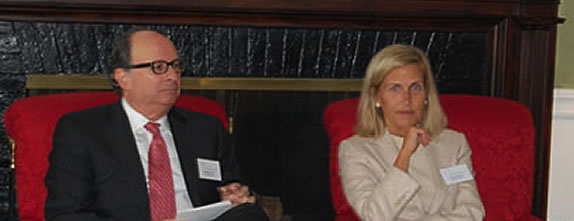
Robert D. Rosenthal, Chairman & CEO, and Gretchen Morgenson,
Pulitzer Prize winner and New York Times columnist.
Our recent Thought Leadership series featured veteran New York Times business reporter and Pulitzer Prize-winning writer, Gretchen Morgenson. Gretchen’s book, Reckless Endangerment: How Outsized Ambition, Greed, and Corruption Led to Economic Armageddon, continues to be at the top of Amazon’s worldwide bestseller list, and recently was named one of the “Best Books of 2011” by Barnes & Noble. FLI clients and friends experienced a highly charged and informative morning with some top line insights such as:
- High powered executives, members of Congress and Washington’s prestigious regulatory community laid the ground work for the financial crisis and meltdown that America is struggling to overcome.
- Washington elites rigged the system for themselves, became rich and powerful and then “slipped quietly from the scene.”
- Early warnings and signs of impending doom were virtually ignored or hidden.
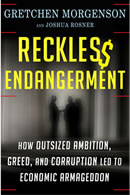 Gretchen Morgenson is a business reporter and writes the “Fair Game” column in the Sunday business section of The New York Times, where she also serves as assistant business and financial editor. She was awarded the Pulitzer Prize in 2002 for her “trenchant and incisive” coverage of Wall Street. Prior to joining the Times in 1998, she worked as a broker at Dean Witter in the 1980s and as a reporter at Forbes, Worth, and Money magazines. She lives with her husband and son in New York City.