“In the business world the rear view mirror is always clearer than the windshield.”
Warren Buffett
Investment Perspective
Despite a lack of clarity and many issues to be concerned with, our clients and most long-term investors experienced significant gains in the third quarter (see Part II, Third Quarter Investment Results). Our traditional equity and defensive equity strategies made impressive gains. Bonds did reasonably well and private equity and real assets continue to show promise in recovering from the economic “decession” of several years ago. Almost all companies in our dividend growth strategy this year have increased their cash payouts on average by almost 9% (three remaining companies are expected to increase their dividends by yearend by at least 9% on average) demonstrating the free cash flow strength of the companies in our portfolio. Our FLI Partners Fund (dramatically outpacing its index) and core equity strategies continued to reflect the power of earnings growth and reasonable valuations. All in all, it was a strong quarter for those investors who committed their core capital to long-term investment strategies with varying degrees of risk. However, these gains came with the continuing anxiety and uncertainty that investors never get used to.
As Mr. Buffet so succinctly stated above, it is easy to now look in the rear view mirror and see those wonderful gains, but at the beginning of the quarter the windshield was not so clear. Investors were concerned then and remain concerned today with a significant number of economic, political, and geopolitical issues. The following are some of the issues that still cloud the windshield as we try to view our investment path down the road:
- A muddled economic recovery in the US and around the world
- Unemployment that continues at an unacceptable level
- Financial repression reflected in a zero interest rate environment
- Uncertain tax policies going forward
- Political paralysis and election uncertainty
- European Union financial and social strife
- High energy prices for gasoline and heating oil
- A growing unconscionable Federal deficit
- Financial weakness in Medicare, Social Security and municipal and private pension funds
- The fiscal cliff and the impact of Obamacare
Ok, the list is long and it makes looking down the road through the windshield seemingly difficult. However, this was pretty much the case at the beginning of the last quarter and the quarter before that. So, as investors we have never gotten used to being able to see through the windshield very clearly.
The answer to this in our opinion remains a prudent and responsible individualized asset allocation for each client. What is demonstrated over and over again is that a prudent asset allocation works over long business cycles to give clients reasonable returns. These returns can be interrupted by “black swan” events such as in 2008, but patience permits investors to return to compounding if they have smart asset allocations. One must remember that compounding depends on not getting badly hurt by the “rogue wave.” One can improve their chances of avoiding the big loss by having a prudent asset allocation that gives diversification a chance to somewhat insulate one from the unexpected or just a plain miserable economy.
We don’t have a crystal ball. But if one invested with us in our Security and Defensive Equity baskets, a good part of the pain from the severe downturn of 2008 would have been mitigated. And by still having a reasonable allocation to traditional equities, with seasoned managers and quality companies, the recovery for those who held on was significant! Today, many companies continue to have strong balance sheets and growing earnings, housing is getting better, and emerging countries are still delivering reasonable growth. This is cause for some optimism.
So, let us make an analogy. One should view having a prudent asset allocation as the GPS system when you are looking through the foggy windshield and confusing road ahead. We believe it will guide you to reasonable returns over the longer term despite the uncertainty and queasy feeling you might currently have. We strongly believe that investing in bonds and cash with tiny returns will not help you overcome higher food and energy prices. So seeking a real return after inflation is critical and that requires having some faith in an asset allocation that departs from just the apparent safety of cash and bonds. Holding too much cash and overloading ones’ bond allocation is a long-term prescription for a negative return after inflation. And with all of the currency (Dollars and Euros) being printed here and abroad, inflation must be considered a danger sometime down the road we investors are travelling on.
The foggy windshield represents the proverbial wall of worry that investors must overcome. Neither should deter an investor from trying to make real returns after inflation to preserve their wealth. As we have often stated, preservation of capital is key and that means avoiding, as best as one can, negative returns from market downturns or inflation. We at First Long Island Investors have investment strategies made up of great companies that have over time made our clients real returns after inflation. Long-term equity investing is not dead. Just ask the owners of Apple, McDonald’s, Occidental Petroleum or so many others.
Finally, we are quickly approaching an important election, the aftermath of which we hope will bring Americans back together again. As a united people, our ability to see through the windshield will be even better. Whoever gets elected President, and those newly elected to Congress, owe us as much.
We will be holding a seminar on November 13th at the Garden City Hotel, with our guest, Senior Economist, Robert F. DeLucia, to discuss our view of the election as it relates to investing, as well as our strategy for investing in a zero interest rate environment. We hope you can join us. Also, as we approach our thirtieth anniversary next year, we are in the process of revamping our website and will invite you to visit it shortly. As always, we remain ready and willing to discuss our views on asset allocation, and how our investment strategies can play an integral part in your investment plans going forward. We also wish you a Happy Thanksgiving!
Best regards,
Robert D. Rosenthal
Chairman and
Chief Executive Officer
Ralph F. Palleschi
President and
Chief Operating Officer
P.S. Most of us have just endured a horrific storm. We have learned how cruel Mother Nature can be, and we hope that everyone’s recovery is as speedy as is possible.
*The forecast provided above is based on the reasonable beliefs of First Long Island Investors, LLC and is not a guarantee of future performance. Actual results may differ materially. Past performance statistics may not be indicative of future results.
Disclaimer: The views expressed are the views of Robert D. Rosenthal and Ralph F. Palleschi through the period ending September 30, 2012, and are subject to change at any time based on market and other conditions. This is not an offer or solicitation for the purchase or sale of any security and should not be construed as such. References to specific securities and issuers are for illustrative purposes only and are not intended to be, and should not be interpreted as, recommendations to purchase or sell such securities.
Content may not be reproduced, distributed or transmitted, in whole or in portion, by any means, without written permission from First Long Island Investors, LLC . Copyright © 2012 by First Long Island Investors, LLC. All rights reserved.
“The key to making money in stocks is not to get scared out of them.”
Peter Lynch
Investment Perspective
Life has a way of injecting reality into our good time. The first quarter was a great period for investors, but one should never annualize investment returns after one good quarter. The second quarter ending June 30th reminded us that volatility caused by an ugly Europe, fiscal problems, higher unemployment, and political paralysis can appear at any time. Despite all of this, the quarter ended down only modestly for many equity strategies, overcoming an earlier sharp downturn. Of note, our dividend growth strategy achieved modest gains for the quarter, outpacing the general market that was down about 2.8%. Bonds also made modest gains in the quarter, but we remain skeptical about bond returns going forward. The important result is that our fixed income, defensive equity and traditional equity strategies are meaningfully positive thus far for the year!
At our recent seminar at The Garden City Hotel (please see our website (www.fliinvestors.com) for a summary) Jason DeSena Trennert, co-founder of Strategas Research Partners (a macro research, advisory and capital markets services firm), and Bob discussed, in an interview format, four big issues facing us as investors:
- The European Debt Crisis (both sovereign and banking)
- The upcoming elections (Presidential and Congressional)
- The fiscal cliff (tax increases and mandatory spending cuts)
- Investment strategies that make sense for the world we live in
We also touched upon the impact of China slowing as well as other potential problems including possible decreases in both corporate margins and productivity. Additionally we discussed Iran and its pursuit of a nuclear bomb as well as our chronic and debilitating unemployment situation.
The bottom line is that we still have a lot of unsolved problems, the solutions to which depend in some part on politicians here, and in Europe and China. This is not a pleasant thought. However, on the brighter side, American businesses both here and abroad have huge cash balances and very strong balance sheets. Our greatest resource just might be the strength of American business as well as the natural resources that remain abundant in our great country (especially natural gas and oil). Of course, we have to encourage the use of that cash and those natural resources, and that requires our politicians in Washington to remember who they represent. Consider that the cry for QE3 to help our economy is only a repatriation of excess cash away in terms of possibly putting to work as much as a trillion dollars. Both sides of the political aisle would have to cooperate and find a constructive way to put the money to use while also raising tax revenue from its repatriation. In our opinion, this will happen in time and that would be a positive for equities and our economy.
So not a lot has changed since our last letter except that those investors who stayed the course in our defensive and traditional equity strategies have maintained some real gains year-to-date after inflation to show for the risk they took. We believe that improved earnings and attractive valuations for many companies, (as well as low yielding bonds and cash), support the equity markets. All of our equity strategies are solidly positive for the year and outpaced bonds and commodities through the second quarter. In our dividend growth strategy, all companies that we expected to raise dividends did, and our performance improved versus the S&P 500 by posting a gain for the quarter. Since inception, this defensive equity strategy continues to beat the market despite being less risky than the market. Our FLI Partners Fund (also a defensive equity strategy) also had a good quarter. Prudent asset allocation with a defensive tilt continues to help us navigate the choppy and uncertain times that we live in, while helping us deliver to you a blended return that has more than outpaced inflation this year. Irrespective of the headlines, we focus on quality companies with attractive valuations and strong fundamentals.
Speaking of inflation, it still seems inevitable to us, given the amounts of money being printed here and abroad. However, velocity (circulation and use of that money) remains poor such that the money resides on the balance sheets of banks and in the treasuries of corporations without benefitting the domestic economy. At some point when greater velocity is achieved, we expect that inflation will increase and interest rates will trend up. Bond investments must reflect this possibility and those investing in bonds with long term maturities or buying low quality bonds will be subject to potentially meaningful losses. Of course, we don’t know when interest rates will rise, however we remain cautious in our purchase of bonds and still believe that higher yielding large cap companies are currently a better investment. Our bond portfolios continue to concentrate on shorter duration and high quality.
The “wall of worry” continues to garner headlines each day. The problems in Europe continue to plague us and slow the pace of corporate earnings of large multinational companies. How soft the landing will be in China remains to be seen. The high unemployment in the U.S. is showing no signs of improvement. An 8+% unemployment rate is terrible and frustrates so many Americans as well as delaying the needed housing recovery. The continued increase in U.S. government debt is a ticking time bomb that must be addressed after being ignored for the last eight years. Health care also must be addressed through revisions to the new health care law that was just ruled constitutional. Providing care to almost all Americans is a noble mission; but it must be accomplished in a fiscally prudent manner. Finding a way to deal with Iran before it possesses nuclear weapons is essential. History is marred with madmen like Hitler and Stalin who used their weaponry to murder millions of innocent people. We can’t let that possibility occur again. Thus there remains a boatload to worry about.
However, we remain cautiously optimistic because we do believe that the American people are resilient and are beginning to make it clear to our elected officials (at both the state and federal levels) that it is time to act responsibly on behalf of those they represent. The paralysis which has become Washington sport isn’t acceptable, and everyone sees what’s happening in Europe. The equity markets might just be signaling this as we still have good gains for the year reflecting a still growing global economy. And those who ventured into our defensive equity strategies (both Dividend Growth and FLI Partners Fund) have achieved gains (since the inception of the Dividend Growth strategy) that are much higher than their bond or money market accounts. We urge you to remain properly allocated among our four investment baskets. Remember, we assess your asset allocation each quarter and will continue to make suggestions to you to better position you for the long term.
So, hold onto your seats as we navigate the next six months. There will be both opportunity and volatility. We believe that quality and defensively tilted investing will reward us as investors while letting you sleep at night. Some measure of greater certainty will result from the upcoming elections and hopefully actions of Congress in the lame duck session. We look forward to it and we believe the markets will appreciate it as well. Please call us with any questions you might have.
Best regards,
Robert D. Rosenthal
Chairman and
Chief Executive Officer
Ralph F. Palleschi
President and
Chief Operating Officer
*The forecast provided above is based on the reasonable beliefs of First Long Island Investors, LLC and is not a guarantee of future performance. Actual results may differ materially. Past performance statistics may not be indicative of future results.
Disclaimer: The views expressed are the views of Robert D. Rosenthal and Ralph F. Palleschi through the period ending June 30, 2012, and are subject to change at any time based on market and other conditions. This is not an offer or solicitation for the purchase or sale of any security and should not be construed as such. References to specific securities and issuers are for illustrative purposes only and are not intended to be, and should not be interpreted as, recommendations to purchase or sell such securities.
Content may not be reproduced, distributed or transmitted, in whole or in portion, by any means, without written permission from First Long Island Investors, LLC . Copyright © 2012 by First Long Island Investors, LLC. All rights reserved.
Jericho, NY: First Long Island Investors, LLC (“FLII”) announced that Ralph F. Palleschi, President and Chief Operating Officer, was appointed non-executive Chairman of the Board of Directors of Astoria Financial Corporation (NYSE: AF), the holding company for Astoria Federal Savings and Loan Association. Palleschi, a certified public accountant, co-founded First Long Island Investors, Inc., the Jericho-based independent employee owned wealth management firm, in 1983. FLII oversees approximately one billion dollars in assets. Mr. Palleschi continues to serve as President and Chief Operating Officer of FLII.
First Long Island Investors Senior Vice President and Chief Financial Officer of First Long Island Investors Stephen Juchem is Long Island Business News CFO of the Year.
Clients and friends of FLI Investors gathered for a discussion on navigating the Fiscal Cliff in light of the uncertainty ahead and this year’s political election. Robert D. Rosenthal, FLI Chairman & CEO, and Jason Trennert, Chief Investment Strategist of Strategas Research Partners, shared their insights and predictions.
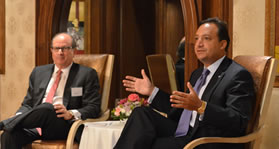
Jason Trennert(right) responds to client’s question about outlook for inflation, the U.S. dollar, gold and energy prices.

Robert D. Rosenthal(left) asks Jason Trennert if Europe and the Euro can stay together in light of the European debt crisis.
HERE ARE SOME OBSERVATIONS FROM THE HIGHLY CHARGED CONVERSATION TO KEEP IN MIND FOR YOUR INVESTMENT PORTFOLIO:
U.S. INTEREST RATES & DEBT
The U.S. Government is using short term debt to run the economy. This is an “extremely dangerous” way to capitalize the economy. US debt has gone from $10.9 trillion to $15.5 trillion in the past three and a half years. Yet, the dollar continues to be the reserve currency.
ASSET ALLOCATION
The only chance for positive real return is equities and the real return from bond funds for the next 5 to 10 years will be negative.
GOLD
Gold may continue to “have an underlying bid for a long time.” It’s not as much of a commodity play, as it is an insurance policy.
ENERGY
Oil production is limited by technology and it’s only a matter of time before a major transport fleet, such as FedEx, converts to natural gas.
THE EUROPEAN DEBT CRISIS
The fiscal authorities in Europe cannot continue to spend money they don’t have. The U.S. is extraordinarily different; it is the only place in the world where people want smaller government—“you will never see a Greek protestor calling for smaller government.”
Hope you will join us at our next event!
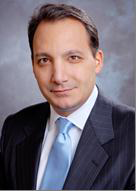 Jason Trennert
Managing Partner — Chief Investment Strategist
Jason Trennert is the Managing Partner and Chief Investment Strategist of the Strategas Research Partners. He has been ranked consistently by Institutional Investor magazine as one of the top Strategists on Wall Street. A keen market observer, known for giving “good copy,” he is a regular guest host on CNBC’s “Squawk Box” and “Bloomberg News.” He is the author of the popular investment book, New Markets, New Strategies, published in 2005 by McGraw Hill. Prior to founding Strategas, Mr. Trennert was the Chief Investment Strategist and a Senior Managing Director at International Strategy & Investment (ISI) Group. He has an M.B.A. from the Wharton School at the University of Pennsylvania and B.S. in International Economics from Georgetown University.