“Your ultimate success or failure will depend on your ability to ignore the worries of the world long enough to allow your investments to succeed.” Peter Lynch
Summary Review
The first quarter resulted in very substantial gains for domestic equity markets (S&P 500 +11%), treading water in bonds, and a slow but continuing recovery in real estate. This is on top of last year’s significant appreciation in equities. Meanwhile, yields on bonds remain low as the Fed continues to buy bonds, unemployment remains stubbornly high and inflation remains low. Investors who have not participated in the record-setting domestic-equity market feel left out and somewhat trapped in their low-yielding bond investments and cash. Prudent asset allocation continues to be the answer for all investors enabling participation in the equity markets while being diversified. Meanwhile, we are pleased to report that we believe all of our clients have appropriate allocations to both defensive and traditional equity holdings and have participated in the escalating equity markets. In particular, our Dividend Growth strategy, one of our defensive equity strategies, led the pack for us in the first quarter appreciating by 14%. (For the three years since inception this strategy has appreciated by 53.3% and has outpaced the S&P 500 which appreciated by 43.1% while still being a defensive equity strategy, in our opinion.)
We believe those investors who have been too skeptical about “stocks” now seem to be finding a way to invest, in part, through buying companies that we own in our Dividend Growth strategy. These stodgy, larger, financially-strong companies that pay generous and growing dividends continue to attract investor interest. However, we believe, based on academic support, that the appreciation for these companies will result from the combination of their higher yields and dividend growth. We also believe that the current market appreciation is not overdone and equities remain a reasonable place to invest as compared to bonds that offer little yield and risk paper-losses if interest rates increase. Corporate earnings continue to grow modestly and price-earnings ratios for large companies (about 15 to 16 on forward twelve month earnings) remain well below that seen in either of the last two market tops in 2000 and 2007 when p/e’s were 26 and 20 respectively. Add to that the fact that bond yields were much higher then and thus more attractive versus the financially-repressed low rates of today. In our view, that combination of reasonable p/e’s and unattractive interest rates continue to make for an investor-friendly equityenvironment. This is further bolstered by the fact that money on the sidelines (both individual, institutional and corporate) is at very high levels and some of it appears to be migrating to quality equities.
Having said that, one needs to focus on our quote from Peter Lynch. What stops investors from achieving attractive long-term gains on investments is their understandable distracting focus on the worries of the world. Certainly there are many to be concerned with, including:
- Geopolitical issues resulting in dreadful headlines about both North Korea and the Middle East.
- Worries about U.S. debt and the viability of entitlement programs such as Social Security, Medicare, and Obamacare.
- The continued haggling in Washington over so many unresolved social (gun control, immigration, and same-sex marriage) and economic issues.
- Our inability to meaningfully bring down unemployment and spur better than weak economic growth.
Meanwhile, American business remains financially healthy and is fostering slow but profitable growth in part through efficiency and global demand. And, for the most part, businesses are sitting on a stockpile of cash giving us comfort that they are stable and can weather unforeseen crises that come on unexpectedly, and typically don’t last too long. Even our large banks seem to be healing and are subject to new regulations that may somewhat protect us in the future.
So it remains our view that there are opportunities to make reasonable returns over the long term from a prudent and diversified asset allocation among our investment baskets of security, defensive equities, traditional equities and private investments. A customized asset allocation among these baskets hopefully permits you to “ignore” the worries and let your investments work for you over the long term. And even though there will definitely be periods of volatility and market corrections, we can see from past history that those who stay the course for the long term are ultimately rewarded with meaningful appreciation. The key is in the asset allocation that provides the strength to weather the worries of the world. Having exposure to bonds, defensive equity strategies (Dividend Growth and FLI Partners Fund), traditional equities and private investments (private equity and real assets) with a quality and concentrated bias is a prudent formula for all of our clients. Patience remains a critical characteristic of the successful investor.
Please call upon us if we can be of further assistance in making sure you have an asset allocation that gives you the ability to ignore some of the worries and let your money compound for you.
Best regards,
Robert D. Rosenthal
Chairman and
Chief Executive Officer
Ralph F. Palleschi
President and
Chief Operating Officer
*The forecast provided above is based on the reasonable beliefs of First Long Island Investors, LLC and is not a guarantee of future performance. Actual results may differ materially. Past performance statistics may not be indicative of future results.
Disclaimer: The views expressed are the views of Robert D. Rosenthal and Ralph F. Palleschi through the period ending March 31, 2013, and are subject to change at any time based on market and other conditions. This is not an offer or solicitation for the purchase or sale of any security and should not be construed as such. References to specific securities and issuers are for illustrative purposes only and are not intended to be, and should not be interpreted as, recommendations to purchase or sell such securities.
Content may not be reproduced, distributed or transmitted, in whole or in portion, by any means, without written permission from First Long Island Investors, LLC . Copyright © 2013 by First Long Island Investors, LLC. All rights reserved.
First Long Island Investors, LLC (“FLII”) a wealth management firm overseeing approximately one billion dollars in assets is pleased to announce a number of significant promotions. Edward C. Palleschi and Philip W. Malakoff have both been appointed Senior Vice President – Wealth Management. Both Ed and Philip had been Vice Presidents at FLII. In addition, FLII is also pleased to announce that Brian Gamble has been appointed Vice President-Wealth Management. All of these executives serve on FLII’s Investment Committee and are involved in research and investment management as well as providing various wealth management services to the company’s clients. FLII is celebrating its 30th Anniversary this year as a leading independent employee owned wealth management company on Long Island.
“Time is the friend of the wonderful business. It’s the enemy of the lousy business. If you are in a lousy business for a long time, you’re going to get a lousy result, even if you buy it cheap. If you’re in a wonderful business for a long time, even if you pay a little too much going in, you’re going to get a wonderful result if you stay in a long time.”
Warren Buffett
Summary Review
Our recent thought piece discussing performance for last year and our outlook for 2013 was mailed earlier in January and we hope you had a chance to review it. We believe it is worth again reviewing the “wall of worry” that we overcame last year to achieve strong investment results. These worrisome challenges included:
- Slow economic growth
- The Presidential election
- European Banking and Sovereign Crisis
- Stubbornly high unemployment
- Fiscal policy uncertainty culminating in the “fiscal cliff” last minute deal
- Geopolitical hot spots in the Middle East, North Korea, and South China Seas
Now on the plus side we have some significant positive developments or expectations as well:
- Housing has bottomed and is on the rise rebuilding some lost wealth and helping employment
- Auto sales are at robust levels and growing
- Consumer debt is significantly down and deleveraging of consumers’ balance sheets is slowing
- Unemployment claims have dropped to below the 350,000 level
- Corporations have strong balance sheets with significant cash and have borrowed at historically low rates to further bolster their finances
- Corporate earnings remain strong
- European banking crisis is being dealt with although not solved
- Energy development is leading to not only potential U.S. energy independence, but is a catalyst to a manufacturing renaissance
- We expect both institutional and individual money to flow into equities as the asset class of choice bolstering stock prices
Our guardedly optimistic outlook is tempered from lingering but real concerns about the following:
- Unsustainable annual U.S. deficit and sixteen billion dollars of cumulative debt
- Entitlement reform to reduce prospective deficits including sequestration
- Unknown economic consequences from the Affordable Care Act (Obamacare)
- Political paralysis in Washington holding back employment gains and energy development
- A nuclear Iran and other global hot spots
- The continued squeezing of the U.S. middle class
- Unknown consequences when the Fed shifts to a less accommodating policy
- Slow global growth and concerns about Europe
Our view of the investing landscape is reasonably bright, but any of the enumerated concerns could cause some turmoil and volatility. The net result is that we favor a higher allocation to defensive equity strategies (Dividend Growth and FLI Partners Fund) whose quality companies should participate in appreciating markets but be less volatile in market disruptions. At the same time, we continue to believe that concentrated portfolios (again) in quality traditional equities are prudent over the long term as part of one’s asset allocation. However, here unanticipated volatility will do more damage in the short term. Both our defensive and traditional equity allocations will benefit from the continuing global growth driven by innovation (e.g., smart phones and payments by plastic) and an emerging middle class in other parts of the world. We also believe that the slow but sure healing of the financial system will benefit the entire global economy. Also, the slower global growth (particularly China and Brazil) has capped what had been highly inflating commodity prices. This continued slower global GDP growth and continued productivity gains should keep commodity prices somewhat subdued. As for gold, if inflation heats up in the future, or if there are regional outbreaks (e.g., the Middle East), gold could be a sound investment.
We remain cautious on bonds for fear of higher interest rates. We believe the bull market in bonds is at or near an end (see Exhibit 1). Better yields and growing income can be obtained from our Dividend Growth strategy (here the growing yield that we expect is a hedge against inflation). Therefore we continue to keep our bond portfolios with shorter duration through reasonable maturities. (Primarily no more than five to seven years on average, even if you plan to hold bonds to maturity.) We also believe that corporate, high yield, and emerging market debt have seen spreads contract. This limits the opportunity there as well.
Prudent individualized asset allocation among our four investment baskets should yield you the best road map to compounding your wealth at reasonable levels despite continued economic, fiscal and geopolitical uncertainty. And the reallocation of liquidity, if it occurs, should benefit all of our investment baskets excluding fixed income (security).
Please call upon us with any questions you might have. We wish you the best for this New Year and look forward to reporting to you at the end of April.
Best regards,
Robert D. Rosenthal
Chairman and
Chief Executive Officer
Ralph F. Palleschi
President and
Chief Operating Officer
*The forecast provided above is based on the reasonable beliefs of First Long Island Investors, LLC and is not a guarantee of future performance. Actual results may differ materially. Past performance statistics may not be indicative of future results.
Disclaimer: The views expressed are the views of Robert D. Rosenthal and Ralph F. Palleschi through the period ending December 31, 2012, and are subject to change at any time based on market and other conditions. This is not an offer or solicitation for the purchase or sale of any security and should not be construed as such. References to specific securities and issuers are for illustrative purposes only and are not intended to be, and should not be interpreted as, recommendations to purchase or sell such securities.
Content may not be reproduced, distributed or transmitted, in whole or in portion, by any means, without written permission from First Long Island Investors, LLC . Copyright © 2013 by First Long Island Investors, LLC. All rights reserved.
“A pessimist sees the difficulty in every opportunity;
an optimist sees the opportunity in every difficulty.”
Sir Winston Churchill
2012 will be remembered as the year when it wasn’t easy being a long term investor, but it proved to be very rewarding. The “kitchen sink” of significant difficulties plagued investors including:
- European fiscal union crisis
- Political paralysis in the U.S. over deficit spending
- An ugly and divisive Presidential election
- Uncertain tax policy culminating in the “fiscal cliff”
- Middle East turmoil
- Continued high unemployment and slow growth
The above wall of worry led to investor pessimism. Outflows from equities by the average investor, both individual and institutional, continued during the year in favor of bonds and cash. Meanwhile, our clients enjoyed gains in the range of about 9% to 17% net of all fees and expenses from our unlevered defensive equity and our traditional equity strategies! This coupled with moderate gains in our bond portfolios and other alternatives permitted our clients to achieve a more than satisfactory blended return from an individualized asset allocation.
Thus the resilience of the American people and Corporate America once again demonstrated that despite ongoing fear and uncertainty, opportunistic long term investing is alive and well. Winston Churchill’s quote describes the typical confused and scared pessimistic investor whose sentiment is negatively influenced by biased media driven headlines and noise. That pervasive pessimism in many cases masks the underlying opportunities for long term investment.
That is not to say that we don’t face serious challenges in 2013 and beyond from:
- Annual deficits and massive cumulative debt
- Geopolitical concerns in the Middle East
- Subpar domestic economic growth and resulting high unemployment
- The need for structural reform of Social Security and Medicare
- Impact from Obamacare
- Economic and political turmoil in Europe
It is our view that many of these concerns will be worked out over time but will require our patience and ability to endure market volatility. It seems that none of the above are surprises and hopefully politicians and central banks will be able to deal with them. In addition, painful sacrifices will need to be made by both Americans and Europeans who are coming to grips with past fiscal irresponsibility.
Despite these challenges there are good things happening that give us “optimists” reason to look forward with a fairly positive view. The improving soundness of our financial/banking system and the strength of many of our corporations are encouraging. The development of our domestic energy reserves is leading to possible energy independence and a manufacturing renaissance in the United States (politicians at both the Federal and State levels have to cooperate). This will lead to many benefits including job creation and enhanced national security. After years of turmoil, our housing sector is picking up, which also is contributing to job growth as well as once again creating wealth among our consumers. And greater certainty as relates to tax policy will also permit both consumers and businesses to once again plan for the future. Finally, pro growth agendas and emerging middle classes in China and other emerging countries, as well as a more growth oriented government in Japan, add to our cautious optimism.
Yet our optimistic view recognizes that we must endure and tackle the serious challenge of unsustainable debt levels. This will lead to contentious political negotiations on entitlement reform in Washington that will likely unsettle equity markets. However, that will give an opportunity to those investors sitting with cash on the sidelines to redeploy that cash to the equity markets. In addition, as interest rates trend up at some point, long duration bond investors will suffer paper losses that should cause them to shift into the equity markets. Down the road, these two factors, along with solid fundamentals including fair valuations and some earnings growth, should contribute to further stock market gains.
So, much of the crowd still doubts the sustainability of the reality of our sounder banking system; a housing recovery; significant stock market gains; robust energy exploration; a mini manufacturing boom and the potential for politicians to work together in Washington. We see opportunity in this. However, we believe that given potential volatility and uncertainty from ongoing political negotiations and geopolitical issues, prudent diversified asset allocation with a bias towards defensive equities still makes the most sense for almost all clients. The key is to not get panicked out of equity holdings. And having sufficient defensive and traditional equity allocations in high quality multinational companies (for the most part) while bonds and cash offer paltry returns seems to be a sound formula for reasonable investment gains over the longer term. We continue to believe that a prudent asset allocation spreading one’s capital amongst our security; defensive and traditional equity and private investment (real estate and private equity) baskets makes long term investing sense. However, at this time we believe the bull market in bonds is over (1983 to 2012) and we would overweight our defensive equity investment strategies.
It has been almost five years since the great “decession” (the term I’ve coined to describe the recession/almost depression of 2008). Our financial system has improved dramatically and the housing crisis has now turned the corner. Our government can now turn to putting our fiscal house in order by constructively dealing with both our current deficit and cumulative debt. The world economy is still growing and despite the aforementioned challenges we still have opportunities as investors. However, patience, caution, and prudent diversification are needed when looking for sustainable investment gains.
Also, of importance to the evolution of our company and our representation of you, I would like to share with you the following promotions to key personnel reflecting their achievements and greater responsibility in the investment and wealth management functions within our organization:
Philip Malakoff – Senior Vice President – Wealth Management
Edward Palleschi – Senior Vice President – Wealth Management
Brian Gamble – Vice President – Wealth Management
Michael Bernstein – Assistant Vice President – Wealth Management
Finally, in an effort to better communicate with you, we invite you to visit our newly refreshed website at http://www.fliinvestors.com. We believe that you will find it more informative and easier to use.
We look forward to working with you this year in guiding your wealth management. Please feel free to call upon us for any help you might need.
Best regards,
Robert D. Rosenthal
Chairman and
Chief Executive Officer
*The forecast provided above is based on the reasonable beliefs of First Long Island Investors, LLC and is not a guarantee of future performance. Actual results may differ materially. Past performance statistics may not be indicative of future results.
Disclaimer: The views expressed are the views of Robert D. Rosenthal through the period ending January 10, 2013 and are subject to change at any time based on market and other conditions. This is not an offer or solicitation for the purchase or sale of any security and should not be construed as such. References to specific securities and issuers are for illustrative purposes only and are not intended to be, and should not be interpreted as, recommendations to purchase or sell such securities.
Content may not be reproduced, distributed or transmitted, in whole or in portion, by any means, without written permission from First Long Island Investors, LLC . Copyright © 2013 by First Long Island Investors, LLC. All rights reserved.
One week after the Presidential election clients and friends of First Long Island Investors met to analyze what President Obama’s re-election means to the economy and investors. FLI Chairman and CEO, Robert D. Rosenthal, and Economist, Robert DeLucia shared their thoughts on this subject. With interest rates remaining near historic lows, Robert DeLucia also discussed how investors should invest their assets in a zero rate environment.
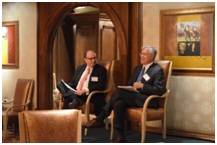
Bob Rosenthal and Bob DeLucia analyze and critique the Presidential election.
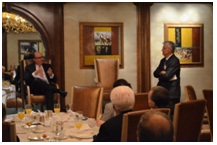
Bob Rosenthal asks Bob DeLucia why companies that grow their dividends are in the sweet spot for investors
Below are some of the highlights from the discussion:
Bob Rosenthal’s Election Observations:
- Government composition largely unchanged
- Exit polls suggest that a majority of Americans want a smaller government
- Country will need to raise revenues in addition to reducing spending
- Challenges of entitlements must be addressed and politicians understand this
- The deficit must be addressed
- Window of opportunity to address the deficit may only exist through 2013 due to 2014 Congressional elections
Bob DeLucia’s Thoughts on the Election and its Ramifications:
- Election results were a negative, but not a huge negative
- Politicians will do something to address the fiscal cliff by the end of December and this will lead to a stock market rally
- Members of Congress don’t want a recession, but the President is less focused on the economy and more interested in helping low-wage earners and a financial redistribution of assets
- If the fiscal cliff is not addressed it would be a $750 billion hit to GDP
Bob DeLucia’s Thoughts on the Economy:
- The economy is better off than most people think
- We’ve survived a difficult post-bubble deleveraging cycle over the last 4 to 5 years
- Government will be the key to whether or not the full potential of the economy is realized
- Economic catalysts include: manufacturing, exports, where we will be a leader, and energy via fracking and horizontal drilling
- We will overtake Saudi Arabia in oil exports by 2020, according to the International Energy Agency
- Housing is beginning to come back and will be a tailwind for the next 5 to 10 years
- Headline unemployment, which has averaged 6% in the past and is now 8%, will remain high
- Growth is the most important tool for reducing our deficit
Bob DeLucia’s Thoughts on Bonds:
- Bonds are a “disaster”
- Fixed income returns will be among the worst in history over the next decade
- Investors should avoid bonds
- Investors can’t get acceptable yields on bonds without taking duration risk
Bob DeLucia’s Thoughts on Equities:
- The “stars are aligned for better equity markets”
- Equity valuations are historically inexpensive
- Companies that grow their dividends are in the best segment of the equity market
- Do not confuse high yield stocks with dividend growers
- Sweet spot for dividend growers are stocks yielding between 2.5% and 3.0%, growing their dividends by 10% to 12% per year
- Many stocks today have higher dividend yields than their corresponding bond yields
 Bob DeLucia Biography
Robert F. DeLucia, CFA, is an independent consulting economist and the founder of Veritas Economic Analysis, LLC, specializing in global capital markets. He was formerly Senior Economist and Portfolio Manager for Prudential Retirement. Prior to that he spent 25 years at CIGNA Investment Management, most recently serving as Chief Economist and Senior Portfolio Manager. He currently serves as the Consulting Economist for Prudential Retirement. Bob has 38 years of investment experience.