“Wars are not won by evacuations.”
– Winston Churchill
As we enter the New Year, many investors are facing a fog of investment war caused by their fear of the recent record levels of the equity markets, the latest spike in volatility, and an increasing uncertainty of how to face the future. Investing is a marathon and often feels like a war when confronted with conflicting factors such as:
- Equity, art, and real estate markets at or near all-time highs
- Interest rates stubbornly staying at virtually all-time lows, resulting in investors earning paltry bond and cash returns
- Inflation remaining quite low
- Oil prices having dropped by about 40% in the last three months
- A new Congress controlled by Republicans hoping to break years of political paralysis
- Geopolitical hot spots in Russia/Ukraine and the Middle East
- Employment steadily improving in the U.S., but mostly at lower level jobs
- A slowing economy in China while Japan is in recession, Europe is on the brink of recession, and the Eurozone is still facing structural issues
- A squeezed middle class in the U.S. with real wage growth continuing to be minimal
- A slower growing deficit but still raising the national debt to approximately 18 trillion dollars
- The continuing war against a growing crisis of terror led by the barbaric ISIS
I am sure I have left out a number of both comforting and troubling factors also contributing to this fog surrounding the thoughtful, longer-term investor, but the above factors do present a formidable list. So, it is not surprising that our clients are looking for even more direction after the volatility of 2014, despite reasonably good results from most of our bond, defensive, and traditional equity investments. The easy thing for investors to do is “evacuate” from higher-risk assets such as equities after having realized years of appreciation. In our opinion, this would be a mistake. The key is how to invest in equities.
First, let us just briefly mention that being a longer-term investor is, in our view, the only way to succeed in an investing world constantly challenged by a changing and seemingly growing “wall of worry” that evokes fear. Investing for the longer term requires ignoring the emotions of fear and greed that typically negatively influence investors. Fear and greed are normal emotions, but they can destroy wealth creation and even worse, can lead to a permanent loss of capital. Numerous studies have shown that many investors make the wrong investment decisions when driven by fear or greed.
Reducing investment risk or trying to mitigate volatility is a worthwhile exercise which we believe can be accomplished through prudent asset allocation. A customized asset allocation reflecting one’s investing temperament as well as one’s stage in life can put one on the path to reasonable investment returns without being overly influenced by either fear or greed. Of course, the asset allocation has to be unemotionally reviewed periodically to reflect changes in market valuations and other life factors.
Over the past several quarters we have urged clients to become somewhat more defensive while remaining prudently exposed to certain markets that have continued to appreciate. As we face this new year and years to come, global growth might become more difficult making quality and selectivity in picking investments even more critical. Additionally, unavoidable volatility from events that one cannot even forecast requires investors to be patient, and unemotional, while having faith in their advisor’s judgment as to asset allocation and selection of quality investments.
Now, being a longer-term investor requires a brief discussion on what “longer-term” means. As our clients span the age spectrum from infants to about ninety, longer is obviously relative. However, the good news is that people are living longer and one should have an investment plan that seeks to provide returns at least above the rate of inflation after taxes over the long term (we hope to be able to do better than that). This requires thought on what asset allocation provides good risk-adjusted returns while still permitting one to sleep at night.
Specifically, while equity markets are at highs, earnings are at record levels for the S&P 500 (constituting many large, domestic companies) as well as many smaller companies. We believe that many (but not all) companies’ earnings will set new records in 2015. That is why we focus your equity investments in high quality companies with continued earnings growth; high-quality companies with growing and above-average dividends; or those that represent what we, or the managers we entrust your funds to, consider great opportunities from a valuation standpoint. In previous letters we have talked about being concentrated in the best ideas. We are cautiously optimistic and believe that there will typically be solid investment opportunities in reasonably valued companies. The challenge is focusing on those and not others. That is why we still believe strongly in active management, not passive index funds. We are confident that the team at FLI, and the managers we work with, are up to that task! Looking ahead, we believe that we can continue to deliver reasonable appreciation over the longer term in our equity strategies. The combination of reasonably valued, quality companies, coupled with earnings and revenue growth, should result in investment success this year and in the future. As a point of information and pride, our under-allocation to companies domiciled outside the U.S. proved to be prescient as those markets as a whole continued to underperform U.S. equities. We still do not see much changing and remain underweight to both developed and developing international equity markets. We also seem to sleep better with the vast majority of our equity and fixed income investments being domiciled in the U.S. However, we continue to believe that having some international allocation is prudent while we wait for fundamentals to dictate a greater allocation. Furthermore, we do achieve some additional international exposure through great U.S. domiciled multi-national companies like Coca-Cola, PepsiCo, Microsoft, Apple, Pfizer, and many others.
In the fixed-income area, we, along with most, have been wrong. We expected that longer-term interest rates would increase in 2014. They declined. This shocked most. However, we still believe this could happen sometime in 2015 and those that have purchased long-term bonds to achieve higher yields might be in for some unpleasantness. Meanwhile, our defensive equity strategies, where we are over-allocated in lieu of a higher allocation to bonds and traditional equities, did well and we expect that to continue. So, we remain convinced that long-term interest rates will creep up during this coming year and therefore are concerned that high-quality bonds will not deliver a return above inflation (even for those that take some interest rate risk by extending maturities). However, we still believe that all clients should have a bond allocation although we remain under-allocated for most at this time.
In the real estate and private equity sectors, we continue to realize returns of capital and profits from most of the investments made in prior years. While we explore new investment opportunities in these areas, we are mindful of a lot of capital chasing these opportunities. We will be quite selective as valuations are rich. A continually improving domestic economy would help future appreciation. It is worth mentioning that all asset classes are being helped by foreign investment in U.S. assets. Foreigners are gravitating to dollar
investments in bonds, stocks, real estate, and collectibles providing some wind in our sails. This reflects confidence in our economy and democracy. Lastly, we have avoided direct investment in commodities (fortunately) and continue to do so. They have been a miserably performing asset class in 2014 and we do not believe this will change any time soon (notwithstanding this, one of our outside managers is investing in what he believes to be a deep-value gold/copper mining company).
I would be remiss in not mentioning an opportunity that could be helpful to investment and economic happiness. It resides in Washington, D.C. After years of paralysis, a new Republican-led Congress could seek bipartisan legislation to help advance challenges in taxation, infrastructure investment, immigration, energy independence, and reducing hyper-regulation. Any improvement in some or all of these areas would create more confidence, investments, jobs, and economic growth. This would be good for investors as well as society. Of course, my optimism is a contrarian opinion to most. We will know more within the next year or so.
Summing up, our clients did reasonably well in 2014 following a great year in 2013. In our view, it is not time to abandon equities. It is time to be both more defensive and more selective within risk assets. Following the sage advice of Churchill (of course from a different context), we will not win the war of long-term investing by selling those asset classes that give investors meaningful returns above inflation over longer periods of time (and after taxes for our high net worth clients).
Our specific recommendations remain similar to our suggestions at the start of 2014:
- Underweight fixed income, but maintain an allocation. Short-term rates should creep up, probably by mid-year, and continue to slowly increase, taking long-term rates with them. This assumption is based on a global economy growing by at least 3% and our Fed raising short-term rates some time in 2015, with current guidance indicating mid-year.
- Remain overweight to our defensive basket with particular emphasis on our two defensive equity strategies. We expect solid dividend increases to help our Dividend Growth strategy and earnings, revenue growth, and reasonable valuations of our select large-cap growth companies to contribute to the success of our other defensive equity strategy.
- Maintain a modest underweight to our traditional equity strategies with a greater concentration within this basket to large-cap domestic companies and continue to de-emphasize foreign-domiciled companies.
- Private equity and real estate will remain opportunistic selections for us on a case by case basis. We continue to pursue opportunities within this basket, but must be convinced the reward is worth the greater risk and illiquidity.
Compounding reasonable returns over the long term by avoiding big down years through a prudent individualized asset allocation is the right battle plan for “longer-term investors.” This diversification, not evacuation from equities, should lead to long-term success while enabling our clients to sleep soundly at night.
Please give thought to our perspective and feel free to counsel with any of us on our investment committee.
Have a healthy, happy, and prosperous 2015!
Best regards,
Robert D. Rosenthal
Chairman, Chief Executive Officer
and Chief Investment Officer
P.S. A historical footnote is required. Third years of presidential terms and periods where the power in Washington is divided have a very strong record of positive equity returns. History is a guide, not a guaranty.
*The forecast provided above is based on the reasonable beliefs of First Long Island Investors, LLC and is not a guarantee of future performance. Actual results may differ materially. Past performance statistics may not be indicative of future results.
Disclaimer: The views expressed are the views of Robert D. Rosenthal through the period ending January 12, 2015, and are subject to change at any time based on market and other conditions. This is not an offer or solicitation for the purchase or sale of any security and should not be construed as such. References to specific securities and issuers are for illustrative purposes only and are not intended to be, and should not be interpreted as, recommendations to purchase or sell such securities.
Content may not be reproduced, distributed, or transmitted, in whole or in portion, by any means, without written permission from First Long Island Investors, LLC.
Copyright © 2015 by First Long Island Investors, LLC. All rights reserved.
States and an international coalition commenced an air campaign against an extreme Muslim self-proclaimed caliphate in Iraq and Syria. If that was not enough, the first cases of Ebola reached our shores. This puzzling (and at times terrifying) picture has left no safe haven-where one can earn a return after inflation and taxes without taking on some risk. Further confusing the investment landscape is the decoupling of the U.S. economy from Europe and Japan. Our economy is expanding, while elsewhere rates of growth are declining and concerns about recession and deflation in the Eurozone are once again rising.
So, we at FLI are spending a great deal of time, both internally and with colleagues, seeking an objective evaluation of the various markets we invest in. Our mission is to seek an unemotional bottom-line approach resulting in an asset allocation focused on achieving investment gains over the long term for our clients. At the same time, we continue to focus our investments on opportunities in quality and deep-value companies as well as with proven outside investment managers who we deem capable of navigating this challenging investment landscape.
The good news is that we believe a number of great companies exist, to invest in and among best of breed managers in both the traditional and alternative investment spaces, that warrant our confidence. Thus, we believe that reasonable returns are attainable over the long term, although we will always face volatility and distracting noise as demonstrated in the period immediately following the close of the third quarter. So, balancing the emotions of greed and fear is the task at hand.
Some specifics are required to make our case for long-term gains. Right now we believe interest rates will increase at some point (probably mid-year 2015). This is actually good news, but its probable eventuality will cause volatility in the markets. The U.S. economy is continuing to improve despite little help from Washington. This growth in our economy, although moderate at best, continues to put more people to work (about 200,000 new jobs per month on average for this year) while gasoline and heating oil prices declined (down about 20% from recent highs!). That is a good combination that will provide a substantial nongovernmental stimulus to the domestic economy in the months ahead. Along with continued improvement in housing prices and the number of homes sold, this stimulus is a good sign that consumer balance sheets continue to improve. In addition, many domestic companies, both consumer and industrial
based, are continuing to increase their earnings. Our view of corporate earnings remains positive, and we believe that with some help from the still growing emerging markets, the S&P 500 will achieve record earnings both this year and next. This would place the price earnings multiple on S&P earnings in the 15x range based on 2015 earnings. Not expensive, but also not cheap. Of course, this assumes there will not be a recession next year nor do we see any evidence of that. Obviously, some companies will fare better than average and those are the ones that we, and the managers we work with, seek to invest in as long as their valuations are reasonable. Our internal research and discussions with the many managers we work with continue to suggest the opportunity remains to own high-quality companies with strong balance sheets that appear to have good value and continued earnings growth.
Given our quandary with extremely low interest rates ultimately trending higher, we remain cautious about fixed income investing. We continue to keep our bond portfolios with shorter maturities (short duration) thus resulting in low yields. Accordingly, we continue to recommend a greater than usual allocation to our complement to fixed income investing—our defensive strategies, especially Dividend Growth where we can still achieve a current dividend yield of 3.0% with projected dividend growth of 7% to 10% per year. This compares very favorably with money markets yielding almost nothing; 5-year AAA municipal bonds at about 1.2%; and the ten year treasury at about 2.4% (fixed for the next ten years). Of course, there is no escape from market volatility. Both our Dividend Growth companies and our bonds face market ups and downs, but probably less so for our Dividend Growth Strategy than for our traditional equity strategies.
Given the geopolitical uncertainty (including Iraq/Syria, the Ukraine and Russia, nuclear negotiations with Iran, and the cease fire in Gaza/Israel) coupled with the serious economic slowdowns in Europe and Japan, we continue to tilt our clients to our defensive basket of investment strategies. Seeking some comfort using defensive strategies makes sense especially given the robust investment performance of the last several years. Additionally, we do not mind at all having a strong tilt towards investing in U.S.-domiciled companies with substantial U.S. economic exposure. The U.S. consumer is in good shape and inflation is low. In addition, U.S.-domiciled companies are, for the most part, in strong financial shape and many continue to innovate with new products. Our strategy remains simple—over-allocate to our defensive strategies which should be less volatile and are over-weighted to U.S.-domiciled companies while we underweight fixed income and traditional equity strategies (especially foreign-based equities).
Our defensive and traditional equity strategies remain mostly positive so far this year, although many are below the market averages like most active managers. We attribute this to a recent market bias towards lower-quality companies which we believe is temporary and will correct itself. Accordingly, we will continue to own quality and value in our investments. Inexplicably, our fixed-income portfolios remain positive as interest rates, to the surprise of most, remain subdued. We believe that a prudent asset allocation with a strong tilt towards defensive strategies and some fixed-income exposure, will continue to work well for our clients in the future as it has in the past. Finally, irrespective of the political outcome, once we have endured the midterm elections we believe that there is hope that the political paralysis will give way to some bipartisan progress in the areas of taxation, infrastructure spending, and immigration reform. This, in our view, will be a positive for economic progress in the U.S. and positively impact the equity, real estate, and private equity markets. In addition, we believe that global concerns in Europe and the Middle East will continue causing foreign investors to allocate more assets to U.S. investments. This would continue to help our domestic markets as well (the combination of economic growth and a strengthening U.S. dollar is a powerful enticement to foreign investors).
In conclusion, we remain cautiously optimistic despite a growing wall of worry as fundamentals in the markets, and more specifically companies we invest in, remain attractive. Emotions of greed and fear must be kept in check as volatility picks up, reflecting the noise and concern surrounding many of the issues we face.
As always, please give any of us a call to discuss your asset allocation and our wealth management outlook as there is much going on. Also, we are approaching year end and there might be some strategies worth considering that could be favorable from a tax standpoint. Give Steve Juchem or Teri Vobis a call should you have any questions about taxes (on your investments or otherwise).
Best regards and enjoy the upcoming holiday season!
Robert D. Rosenthal
Chairman, Chief Executive Officer
and Chief Investment Officer
*The forecast provided above is based on the reasonable beliefs of First Long Island Investors, LLC and is not a guarantee of future performance. Actual results may differ materially. Past performance statistics may not be indicative of future results.
Disclaimer: The views expressed are the views of Robert D. Rosenthal through the period ending September 30, 2014, and are subject to change at any time based on market and other conditions. This is not an offer or solicitation for the purchase or sale of any security and should not be construed as such. References to specific securities and issuers are for illustrative purposes only and are not intended to be, and should not be interpreted as, recommendations to purchase or sell such securities.
Content may not be reproduced, distributed or transmitted, in whole or in portion, by any means, without written permission from First Long Island Investors, LLC . Copyright © 2014 by First Long Island Investors, LLC. All rights reserved.
With just a few weeks to go before the 2014 mid-term elections, clients and friends of First Long Island Investors gathered at the Garden City Hotel, on October 14, 2014, to hear John Zogby, political analyst and pollster, provide his of-the-minute perspective on the election and how it could impact the affluent investor and the landscape in Washington.
 Robert D. Rosenthal, Chairman & CEO of First Long Island Investors LLC (left), and John Zogby, Political Analyst and Pollster (right). |
 John Zogby shares his perspective on how Millennials will impact on this election. |
|---|
John Zogby started by cautioning the crowd that many of the elections may be decided by as little as 1-3 points and that factors are changing daily. Here are some of his insights, as of October 14, 2014.
The U.S. Senate
The US Senate majority is currently held by the Democrats (and independents caucusing with the Democrats) with 55 seats to 45 seats held by the Republicans. In order for Republicans to take control of the Senate, they need to gain a net of 6 seats. If elections were held today (10/14), the GOP would win the 6 seats and take control of the Senate with the following results:
- Assumed GOP wins are: West Virginia, South Dakota, and Montana
- Competitive seats that the GOP could win include: North Carolina, Arkansas, Louisiana, Colorado, Alaska, and Iowa
- Competitive seats the GOP could lose include: Kentucky, Georgia, and Kansas
Based on the number of competitive races the GOP likely must win more than 6 races to win the Senate because of the likelihood of losing at least 1 current seat.
GOP Advantages
- Obama: The Anti-Obama message is serving as a unifying factor. The GOP is trying to use Obama’s low approval rating to their advantage. Zogby did remind the group that while low, President Obama’s approval rating is not historically low for a 2nd term president.
- Independents are leaning towards the GOP:
- ½ of Independents describe themselves as “conservative”
- ½ of Independents are not sure who they will vote for and attack ads may be effective in keeping them from going to the polls. Low voter turnout helps the GOP
- GOP recruited a better level of candidate than in 2010: The 2014 class of Republicans are young and accomplished which should bode well for the GOP both in this race and in the future.
GOP Disadvantages
- Brand: The GOP brand has been badly damaged and while it is recovering, it is not yet fully restored. They are seen as the “Party of Old, White, Men” and voting Republican is “not on the radar” for the increasingly important 18 – 34 year old demographic.
- Latino Voters: Latino voters are a growing demographic within the voter base. Latinos made up 4% of voters in 1996, 10% of voters in 2012, and the trajectory is continuing. President Obama’s approval rating among Latino voters is 74%.
- “What’s the alternative?” It is not enough to campaign on the fact that you are not Obama. Voters are consistently asking all candidates, including the GOP, “what have you done for me lately and what are you going to do next?”
- Tea Party: The Tea Party is driving the GOP message and that message does not resonate with Independents. They are putting the party in a Catch 22 Position:
- They came into Congress with the attitude of no compromise
- Their failure to compromise means they cannot accomplish anything
- It is difficult to be reelected without accomplishments
- Yet, if they had accomplishments then they compromised on principles
Democrat Advantages
- The Economy: The United States has come out of a recession, the stock market is doing well, the unemployment rate has gone from 10.1% to 5.9% and job increases are at a better pace (approx. 225 – 250K per month).
- Obamacare: There are more people insured than ever and there is a possibility that we will see a higher turnout of voters who are now insured.
- Barack Obama: President Obama is the only one who has shown he can energize young, Latino, and African American voters. Looking back to 2012, young women voted for Obama and against the GOP. As the registration deadline nears, Obama has used media outlet Republicans “…have never heard of.” (i.e., Twitter, Facebook, and other social avenues.)
Mr. Zogby rounded out his presentation with a discussion of key demographic trends that will pay a role in this and future elections.
- The National vote is trending non-white:
- 81% of Baby-boomers were white
- 60% of Millennials are white
- 48% of the next generation is white
- Millennial generation (those born in ’79 – ’96) is almost as big as Baby-boomers:
- Millennials are 1/3 of workforce
- Will be 1/3 of the electorate in 2020
Question and Answer Session
How will the low approval ratings of the President and Congress affect the Elections?
The President’s current approval rating is 42-43%, which is better than Nixon, Bush, Truman, and Carter and not near record lows. History has shown that the base can still turn out with these ratings.
Congress currently has an approval rating of 13% and as low as that is, the GOP receives even lower ratings. 37% of people trust the President to tell the truth; 17% of people trust Congress to tell the truth; and 37% don’t trust either. Generally speaking, a low turnout favors the GOP.
Is the younger generation aware of the global issues?
Young people are aware of what is going on globally. They were and are growing up in a “non-superpower world” where they have seen the limits of power. They see the US as an “empire in decline” and have lost faith in government changing things for the better.
This generation has a different perspective and comes at situations from a very different point of view than previous generations. They are users of global petition campaigns, crowd-sourced ideas and crowd-funded initiatives. They have a strong desire to work in teams and to be involved, but have no strong desire to vote or run for office. There are now “Libertarians” and “Communitarians”, no more “Liberals and Conservatives”. They are believers that the government should be efficient and not create as much debt.
How does the electorate tell Washington that the Middle Class is being squeezed? Are both parties becoming more extreme?
The message of the Middle Class has been delivered and acknowledged by politicians in private. The reality is that it is hard for politicians to empathize with the Middle Class because they are coddled in Washington. Politicians who “buck the political trend” are hard to deal with in Congress so it is difficult for them to break out.
Zogby went on to say that it would have been helpful if Obama had run something in his life prior to becoming president. However it is difficult when the strategy of the other-side is to “destroy” you.
Serious issues must be dealt with prior to 2016 election. Will there be cooperation?
Zogby shared that he does not feel the parties will come together. He does not see a healthy relationship between Republicans and Democrats today, and went so far as to say that Mitch McConnell (US Senate Republican Leader) and President Obama “hate each other”. Boehner (Speaker of the House) and Obama have a better relationship – they want to get something done. Much of their ability to do so depends on how the midterm elections go. Zogby expects that the President will announce an aggressive agenda at the State of the Union Address which will be all about his legacy and nothing more. There is worry of another government shutdown.
How does the situation of Illegal Immigrants with children in the United States impact the election?
In the years of Pataki and Giuliani and George H. W. Bush the relationship between the GOP and the Latin Community had been revived – George W. Bush carried 40% of Latino vote in 2004 and in 2006 Republicans carried 20% of the Latino vote. The GOP never recovered with the Latino Community and are in an “anti-Latino” direction. Anti-illegal is seen as anti-immigration which is seen as anti-Latino.
How will Ebola Crisis affect elections?
The current Ebola crisis does not play to the Democrats’ favor. It isn’t possible to say how it will effect turnout – Ebola may turn people off from voting but may not turn them on enough to vote.
What is the impact of events like Super Storm Sandy on elections?
The President looked presidential after Sandy. The images of him and Chris Christie walking through Atlantic City was a “powerful image” that resonated with many. That election was extremely close just prior to Election Day and ultimately Obama won 11 of 12 battleground states. Going into the election, many were not sure about the young voters and ultimately young women came out strong for Obama because the GOP “scared them” on social issues.
Likelihood of a Clinton vs. Bush 2016 Election?
Zogby explained that there is a dynamic in the US which naturally opposes dynasties. He does not see traction for Jeb Bush nor does he believe Hillary will get the nomination. Zogby’s feeling is that Hillary’s biggest problem is running against herself and that America likes Bill Clinton except when he is campaigning for Hillary. He opined that John Kerry may be a surprise for the nomination.
For the GOP, he feels Mitt Romney is still a likely candidate. He has a few things going in his favor – he is still the next republican in line, wants to run, possesses the “I told you so” factor, and does not currently have much competition.
Jericho, NY (October 7, 2014) – The Diabetes Research Institute Foundation (DiabetesResearch.org) is pleased to announce that Bruce A. Siegel of New York, NY, has been elected to serve on its National Board of Directors. He also serves as co-chairman of the organization’s Northeast Region Board, alongside Marc S. Goldfarb.
Robert D. Rosenthal, Chairman, Chief Executive Officer and Chief Investment Officer of First Long Island Investors, LLC is honored by the New Leadership Division Pediatrics at Cohen Children’s Medical Center.
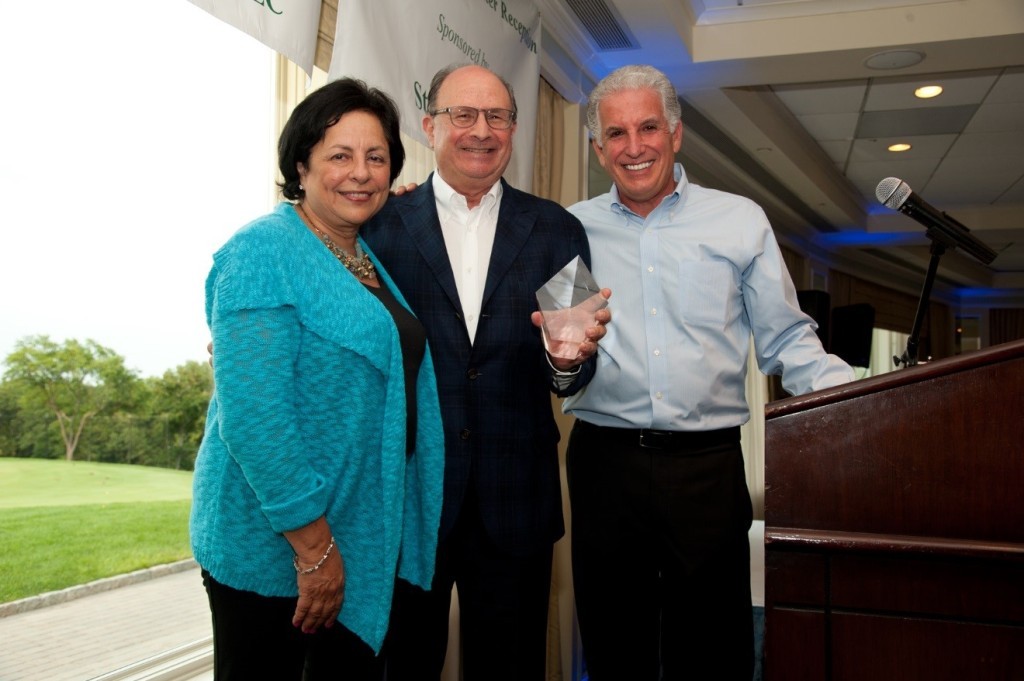
From left to right: Dr. Marsha Sherman, Robert D. Rosenthal, and Mark Claster, Chairman, Board of North Shore-LIJ Trustees.
For the 25th year, NLD for Pediatrics hosted their Annual Golf Classic at Fresh Meadow Country Club and Deepdale Golf Club in Manhasset, NY. The event honored Robert D. Rosenthal. Over $466,000 was raised to support the Child Life and Creative Art Therapies program at Cohen Children’s Medical Center, which is overseen by trained professionals with expertise in helping children and their families overcome life’s most challenging events that bring a child to a hospital.