On June 25, 2015, clients and friends of First Long Island Investors came together to learn more about cybersecurity. Robert DeStefano, Executive Vice President, and Chief Information Officer at Astoria Bank, and Bhavesh Chauhan, Security Solutions Engineer at Verizon, led a discussion on the information security landscape and provided ideas and strategies for reducing the impact a cyberattack could have on individuals and businesses.
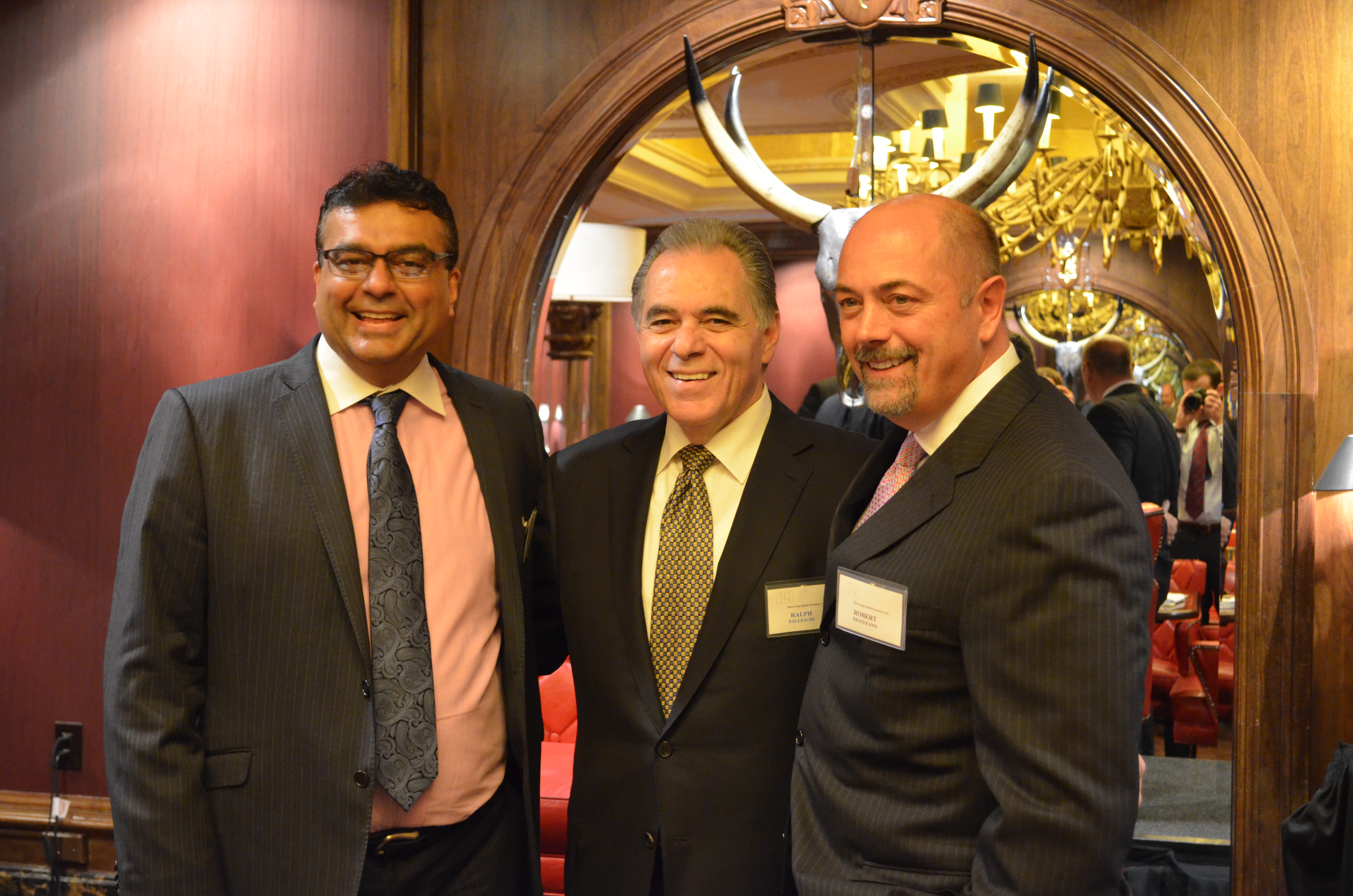
From left, Bhavesh Chauhan, Ralph Palleschi, and Robert DeStefano.
Bob DeStefano led off the conversation with an overview of cybersecurity. Some of his points included:
- A cyber-security threat is any action that may result in unauthorized access to or manipulation/destruction of, the integrity, confidentiality, or availability of an information system
- The security landscape has changed dramatically over the past few years and continues to change. Newer and more sophisticated threats are availing themselves daily
- Completely preventing all cyber threats is next to impossible, but both individuals and organizations should focus on how to (a) minimize the impact of an attack (b) ensure they have the best identification and remediation possible and (c) respond quickly in the event of an attack. Having a firewall is not enough to protect yourself. Multiple layers and strategies of security control from different vendors should be combined to prevent and monitor potentially damaging breaches.
- The potential of a cyber-security threat needs to be taken seriously because it can significantly impact the reputation and financial position of a company or an individual
- Cybercrime is increasing due to the ability of cybercriminals to operate from countries where they risk little intervention from law enforcement, and cybercriminals are beginning to make substantial money for their efforts
- Recent studies estimate the average cost of a data breach to a major company/financial institution to be approximately 3.8 million dollars. This is up 8.5% from the previous year. This hard-dollar cost is in addition to the reputation risk and customer confidence risk that an organization faces
- A good cyber-security plan includes risk management and mitigating strategies including adequate resources and support from the board and executive management, development and implementation of cyber-security policies, use of multiple layers of security controls from different vendors, third party oversight, education and awareness of all employees, risk assessments and penetration tests, cyber-security insurance coverage, ensuring computer/mobile devices and preventative software stays updated, and having an incident response plan
Bhavesh Chauhan then shared with the group some highlights of Verizon’s 2015 Data Breach Investigation Report.
- The Data Breach Investigation Report is put together annually by Verizon to review the types of vulnerabilities that many companies are seeing and provide insight and perspective on how companies can best allocate resources and dollars in the prevention and response to cybercrime. The report brings together information from 70 contributing organizations and analyzes nearly eighty thousand security incidents across 61 countries for events happening in the 2014 calendar year
- One of the primary challenges of the security industry is that in 60% of cases, attackers are able to compromise an organization within minutes. Additionally, there is a wide gap between the time it takes a cybercriminal to compromise and organization and the time it takes a defender to detect a compromise. In 2014 this gap started to shrink, but it is still significantly wider than the information security community would consider acceptable.
- For two years in a row, more than two-thirds of incidents that comprise the Cyber-Espionage pattern have featured phishing. Even with the increased awareness of phishing, 23% of recipients open phishing messages and 11% click on the attachments. Of those who open the email, nearly 50% open the email and click on the phishing links within the first hour of receipt
- Software and hardware companies regularly issue patches and updates to fend off common vulnerabilities and exposures (CVEs). From the analysis, Verizon found that 99.9% of the vulnerabilities exploited in a cyber-attack were compromised more than one year after the CVE was published. Bhavesh reiterated the importance for both individuals and organizations to ensure that they update all of their devices (computers, tablets, mobile phones, etc.) with patches as soon as they become available
- Somewhat surprisingly to the information security community, mobile devices are not a preferred vector in data breaches. Only a negligible 0.03% out of tens of millions of mobile devices were infected with truly malicious exploits
- The most common types of cyber-attacks in 2014 were point of sale (POS) intrusions, crimeware, and cyber-espionage. In looking back over the last 10 years, the top three have changed, but overall there are still only 9 core intrusion types
- While there are a vast number of strategies organizations can use to protect themselves and their customers from cyber-attacks, being able to focus efforts is key. Organizations should use this report to see how their industry and companies of their size are being attacked and then build a plan that can most effectively protect them from attacks
- A copy of the report can be downloaded at the following link: http://www.verizonenterprise.com/DBIR/2015/
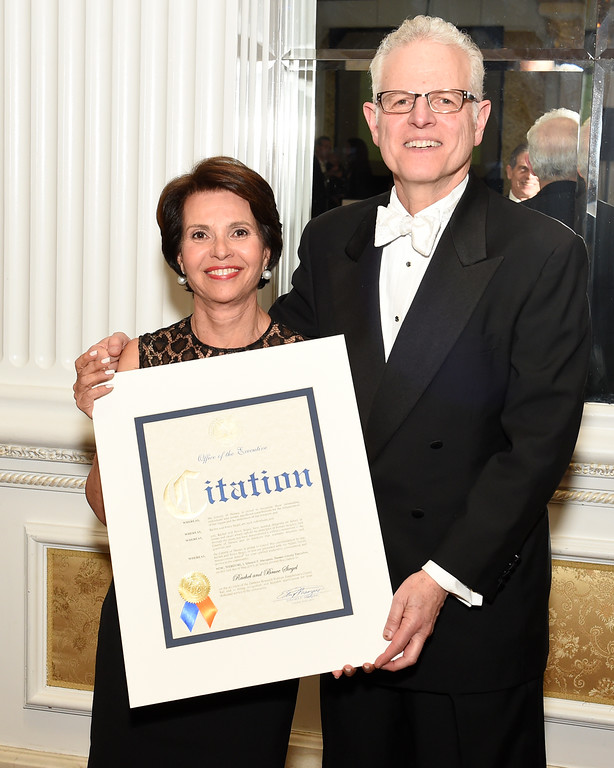
Bruce A. Siegel, Executive Vice President and General Counsel of First Long Island Investors, and his wife, Rachel were presented with the Gillin Family Humanitarian Award at the 17th Annual Crystal Ball benefiting the Diabetes Research Institute (DRI). The evening raised more than $520,000. Mr. Siegel has served on the DRI Foundation’s regional board since 2011 and is currently Co-chairman of the Northeast Board. He also serves on the National Board of Directors and the National Planned Giving Committee. A recap of the event is available by clicking here.
“One thing we have lost, that we had in the past, is a sense of progress, that things are getting better. There is a sense of volatility, but not of progress.”
Daniel Kahneman (Winner of the 2002 Nobel Memorial Prize in Economic Sciences)
The first quarter ended with a whoosh of volatility reflected in a second to last day gain of more than 200 points for the Dow, only to be followed by a loss of 200 points on the last day of the quarter. This sort of volatility permeated the entire quarter, and at the end of the period, the S&P 500 was ever so slightly higher while the Dow suffered a slight loss. International indices did somewhat better on average this quarter, but after underperforming the S&P 500 from January 1, 2008 through December 31, 2014, that is a welcome improvement.
Other markets also suffered from uncomfortable volatility. Oil was down another 10% (falling by more than 50% in the last nine months) while the yield on the 10-Year German Bund (government bond) suffered a drop of almost 60% (declining to a jaw dropping 18 bps). Currency markets also witnessed continued volatility with the Euro dropping to about €1.08 to the U.S. Dollar. Equity markets reached all-time highs while domestic interest rates stayed at very low levels. Unemployment continued to fall, although wage growth remained somewhat anemic. So, what does this all mean and is the volatility overshadowing economic progress?
First, in our opinion, volatility is being caused by the following:
- The inevitable increase in short-term interest rates by the Federal Reserve continues to be a source of constant speculation and thus volatility. However, an increase in rates will be slow and probably will not be disruptive to the economy or corporate earnings. It will signify that the U.S. economy has almost fully recovered from the great recession.
- The strengthening dollar is adversely impacting earnings for U.S.-domiciled companies with significant overseas operations. The speed with which the strengthening has occurred and its uncertain impact on earnings is contributing to volatility but does not reflect the strength of operations in local currencies.
- The precipitous drop in oil and natural gas prices has impacted the earnings projections of oil and gas-related companies. It has also led to layoffs and reduced exploration expenditures in a number of companies. This will have a somewhat negative effect on this sector of the economy. This drop has yet to lead to increased spending by consumers.
- The terrorist wars in Syria, Iraq, Yemen, and Libya as well as the murders of Christians in parts of Africa coupled with the ongoing negotiations with Iran, which is sponsoring terror throughout the Middle-East, is causing serious uncertainty and domestic political infighting. The headlines of atrocities are affecting the attitudes of retail investors and causing volatility.
- The impact of Europe’s attempt at stemming possible deflation while stimulating the Eurozone through its version of quantitative easing, utilizing bond purchases, has yet to be understood by investors. At the same time, Europe’s old economic nemesis, Greece, has once again changed its political leader and is on the cusp of leaving the European Union.
- Many pundits are worried about stock market valuations and, coupled with slowing earnings growth and a downturn in growth in China, is leading to concerns about virtually all markets.
- In Washington, the newly elected Republican majority in both Houses of Congress has not relieved the paralysis that has plagued Washington since President Obama took office. So far, the U.S. has not implemented strong fiscal policy to complement our monetary policy, which has been on steroids, leaving us with a continuation of financial repression and little happiness for the average saver and less than optimal economic growth.
- After six years of a rising stock market, there is skepticism whether equity markets can continue rising. Thus, any bad news, economic or geopolitical, gives rise to fears that the long-awaited correction (or worse, a bear market) is upon us. This is causing volatility.
All of the above gives one cause for concern and certainly explains the current volatility, but one would need to have blinders on to not realize the progress that is begrudgingly being made:
- The U.S. economy is growing slowly and does not appear to be facing recession anytime soon. Slow GDP growth of 1.5 to 2.5 percent per year, which also reduces inflation risks, seems to be what is in store for us given the lack of fiscal policy initiatives and the strong dollar slowing our exports. Slow growth, low inflation, and continued low interest rates are a sound formula for stock, real estate, and private equity markets to continue to perform reasonably well.
- Employment continues to grow at a moderate pace. Wage growth, especially for the middle class, is still somewhat anemic, but there are signs of growth at a pace better than inflation. Additionally, many large employers are unilaterally raising minimum salaries paid and several states have passed legislation to raise their state’s minimum wages. This is progress, any way you slice it, and will support economic growth.
- The precipitous drop in gasoline and heating oil prices is a big benefit to virtually all consumers and many businesses. This should more than offset the pain inflicted on oil-related companies. However, up until now there has been very little to no corresponding increase in consumer spending. It is our understanding from our consulting economists that consumer spending increases lag reduced oil prices by at least six months. Thus, we believe there will be a pickup in consumer spending later this year. This will contribute to economic growth and should there be a nuclear arms deal with Iran, more oil supply will come to market down the road as economic sanctions against Iran are lifted. (We have little faith in the Iranians adhering to any deal so this increase in supply might be short lived.)
- There continues to be monetary easing in Europe, China, and Japan, while in the U.S. we expect some liftoff to short-term interest rates in late summer or early fall. Those policies reflect the fight against deflation, stimulation of economic growth, and the recognition that economic conditions in the U.S. have improved. We would expect a rise in interest rates to increase consumer confidence and, if consumers are more optimistic, that should lead to aggregate demand that would be positive for the businesses and real estate we invest in.
- Equity values, in our opinion, remain fair and do not resemble the bubble markets of 2000 and 2007. One could argue that some regions of the country are facing unreasonably high real estate valuations, and smart investors are seeking better opportunities in other areas. We also believe that stronger demand for office and residential housing is yielding higher prices. Low interest rates remain a driving force in somewhat higher stock market valuations and support higher real estate values.
- Bond valuations seem very stretched and that is reflected in unusually low yields. As of March 31, 2015 the 10-year Treasury was at 1.9% and a triple-A 5-year municipal yielded 1.3%. A rise in the short-term rate target from the Federal Reserve may gradually increase those rates, but not by much in our opinion. Our view is that rates will slowly increase. Therefore, low rates might be here for a while unless inflation picks up and that does not seem likely.
So, we believe that volatility is based more on speculation and anticipation, not on well-founded information or Federal Reserve policy at this point.
Investors’ concern about many of the issues outlined above, in and of itself, is a source of volatility. At the same time, the improvement of corporate balance sheets since 2007, slow growth, low interest rates, accommodative central bank policy, reasonable stock market valuations, cheap oil, and better employment globally seems to be what will carry the day on a longer-term basis in our opinion.
In considering asset allocations for our clients, we remain tilted towards our defensive strategies, where a significant part of clients’ asset allocations should be directed. Defensive strategies seek to reduce the volatility of our investments and help clients weather equity market volatility while still seeking to achieve reasonable appreciation and income. Some bond allocation remains necessary, but with shorter duration. In pursuing real estate-oriented investments, we continue to look for some current return as well as potential appreciation. In all cases, valuation in each asset class is critical. In equity-oriented strategies we continue to focus on high active share (concentrated portfolios) given the slower global growth and the increase in volatility. We never forget that preservation of capital is paramount. This is especially the case in a world where there are many geopolitical and economic factors impacting our investments.
At the end of the day, there are legitimate issues causing volatility but as our quote from a Nobel laureate for economic sciences suggests, the progress being made is not being given the attention it deserves. We believe this will prove to be an opportunity and we expect that the slow but persistent progress, despite the volatility, will make 2015 a positive year for our clients.
Please contact any member of our investment team with any questions you might have or to discuss your asset allocation or any other wealth management needs you may have.
Best Regards,
Robert D. Rosenthal
Chairman, Chief Executive Officer
and Chief Investment Officer
*The forecast provided above is based on the reasonable beliefs of First Long Island Investors, LLC and is not a guarantee of future performance. Actual results may differ materially. Past performance statistics may not be indicative of future results.
Disclaimer: The views expressed are the views of Robert D. Rosenthal through the period ending April 23, 2015, and are subject to change at any time based on market and other conditions. This is not an offer or solicitation for the purchase or sale of any security and should not be construed as such. References to specific securities and issuers are for illustrative purposes only and are not intended to be, and should not be interpreted as, recommendations to purchase or sell such securities.
Content may not be reproduced, distributed, or transmitted, in whole or in portion, by any means, without written permission from First Long Island Investors, LLC.
Copyright © 2015 by First Long Island Investors, LLC. All rights reserved.
Robert D. Rosenthal discusses First Long Island’s perspective on the factors concerning investors today and how FLI thinks the longer-term investor should approach 2015 in a web seminar.
This report on the Fourth Quarter will be brief as, by now, you should have received our annual thought piece: The Longer-Term Investor – 2015 and Beyond. It contains our view of the future and describes many aspects of the investment landscape confronting the longer-term investor, some of whom might be thinking about evacuating from the equity, and other risk, markets that have provided them with significant returns over the long term. Fear of record prices, volatility, geopolitical hot spots, and political uncertainty are causing a fog. Our thought piece tries to pierce that fog and give direction to our clients.
Perhaps the fourth quarter provides a glimpse into what 2015 might be. For in the fourth quarter we lived through appreciation for most, but not all, equity indices, a precipitous drop in oil prices, continued concern over geopolitical hot spots, a robustly growing gross domestic product, a contentious mid-term election giving Congressional control to the Republicans, and growing earnings for many companies. Also, ongoing concerns from some of these factors led to a spike in volatility in the equity markets during the quarter which resulted in a number of significantly down and up days (As usual, the big down days were not fun). This in turn hurt many hedge funds while resulting in better results for long-only equity strategies for those
advisers and investors who stayed the course.
In particular, our defensive equity strategies each had a strong quarter. Additionally, our traditional equity strategies had solid performance in the quarter with excellent performance from our traditional growth strategies. In all, each FLI strategy appreciated during the quarter.
Of course, fixed income continues to be perplexing as the Fed has continued to kick the can of raising interest rates down the road. However, at the most recent meeting, the Fed did change the language in its statement, and it looks like it will finally start to slowly raise short term rates in mid-2015. This of course assumes that our domestic economy continues to expand and international economies do not significantly worsen. When (and if) rates go up this could create some additional short-term volatility.
The fourth quarter demonstrated to us that fundamentals of rising earnings, low interest rates, and reasonable valuations do matter. These factors prevailed over short-term volatility caused by geopolitical, domestic, and foreign economic headlines. Many active managers failed to keep up with indices during 2014 as lower-quality companies (those with poorer balance sheets) appreciated more than stronger companies. We believe this began to change in the fourth quarter. We expect this will continue in 2015 as growth in earnings should be more dependent on revenue growth from stronger companies as opposed to higher profit margins from layoffs and cost cutting initiatives.
The fourth quarter also reflected greater consumer confidence resulting from better employment numbers and the significant decrease in oil prices. The decline in oil prices acted as a tax cut and gave all consumers
Results are exclusive of one strategy which has yet to report results. and oil consuming businesses extra cash flow. Some of this extra cash found its way into consumer spending in the quarter and we expect to see more of this in 2015.
In summary, on balance, we had a strong fourth quarter. Several of our defensive and traditional equity strategies exceeded their benchmarks for the quarter and most achieved strong absolute returns for the year. When considering that these results followed a banner 2013, we are quite happy and we hope you are too.
At the same time, we try to keep risk low through prudent asset allocation and concentration within each asset class. As an example, we continue to significantly underweight foreign-domiciled companies (with respect to both stock holdings and fixed-income portfolios). Foreign equities continued to underperform (in the fourth quarter and all of 2014) all domestic equity indices. In our opinion, a modest international allocation is still most appropriate.
We remain cautiously optimistic going into 2015 and think the bumps in the fourth quarter might just set the stage for what we will have to endure this coming year. By the way, from a historical standpoint, the third year of a Presidential term has been positive for domestic equity markets over the past 50+ years.
That is a nice historical data point, but as we often mention it is not a guaranty, just a guide.
We look forward to serving and guiding you as we enter 2015. Please feel free to call upon us for any of your wealth and money management needs. Starting a new year is always a good time to review your asset allocation, estate, and income tax planning, and all of your life, health, and property insurance needs. If we
do not hear from you rest assured you will hear from us each quarter.
Best regards and Happy New Year,
Robert D. Rosenthal
Chairman, Chief Executive Officer
and Chief Investment Officer
*The forecast provided above is based on the reasonable beliefs of First Long Island Investors, LLC and is not a guarantee of future performance. Actual results may differ materially. Past performance statistics may not be indicative of future results.
Disclaimer: The views expressed are the views of Robert D. Rosenthal through the period ending January 12, 2015, and are subject to change at any time based on market and other conditions. This is not an offer or solicitation for the purchase or sale of any security and should not be construed as such. References to specific securities and issuers are for illustrative purposes only and are not intended to be, and should not be interpreted as, recommendations to purchase or sell such securities.
Content may not be reproduced, distributed, or transmitted, in whole or in portion, by any means, without written permission from First Long Island Investors, LLC.
Copyright © 2015 by First Long Island Investors, LLC. All rights reserved.