Robert D. Rosenthal, Philip W. Malakoff, and Brian Gamble discuss the factors causing market volatility and provide perspective on our approach to long-term investing in 2016 and beyond in an hour-long web seminar.
This critique of the Fourth Quarter will be brief as by now you hopefully have read our annual thought piece: “Welcome Back Volatility.” It describes how volatility became more pronounced in both the third and fourth quarters of 2015. The contributors to that volatility were investor uncertainty as to when the Federal Reserve would finally raise interest rates (they finally did in December), the continued plummeting of commodities led by oil, geopolitical tension around the world including terrorist attacks in Paris and San Bernardino, California, and the slowing of the Chinese economy as well as the devaluation of its currency.
These factors and the ensuing volatility masked what turned out to be a very positive quarter for equity markets which bounced back from the correction in the third quarter. (Our first correction since 2011!) However, the fourth quarter rally was not broad based and did not lift all ships. In fact, a number of large-cap growth companies, including Facebook, Amazon.com, and Alphabet (formerly Google), along with some others, helped the S&P 500 achieve a solid gain in the fourth quarter and were very much responsible for that average eking out a slight gain for the year. However, the reality is that many stocks declined in price as the result of a slowdown in growth of the global economy, collapsing oil prices, and the appreciation of the U.S. dollar.
Fortunately, all of our equity based strategies delivered solid performance or better in the fourth quarter. As mentioned before, our asset allocation advice to our clients to participate in growth-oriented strategies led to reasonable gains for the quarter and full year in our hedged growth strategy (nine consecutive years of outpacing its index); our Core strategy (which beat the S&P 500) and our growth-oriented equity strategy which also beat its weighted benchmark (includes both domestic and international components). Our Dividend Growth strategy delivered on its goal of providing clients with a strong increase in its annual dividends. The strategy’s average dividend increased by 9.5% and it also outpaced one of its indices, the Russell 1000 Value Index.
In other areas of investing, we are very pleased with the real estate mezzanine debt investment we launched in the third quarter as it appears to be making progress. Two of our value-oriented investments are very much tied to the success of Sears Holdings and Seritage Growth Properties (the R.E.I.T. created with some of the properties previously owned, or in a few cases ground-leased, by Sears and now leased back to it). Although progress was achieved from a corporate standpoint, Sears’ stock remains a disappointment, however we continue to believe in Edward Lampert, Chairman and CEO of Sears Holdings; Bruce Berkowitz, President of Fairholme, our deep value manager with a large position in Sears and Seritage; and the significant underlying value of the real estate in both entities.
In summary, we believe that we achieved reasonable results in a difficult environment for investing. Several of our strategies did well from both an absolute and relative standpoint. After many years of market appreciation and 0% interest rates, both a correction and an increase in interest rates were inevitable. We believe these will be digested by the investment markets, but with greater volatility, which we will just have to live with.
Careful asset allocation and concentration in companies with good earnings and revenue growth along with those companies that continue to grow dividends should help us achieve decent results in what we expect will be a most volatile 2016. In addition, investing in some strategies that have less correlation to equity markets should also provide some help in delivering a positive year facing the typical “wall of worry” that we as investors are used to.
We are pleased to share that Teri Vobis, has been promoted to Assistant Vice President and Director of Taxation. Teri is an integral part of our finance team and is available if you have any tax related questions. Please call upon any of us at FLI for help with your wealth management needs.
Best regards and wishing you a healthy and Happy New Year,
Robert D. Rosenthal
Chairman, CEO, CIO
*The forecast provided above is based on the reasonable beliefs of First Long Island Investors, LLC and is not a guarantee of future performance. Actual results may differ materially. Past performance statistics may not be indicative of future results. Disclaimer: The views expressed are the views of Robert D. Rosenthal through the period ending January 29, 2016, and are subject to change at any time based on market and other conditions. This is not an offer or solicitation for the purchase or sale of any security and should not be construed as such. References to specific securities and issuers are for illustrative purposes only and are not intended to be, and should not be interpreted as, recommendations to purchase or sell such securities. Content may not be reproduced, distributed, or transmitted, in whole or in portion, by any means, without written permission from First Long Island Investors, LLC. Copyright © 2016 by First Long Island Investors, LLC. All rights reserved.
“Anything is possible, and the unexpected is inevitable. Proceed accordingly.”
Jason Zweig (noted investment authority)
2015 proved to be a challenging year for many traditional and hedge fund investors. Most indices were down or only slightly positive (Dow 0.2%; S&P 500 1.4%; Russell 1000 Value -3.8%; Barclays Aggregate Bond Index 0.6%; MSCI EAFE -0.8%; High Yield Index -4.0%; the Alerian MLP -32.6% and the HFRX Equity Hedge Fund Index -2.3%). The one bright spot was a small group of large-cap growth companies that helped the Russell 1000 Growth Index and the NASDAQ Composite appreciate by 5.7% and 7.0%, respectively. This helped three of our strategies post solid gains in this challenging environment. Strong earnings and revenue growth from these larger companies paid off. More about that later. Meanwhile, concerns about when the Fed’s liftoff might occur, after seven years of “0%” interest rates (who would ever have thought that!), were finally answered in December. The uncertainty as to when the Fed would finally raise rates was a cloud over investors throughout 2015, contributing to stock price volatility. Also, the unexpected plummeting of oil prices by 30% in 2015 (almost 65% from its recent high!) also added to volatility and worries about global growth. The reduction in oil prices should be the ultimate tax decrease for consumers and many businesses. This contributed to a very positive December consumer sentiment indices both in the U.S. and Germany.
Meanwhile geopolitical concerns, including a mounting threat from ISIS, continue to be a concern, exemplified by recent senseless civilian deaths in both Paris, France and San Bernardino, California. The civilized way of life is being threatened by both Iran, with its nuclear ambitions, and the brutality of the Islamic terrorist caliphate growing in Iraq, Syria, and Libya. The response to this from the United States and its allies has been somewhat disheartening. The Obama administration has talked a strong game, but its desire to not commit ground troops, and to use a constrained air attack, has not sufficiently worked thus far in our opinion. In addition, inconsistent support from moderate Arab nations has also been disappointing. This has opened the door to Russia playing a more meaningful role in Syria, both bombing ISIS while at the same time supporting the brutal Syrian dictator Asad by attacking rebel forces. Our government’s underestimation of this threat, while signing what we believe to be a weak nuclear agreement with Iran, leaves a very troubling situation in the Middle East. This in turn creates the potential for more volatility and investor hesitancy to take on risk.
Our slow, but sustainable, growing domestic economy is reflected in stronger employment and modest GDP growth. Unemployment has dropped to 5% and wage growth has started to gain some traction, however the strengthening dollar over the past year has reduced the earnings of many of our U.S. domiciled multinational companies. Additionally, a weakening and transitioning (from infrastructure to consumer driven) economy in China and generally slow global growth are concerns for investors. These factors contributed to a sizable increase in volatility in both the third and fourth quarters of 2015. The following chart demonstrates this, and confirms our suggestions of forthcoming higher volatility made in both our third quarter report and mid-year web seminar:
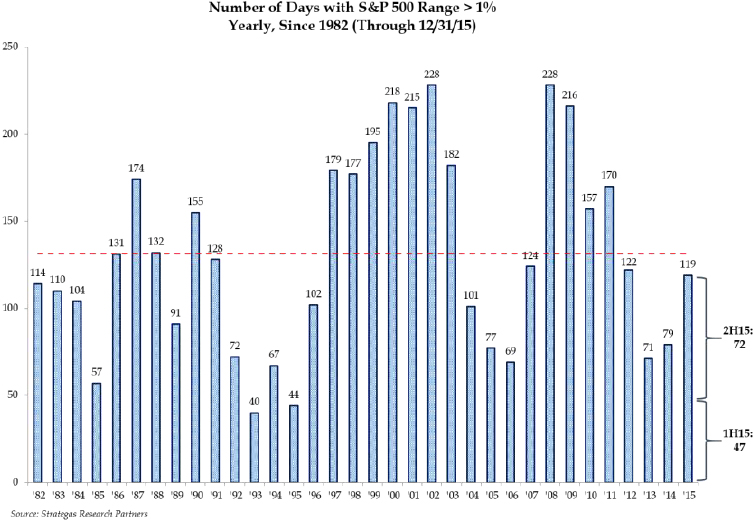
This increased activity of one percent or more daily moves in the equity markets has been disconcerting to most investors. We expect more of the same in 2016 as the factors creating this volatility remain in the forefront. Although the Fed has suggested its interest rate increases will be moderate and gradual, there is still uncertainty and increases will be data dependent. Thus, the anticipated gradual increase in interest rates by the Fed makes us very cautious on fixed-income investing as increasing interest rates could result in meager bond returns, or possibly even losses. The threat of higher interest rates, distress within energy companies, and the failure of one high-yield mutual fund to deliver on daily liquidity led to exaggerated losses, which we believe may not have been necessarily based on fundamentals, in high-yield bonds, which overall had a very poor 2015. Thus, we believe this could represent an opportunity if one steers clear of most of the energy sector. (We are currently exploring an investment in this area and conducting thorough due diligence before presenting it to suitable clients.) Furthermore, virtually the entire panoply of commodities has plummeted. Copper, gold, oil, natural gas, and other commodities have suffered double-digit declines. Fortunately we at FLI have never been fans of investing in commodities, and avoided virtually all of this carnage. Many other wealth managers, as well as certain consultants, call for a modest allocation to commodities. We generally avoid the space.
Another potential catalyst for volatility will most likely be the Presidential election this November. With the ending of President Obama’s final term, the Presidential race appears to be one of very different opinions on taxes and social issues, as well as how to defeat ISIS and combat terror. At this point, at least on the Republican side, nothing seems clear. The eight remaining candidates seem to be in different camps ideologically: the very conservative, the more moderate, and the non-politicians. At the same time, while the House seems safe for the Republicans, the control of the Senate will be fiercely contested. Too much money will be spent on these elections. Perhaps one day there will be real election finance reform. The money could be better spent elsewhere, such as philanthropy. Of note, year-end compromises did lead to legislation funding the government, as well as certain tax breaks and social benefits without the typical acrimony. Perhaps things are changing for the better.
There is going to be volatility. That does not mean we cannot make money. We believe that a prudent and defensive asset allocation, one utilizing investment strategies with high active share and concentration in the best ideas, can result in decent investment gains. The following chart shows that in the past, periods of higher interest rates supported appreciating equity markets (and real estate is still taking advantage of low rates and a growing domestic economy).
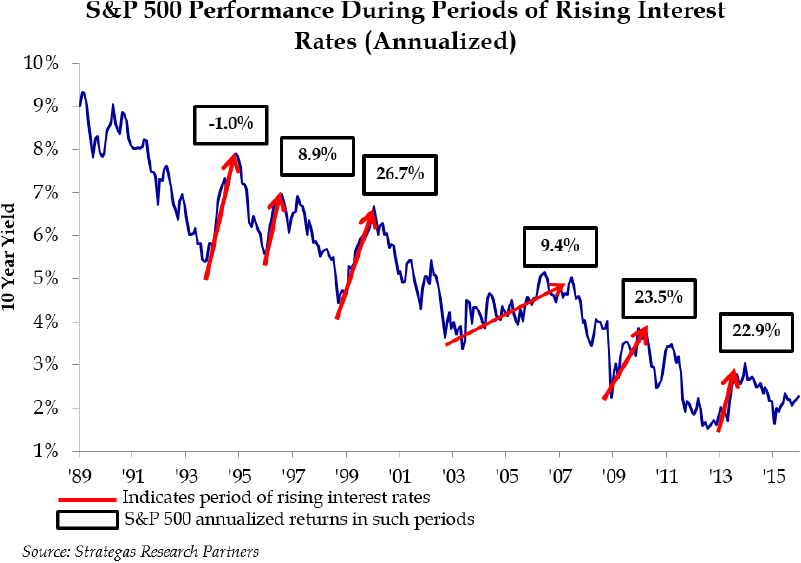
The chart demonstrates that when interest rates rise because of a stronger economy, equity markets can appreciate. It should also be pointed out that historically a recession does not occur until about five years after the first interest rate increase. This certainly is cause for guarded optimism for equities and real estate in our opinion.
Before getting to what we believe is a prudent asset allocation for 2016, we must take a look at market valuations. This past year we suggested that valuations for U.S. equities were reasonable, but not cheap. (We are still underweight international companies based on valuation.) Despite this, investors pulled billions of dollars out of domestic equity markets, especially during the third quarter correction. As we shared in our third quarter report and maintain today, we believe that domestic equity markets are reasonably priced and provide select opportunities. Corporate earnings in 2015 for the S&P 500 are expected to be ever so slightly down. This pause in earnings growth can be attributed to a large degree to the strengthening dollar and to a lesser degree both a slowing global economy and declining oil prices. U.S. domiciled multinational companies whose operations may have prospered in local currencies were penalized when those foreign earnings were translated back to the U.S. dollar. The plummeting price of oil severely impacted energy companies, which make up approximately 6.5% of the S&P 500 (down from 8.4% as of 12/31/14) and lost 24% in 2015. The price of oil has now dropped about 65% over the last eighteen months.
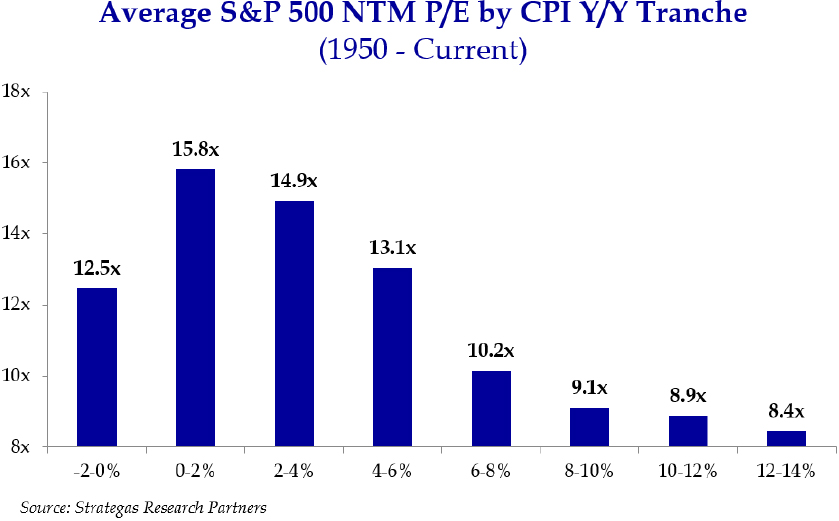
Oil has just about reached the same low point as at the depth of the 2008 financial crisis which I coined, the “Decession.” There is a bit more supply, but it seems as if things are just not that bad enough globally to warrant such a drop. Perhaps oil and oil-related companies might not be the same drag on S&P earnings in 2016. We believe that many companies continue to grow earnings and in general are trading at a reasonable P/E of approximately 16 on 2016 projected consensus earnings, which to us is fairly valued. The following chart supports our contention that this level of price earnings multiple is similar to other periods of time where low rates of inflation supported multiples in our projected range:
And, by the way, there are some glimmers of hope that the Eurozone economy will resume growing. Perhaps it will contribute to global earnings growth this year. We believe smart stock pickers can find opportunity in this investment landscape. Some companies will grow well above average and some provide solid values. Our job, and the job of our outside managers, is to find them. As indicated earlier, some large growth companies did well last year. We owned some of them across several of our strategies.
2016: What to expect and what to do
Let us start with what we expect. Interest rates will increase slowly this year. Bonds will provide little if any return and in some cases a negative return (high-yield could be the exception). Cash will continue to provide virtually no return. S&P 500 earnings will grow modestly, especially with the appreciating dollar being less of a factor (historical analysis actually shows the dollar declines in value after interest rates start to rise). Housing will remain robust and contribute to an expanding domestic economy. Oil will bottom out in our opinion at something close to current levels as we suggested earlier. Inflation will remain reasonable at about 2%. Congress will attempt to tackle tax reform with a view towards making our corporate tax rates more competitive globally. The fight against Islamic terror will intensify through a U.S. and moderate Arab-led coalition. Unfortunately there will be other terror attacks. A new President will be elected. The Chinese economy will continue to slow as it transitions from an infrastructure/industrial based economy to one that is more consumer/consumption driven. But nevertheless, the second largest economy growing between 4% and 5% per annum, is still constructive. Other emerging markets that are commodity-driven face recession. And yes, there will be more volatility!
In this type of environment, we will remain tilted to defensive strategies, growth companies, and quality investments. Sounds familiar? We expect to make money by using that bias while still being opportunistic. We will deploy capital to reasonably valued companies in our defensive, traditional and private investment baskets with above-average revenue and earnings growth, companies with strong dividend growth, deep value companies where catalysts exist to trigger appreciation, real estate oriented opportunities with high current yields, and potential private equity opportunities with among best of breed managers if we can gain access. We will underweight fixed income as the yield on high-quality municipal bonds and the after-tax yields on high-quality corporate bonds appear limited and barely above the expected rate inflation. We continue to explore high-yield debt in an opportunistic way seeking to take advantage of market disruptions as is the case now. For the most part, we will continue to avoid companies with direct exposure to commodities.
Many investors still are reluctant to stay the course in equities as evidenced by equity outflows in the third quarter correction and during the fourth quarter. (Fortunately not our clients as equity markets significantly rallied in the fourth quarter!) We believe reducing equity allocations (for properly allocated investors) was and continues to be a mistake. With equity valuations being reasonable and opportunities to own reasonably valued companies with strong earnings and revenue growth, long-term investors can be rewarded. The same can be said for larger companies that continue to raise cash dividends each year. (Companies in our Dividend Growth strategy have raised dividends for 26 consecutive years on average!) Financial companies, after years of significant litigation expense and government hyper-regulation, might just have some wind in their sails from modestly higher interest rates, dissipating litigation from actions that led to the financial crisis, and an improving economy (as long as the yield curve does not flatten too much). In our opinion, investor skepticism based on worries of these moderately higher interest rates is unfounded based on history. Equity markets have typically appreciated after initial rate increases by the Federal Reserve.
Be prepared for continued volatility. Despite this, we remain convinced that through careful and objective research there are ample investment opportunities for quality and defensive-minded long-term investors. We seek to accomplish long-term positive performance through our recommendation of a prudent, individualized asset allocation for each of our clients. A diversified asset allocation was key to most of our clients achieving reasonable relative 2015 performance in a difficult investment environment by having an exposure to large-cap growth companies, which outperformed large-cap value companies by almost 1000 basis points! As an example, the bastion of smart value investing, Berkshire Hathaway, suffered a 12% decline (We still like the company). Certain well known value-oriented hedge funds also suffered double-digit declines. Who would have thought? Again, a diversified and individualized asset allocation remains an important focus as we do not have the benefit of a robust global economy to lift all ships/asset classes. In addition to certain equity asset class sub-categories, real estate, with a proper valuation discipline, also represents opportunity. Finally, we must be prepared for the unexpected such as was the case with interest rates at “0%” for seven years or oil dropping by a whopping 65% over the past eighteen months. Being diversified but concentrated and tilted defensively, in our view, can help protect one from the unexpected, while not giving up the opportunity to prosper over the long term.
One last thought. It was not long ago that certain pundits suggested one could not be rewarded by being a long-term investor in equities. We believe that has been disproven and is nonsense. The key is to identify great businesses that are well managed and innovative with strong finances, vision, and reasonable valuations. We, and our outside managers, have been able identify and make investments in many of these great business over the long-term, benefitting several of our strategies. We believe there are a number of companies that meet this criteria and still represent sound investment opportunities as a significant part of one’s asset allocation. Just ask Warren Buffett, the iconic long-term investor. We will however, just have to endure the volatility and occasional company disappointments that go along with investing. This is nothing new and actually provides opportunity.
We at FLII wish you all a healthy, happy, and prosperous New Year. We are here to help you achieve each of those goals. We will be holding our 2016 Outlook web seminar on February 2, 2016 at 2:00 pm and encourage you to join us. You can register by emailing us at events@fliinvestors.com. Please do not hesitate to call me, Ralph, Phil, Ed, or any other member of our investment team if there is anything we can do to be of assistance.
Best regards,
Robert D. Rosenthal
Chairman, Chief Executive Officer
and Chief Investment Officer
*The forecast provided above is based on the reasonable beliefs of First Long Island Investors, LLC and is not a guarantee of future performance. Actual results may differ materially. Past performance statistics may not be indicative of future results. Disclaimer: The views expressed are the views of Robert D. Rosenthal through the period ending January 19, 2016, and are subject to change at any time based on market and other conditions. This is not an offer or solicitation for the purchase or sale of any security and should not be construed as such.
References to specific securities and issuers are for illustrative purposes only and are not intended to be, and should not be interpreted as, recommendations to purchase or sell such securities. Content may not be reproduced, distributed, or transmitted, in whole or in portion, by any means, without written permission from First Long Island Investors, LLC. Copyright © 2016 by First Long Island Investors, LLC. All rights reserved.
On October 20, 2015, First Long Island Investors hosted a thought leadership breakfast for clients and friends of the firm. The session was led by Kevin S. Law, President and CEO of the Long Island Association and Robert D. Rosenthal, our CEO. Kevin has led the LIA since September of 2010 and is focused on economic development and creating a better business climate on Long Island to strengthen it as a place to live, work, and do business.
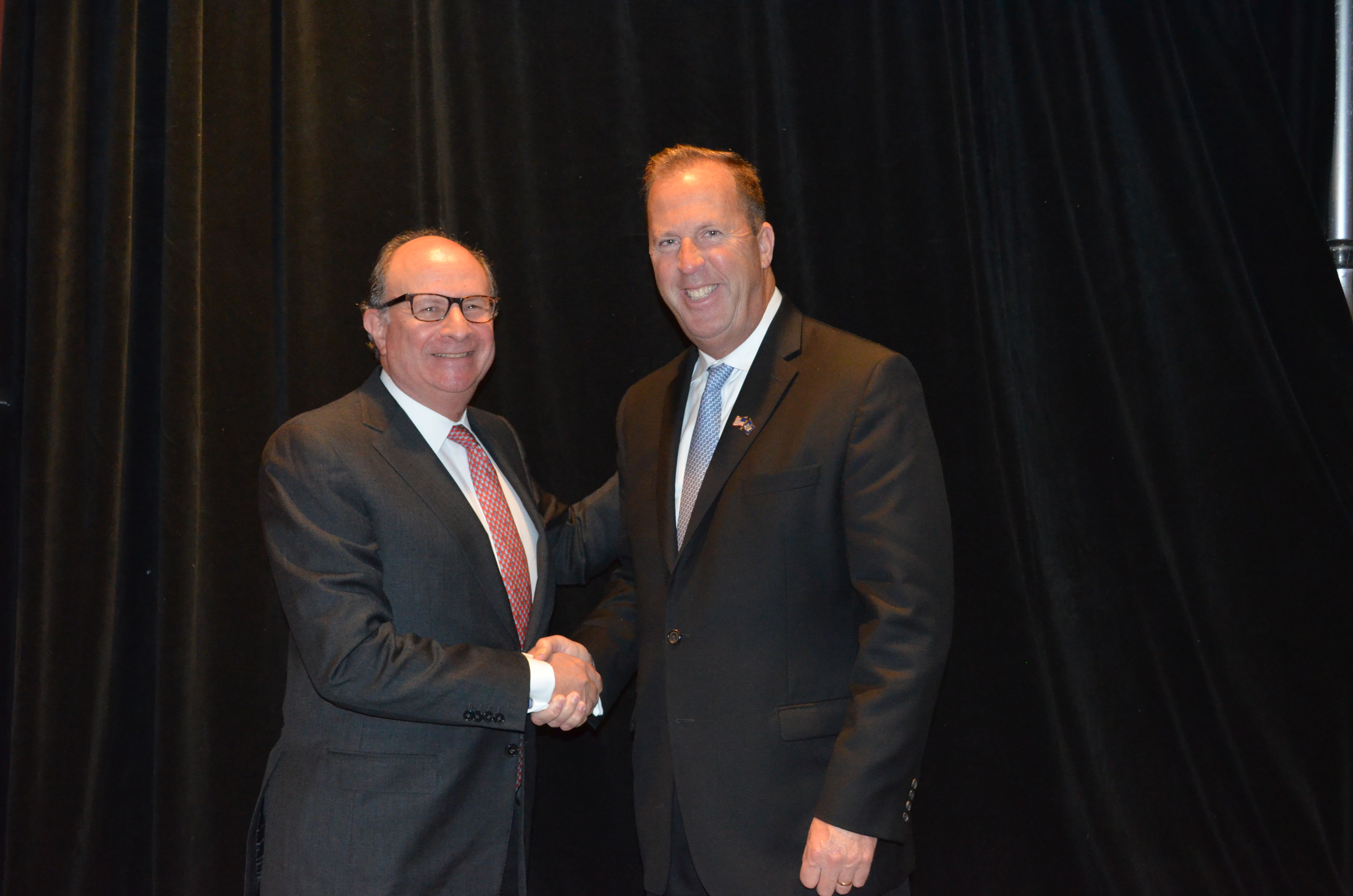
From left, Robert D. Rosenthal and Kevin S. Law.
Kevin made the following key points:
- Long Island has several challenges:
- It is a high cost area with both high property taxes and high energy costs. Additionally, it is a high traffic area.
- Demographically, the biggest challenge is that the size of the population is staying the same, but overall getting older. There have been about 2.8 million people on the island for the last 10 years. However, Long Island is losing 20-34 year olds and residents are not having as many children.
- One of the reasons Long Island is losing 20-34 year olds is that while we have single-family housing units, there are not a lot of multi-family units which makes affordable housing for a single person more difficult to come by.
- Alternatively, Long Island also has a lot of assets:
- We have one of the best educated and trained work forces.
- The public school systems on Long Island are very good, making it a desirable place to raise a family. Additionally, there are a number of beautiful environmental landmarks on Long Island – parks, beaches, etc.
- Long Island is in close proximity to New York City.
- The gross domestic product of Long Island is $140 billion.
- Long Island has recovered from the 2008 recession – unemployment is under 5% and real estate prices have recovered. However, the economy is not growing.
- The Long Island Association, under Kevin’s leadership, is working on and supporting a number of very interesting projects designed to improve Long Island’s economy and working on obtaining state and federal funding for these projects.
- Kevin is actively working on getting more investment money from the government. We send $5 billion more to Albany than we get back in investments and we send $23 billion more to Washington than we get back. Some of this is due to the fact that governments tend to focus more on cities than the suburbs.
- Some of the projects underway and/or under review include the following:
- The redevelopment of Nassau Coliseum and the surrounding area. The coliseum is being redone, but will not have a professional team. There will be an adjacent, new, tiered parking structure, half underground, half above ground. The Nassau Hub plans include a new biotechnology center that will be focusing on researching ways to deal with pain through electronics.
- There are a number of projects underway that together are designed to create a science and technology epicenter on Long Island. Two notable initiatives are the development of a super computer building at Stony Brook and a new startup vaccine company in Farmingdale.
- The LIA is more focused on providing ways for companies that are here to stay and grow rather than initiatives to attract new companies.
- Infrastructure is a key area for investment on Long Island. Two-thirds of Suffolk County does not have proper sewage infrastructure. Investment in the railroad and access to New York City is critical to the future of Long Island. Thirty percent of Nassau County residents work in the city and those residents account for fifty percent of revenues of Nassau County businesses.
Kevin concluded the session by reminding attendees that there are three things that we as Long Islanders should never forget or take lightly: the environment, our schools, and public safety. The degradation of any of these three things would have a negative impact on our economy.
“In investing, what is comfortable is rarely profitable.”
-Robert Arnott (investor, editor, and writer)
The quarter ended September 30, 2015 evidenced significantly greater volatility and the first “correction” (a decline of 10% or greater) since 2011. Both the volatility and correction were overdue as we suggested in both our last quarterly letter and our web seminar on August 6, 2015. We believe the correction is healthy and primarily reflects fears of the softening in the Chinese economy as well as continued uncertainty surrounding the Federal Reserve’s interest rate policy (as well as some other factors mentioned later in this letter).
The collision of these fear factors has made investors quite “uncomfortable” thereby resulting in a meaningful decline in equity averages (the S&P 500 and the NASDAQ declined by 6.4% and 7.4%, respectively, in total for the quarter) and led to continued withdrawals from domestic equities. The short-term nature of many investors and the advent of high-frequency trading can exacerbate market movements during periods of volatility, in our opinion. It is at times like this that the investment professionals at FLI are called upon to analyze the economy, both domestic and international, to render an opinion on the attractiveness of investable markets from which we suggest prudent asset allocations for our clients.
We believe that the domestic economy continues to show positive signs. The upward revision of real gross domestic product (GDP) growth to 3.9% for the second quarter, rebounding from a moribund-weather impacted first quarter, gives us some reason for optimism. In addition, the trend of growing employment continued throughout the quarter, although the weaker than expected September employment report and modest downward revisions for July and August were disappointing. Significantly lower energy costs from a year ago should strengthen the consumer in coming months, in our opinion. Also, inventories are not elevated suggesting room for continued GDP growth while demand seems reasonable both from a domestic industrial and consumer standpoint. Further strengthening our case for reasonable economic growth is the continued improvement in the housing market and strong automobile sales, as well as an improvement in other retail sales. This, we believe, is an indication that the consumer is reasonably strong and the U.S. economy is not facing a recession at this time. Consumers make up about 70% of the domestic economy and their balance sheets are in “good shape” according to Strategas (a strategic economics consultant). In fact, based on their research, consumer balance sheets are the best in 35 years.
The economic growth characterized above is modest to reasonable in our opinion. We still believe that real GDP growth will be between 2% to 3% for this year and next. As such, inflation remains tepid. Labor and commodity costs continue to have slack, which supports this current low level of inflation. This continues to be a concern for the Federal Reserve as its target inflation rate of 2% remains elusive while its mandate for full employment is close to being accomplished despite a low workforce participation rate. This, coupled with concerns about economic growth in many international markets (emerging markets and China, in particular), we believe led to the Fed’s decision to not “lift off” (increase short-term interest rates) at its September meeting. The lack of a rate increase upset the equity markets around the world, in our opinion, as it could be interpreted that economic growth is not yet strong enough to take our monetary policy out of its crisis mode of the past seven years. We believe the Fed’s decision was a mistake! We believe that a modest increase of 25 basis points (one quarter of one percent) would not have disrupted our economy at all and would have signaled the Fed’s intention to start bringing interest rates back into a more normal range. Unless some exogenous event takes place pushing our economy into recession (we do not believe that a recession is in sight for the U.S.), we believe the Fed will raise rates sometime in the near future. However, future rate increases will be modest and gradual in our opinion, especially as the economy, both domestic and international, remains in a slow growth mode.
The concern about international economies probably contributed to the Fed’s decision to not raise rates. A specific request to the Fed from Christine Lagarde of the International Monetary Fund, to refrain from a rate increase, as well as weakening economic growth in China were likely factors considered by the Fed. China is transitioning from an industrial/infrastructure driven economy to a more consumer- oriented one. This probably has led to declining raw materials usage and thus pricing on a global basis. In addition, the modest devaluation of the Chinese currency, the yuan, also contributed to recent volatility and uncertainty. However, it is likely that growth in China will remain meaningful. Although Chinese industrial production and retail sales have risen more slowly (6.1% and 10.8%, respectively) than in recent years, this is still meaningful growth. The impact on our domestic economy is modest at best. You can see from the chart below that U.S. exports to China accounts for less than 1% of total U.S. GDP. Additionally, two U.S. domiciled companies that we have investments in, Apple and Nike, have just reported that their business in China is very robust. However, a concern remains as to the impact on other emerging economies from the softening growth in China. We will have to wait and see if there is any significant spill-over to other developed economies.

Nevertheless, equity markets are correcting and some investors have headed to the sidelines. Outflows from domestic equity funds have been substantial while inflows to bond funds have been plentiful so far this year. As reported in the press, well-known hedge funds have suffered bigger losses (double-digit year-to-date) than the equity markets and have grown cautious (Greenlight, Appaloosa, and Carl Icahn, as examples). Meanwhile, interest rates remain stuck in a narrow range near historic lows with the ten-year Treasury ending the quarter at 2.1%. This rate and the rate for high-quality municipal bonds with similar duration remain at slightly below or barely above the expected long-term rate of inflation (2%) on an after tax basis. We consider the current returns available on Treasuries, municipals, and cash to be poor returns for long-term investors, although to some it feels more “comfortable” than the current pronounced volatility in the equity markets. As stated earlier, volatility has picked up and the following chart demonstrates this. (We used a similar chart in our most recent web seminar but have updated it to reflect the recent market volatility).

From a valuation standpoint, we remain satisfied that current valuations for the market as a whole remain reasonable (but not cheap) in this environment when looked at through the prism of next year’s consensus earnings estimates for the S&P 500 of $129 (up from this year’s projected earnings of $117). This works out to about a 16 multiple. We invest in a more concentrated way (our in-house strategies and the portfolios of our outside managers are more concentrated and have high active share). Additionally, we believe the valuations for our strategies are more attractive. We again say this is not “nosebleed” territory especially in an economy characterized by low inflation and low interest rates while many multi-national companies’ earnings have been compromised by the strong dollar. Also, if one were to extract the depressed energy sector earnings, S&P 500 earnings would be even more robust leading to more attractive valuations. The energy sector is bringing its own volatility not just in the price of oil having declined by more than 50% from last year, but also in terms of possible bankruptcies in energy and energy-related companies. This can impact both stocks and bonds (especially high-yield bonds) of energy and energy-related companies.
The negative investor sentiment and the potential impact of the slowing Chinese economy is actually heartening to us as contrarians. Taking all of these factors into consideration, we remain optimistic about the U.S. economy and believe that any domestic recession is still a ways off. This bodes well for many of the companies we invest in, the bonds we own, the growing dividends we expect to collect, and our recently established domestic mezzanine real estate investment. Real estate will continue to benefit from low interest rates although valuations in certain markets are stretched in our opinion. Strong growth companies and companies with above-average dividend yields increasing annually make us much less “uncomfortable” at this time.
The recent spike in volatility and all of the global economic and geopolitical issues must be reckoned with by investors. Accordingly, our defensive posture should continue to help mitigate this volatile market environment for our clients. In this last quarter, all three of our defensive strategies did better than the general stock market and each of the benchmarks they are compared to. This remains important because the type of volatility we are experiencing can be disheartening. Additionally, fundamentals will work to our advantage over the longer term. However patience and a strong stomach are required for now.
From an investment allocation standpoint, we maintain our bias to being defensive and recommend that all clients overweight the strategies in our defensive basket. We believe these strategies will outperform bonds over the next few years. We remain cautious in bond commitments given their paltry returns and poor valuations. Our traditional equity strategies are not cheap, but we are satisfied owning some great companies whose growth/value characteristics should result in reasonable appreciation over the long term. We are maintaining a reasonable weighting in the traditional equity area as we do not see a looming recession and believe valuations are fair. As mentioned earlier, a 16x P/E on next year’s consensus earnings estimates is not unreasonable, based on history, for this environment of tepid inflation and low interest rates. However, we continue to recommend that clients overweight defensive strategies as they possess characteristics which should weather volatility well, while providing reasonable appreciation potential. We also believe that our defensive and traditional equity strategies (which are concentrated to utilize best ideas) will benefit from what we perceive to now be an advantage for active managers (managers that pick individual stocks rather than investing in an index or ETF). Anecdotally, the Wall Street Journal reported on August 25, 2015 that “dozens of ETFs traded at sharp discounts to their net asset value leading to outsized losses for investors who entered sell orders at the depth of the panic.” So investors trying to buy a big package of stocks through an ETF in a given area face a danger in periods of extreme volatility. We believe these to be nothing more than a “deworsification” and typically avoid using ETFs, preferring concentrated portfolios of best ideas in our strategies and those of our outside managers. Finally, we should point out that we remain underweighted to international companies, as we still see greater potential in domestic, large-cap companies.
Anecdotally, the third quarter for the S&P 500 has historically been the worst of the four quarters. The best quarter historically since 1928 is the fourth (October – December). We hope that this historical guide is an accurate predictor for the quarter we have just started. The prevailing negativity from a contrarian standpoint, as well as all of the cash on the sidelines earning very little, leads us to believe that stocks will rebound in this fourth quarter once investors become more comfortable with the Fed’s evolving policy and China’s ultimate growth trajectory. Of course, the geopolitical situation in the Middle East must also be watched carefully.
We invite you to our renovated office to visit with us and review any investment and wealth management issues you might want to discuss. We would then be delighted to introduce you to our three newest colleagues at FLI (Drew Wray, Assistant Vice President, Wealth Management; Chris Butler, IT Professional; and Nicole Villarica, Receptionist). Most importantly, we wish you a wonderful holiday season which is soon approaching.
Best regards,
Robert D. Rosenthal
P.S. We are off to a very positive start of the fourth quarter. This has resulted in meaningful appreciation to all of our strategies as best as we can tell at this point. We are hopeful it will continue.
*The forecast provided above is based on the reasonable beliefs of First Long Island Investors, LLC and is not a guarantee of future performance. Actual results may differ materially. Past performance statistics may not be indicative of future results. Disclaimer: The views expressed are the views of Robert D. Rosenthal through the period ending October 29, 2015, and are subject to change at any time based on market and other conditions. This is not an offer or solicitation for the purchase or sale of any security and should not be construed as such. References to specific securities and issuers are for illustrative purposes only and are not intended to be, and should not be interpreted as, recommendations to purchase or sell such securities. Content may not be reproduced, distributed, or transmitted, in whole or in portion, by any means, without written permission from First Long Island Investors, LLC. Copyright © 2015 by First Long Island Investors, LLC. All rights reserved.