March 31, 2017
“It’s far better to buy a wonderful company at a fair price than a fair company at a wonderful price.”
– Warren Buffett
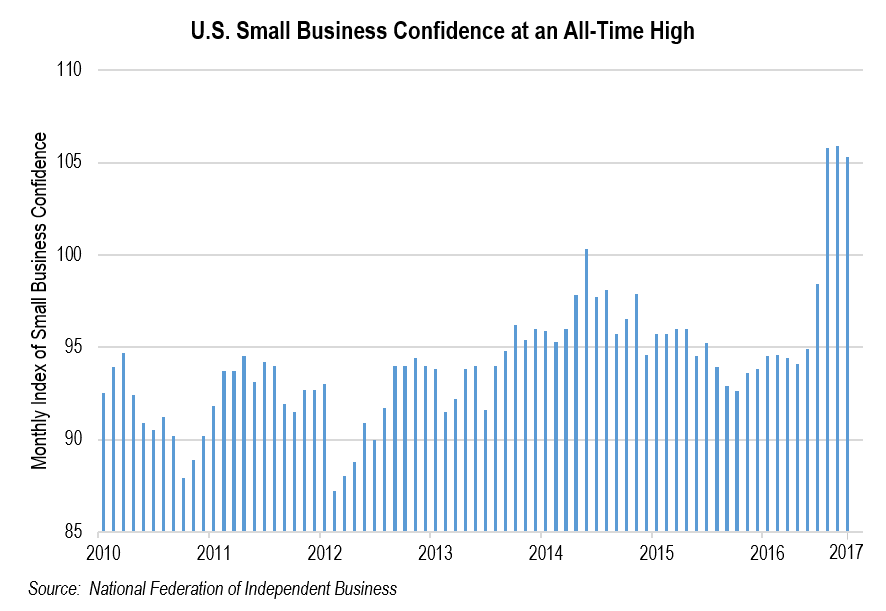
Virtually all domestic equity markets in the first quarter of the year reflected continued economic optimism that resulted post the contentious 2016 Presidential election. Small business and consumer confidence, important factors which support the markets in our opinion, continued to gather steam in the quarter as indicated in the charts below:

The domestic equity market, as measured by the S&P 500, recorded a 6.1% gain and reached an all-time high during the quarter. The NASDAQ also registered a new high with a gain of 10.1%. Other domestic equity indices did fairly well (mid and small-cap growth), and international indices showed some lift (the MSCI All-World ex US appreciated 7.9%). However, not all industry sectors followed suit with banks, transports, and energy companies giving back some gains since the November election. Small-cap value was actually the only domestic equity style that had a very slight decline (-0.1%). Oil continued to be range bound ($45-$55) ending the quarter at $50.54 per barrel. Not much of a spurt given the attempt by OPEC nations to cut production and raise prices. Housing was strong both from a sales price standpoint and the number of homes sold. Corporate earnings, represented by the S&P 500, grew in the fourth quarter of last year (4.9%) (we await results for the first quarter). Projections from our economic consultants indicate continued growth in S&P 500 earnings in this first quarter with perhaps a rise of as much as 10%.
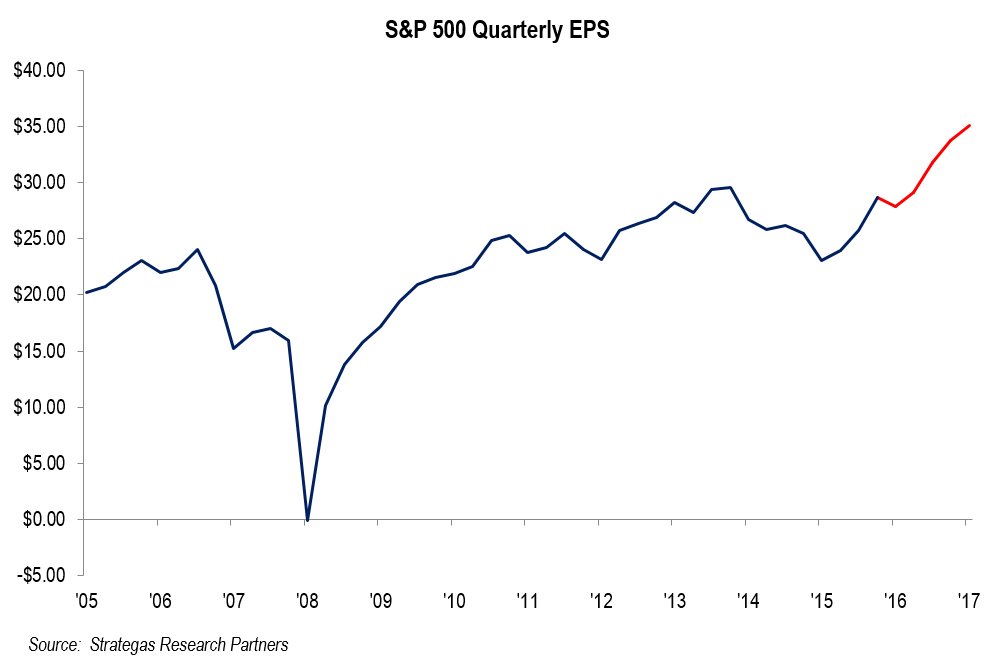
If earnings continue to rise throughout the year (and we believe there is a good chance that will happen), valuations will become more reasonable which could bode well for equities. By the way, most major equity indices outperformed bonds. Quality bonds with shorter maturities continue to have very modest yields and in some cases yields below the current rate of inflation. Accordingly, we continue to underweight bonds for most clients.
Our defensive and traditional equity strategies (those in baskets two and three) all had strong first quarter results. Things sound and feel rather good. We at FLI remain with a defensive tilt and an overweight to our defensive strategies.
Our reasoning is based on a series of factors (some are concerning and some are constructive):
- As expected, the Federal Reserve raised rates by a quarter of one percent in March and is predicting an additional two raises this year. This is not necessarily a negative as we believe that the Fed intends to raise rates because it believes that economic conditions should improve, and rates remain historically low. However, the gradual rate increases and the slimming down of the Fed’s balance sheet could present some volatility later in the year.
- Politics in Washington remains contentious, and the Republican majority in both Houses has not resulted in any meaningful pro-growth legislation as of yet. The confidence gap in Washington (low approval ratings of both Congress and the President), felt by most Americans, remains in place. More on this later.
- Valuations are at the high side of reasonable, in our opinion. Nothing is cheap but better earnings and a possible corporate tax reduction would help to reduce the price-earnings multiple on the S&P 500 (currently projected at 18x 2017 earnings) and other indices.
- The yield curve is flattening somewhat, but still steep enough to promote healthy bank earnings in our opinion.
- North Korea and Syria remain geopolitical hot spots.
- Volatility remains unusually tranquil. There were only two days where the S&P 500 moved by 1% or more (in either direction) during the first quarter. Quite different from the first quarter of last year where volatility was much greater. We do not believe this will last.
- There is potential political instability in Europe. Populism is an issue.
- Trade policy out of Washington remains an unknown and a possible concern if we become more isolationist.
- Tax reform needs to become a reality in order to help boost GDP growth above the current sluggish 2% level.
- Employment remains strong.
- Banks and consumers are financially strong, for the most part.
The above economic and political factors paint a reasonable but cautious picture. We are in an environment where animal spirits are held back somewhat by continued political paralysis, but bearish sentiment is tempered by many positive economic factors. This presents a dilemma for investors who do not utilize a well formulated and prudent asset allocation. This yin and yang of investment sentiment is actually a positive as far as we are concerned. There is no unabashed optimism about anything right now. From a contrarian standpoint, that would suggest there is more good news to come.
History is on our side based on the S&P 500 having just recorded a strong first quarter of 2017 with a return of 6.1%.
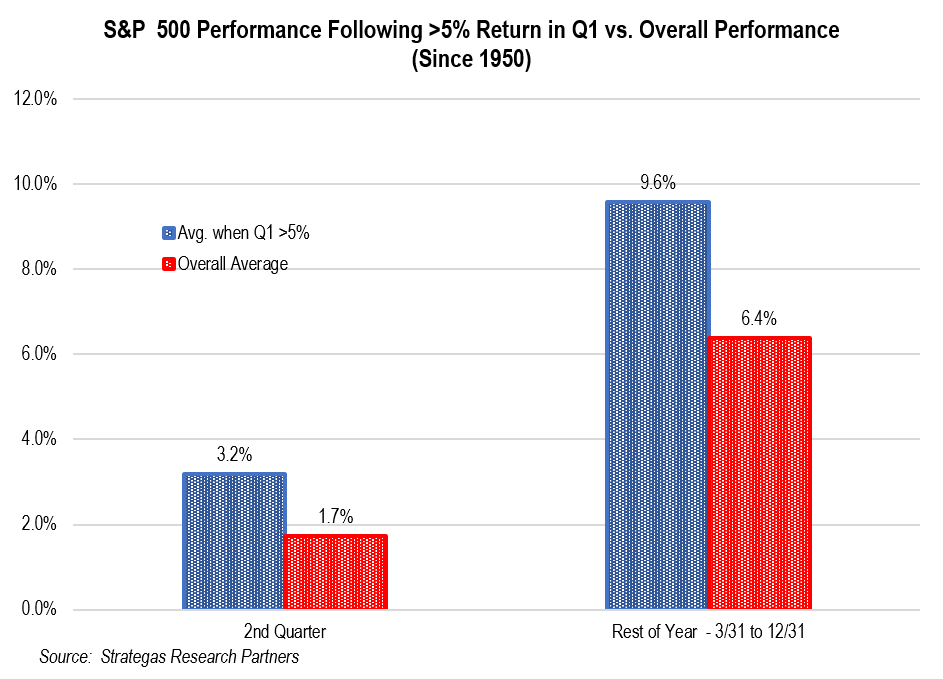
As the chart above indicates, a robust first quarter is historically followed by stock market happiness during the rest of the year. At least that has been the case over the past 66 years.
Another chart which gives cause for optimism is this political snapshot of stock market history:

Although we are students (disciples) of history, we know it is only a guide and not a guaranty. We need to see fiscal growth and reform initiatives take the baton from the monetary policy we have been relying on over the past eight years. That will require something better than we have seen in the last sixty-plus days out of Washington. The animus from the November election unfortunately continues. The leadership on both sides have yet to act in a bipartisan manner. This behavior is not in the best interests of America. Only time will tell if this changes. Meanwhile, we must invest prudently and rely on fundamentals to give us the best opportunity for long-term appreciation.
As Warren Buffett recommends in our quote of the quarter, we believe, for the most part, that we are paying a “fair price” for really good companies. Those companies that are really good but sell at prices we deem too high, we will not purchase, but we have little fear in owning really good companies that are fairly priced. Even with market setbacks, they should grow into their own over time especially as we and others believe that corporate earnings will continue to grow. The same holds true with other asset classes that we invest in. Our real-estate oriented investments are also made with a view towards quality (location) and realistic valuations. This is especially important when interest rates could trend higher. If rates were to ratchet up, this might impact real-estate valuations. It is unclear if the Fed will raise interest rates another two or three times this year. It will be data dependent and much will depend on what happens in Washington. The same holds true with art and other collectibles. As the cost of borrowing gets higher, and if economic growth remains anemic, quality and price has and will continue to matter.
As advisors to investors (including ourselves as we invest side by side with clients), we are mindful of the cumulative gains we have made over the past eight years. Fairly assessing the economic landscape and current valuations are critical to our advice. Reality has to pervade our thinking even if we tend to be cautious. Although we do not see a recession occurring in the near future, our defensive tilt results from some uncertainty about the pace of domestic and global growth. Adding to this is the business as usual lack of bipartisan cooperation in Washington, D.C. However, we remain bullish on America over the long term. Accordingly, we remain committed to an asset allocation that should give us returns that exceed inflation and taxes. Our portfolios in various asset classes are typically concentrated. We generally look for the best companies that are reasonably priced, the best investment managers that we can partner with, and the best hard assets that we can find of quality and fair valuation. American business is great at innovating while Americans are a hearty and productive society that does not permit temporary disappointments to become permanent set-backs.
As Warren Buffett stated in Berkshire Hathaway’s most recent Annual Report: “This economic creation will deliver increasing wealth to our progeny far into the future. Yes, the build-up of wealth will be interrupted for short periods from time to time. It will not, however, be stopped. I’ll repeat what I’ve both said in the past and expect to say in future years: Babies born in America today are the luckiest crop in history.”
We agree with Mr. Buffett. Never bet against America. Despite political bickering and geopolitical issues (all of which we have lived through before, time and time again) we invest for the long term with customized asset allocations for each of our clients to reflect their individual needs, goals, and circumstances. Let us help you evolve an asset allocation that keeps you moving forward in wealth creation over the long term through our experienced guidance in both wealth and money management.
At this time, we continue to underweight our security basket (bonds and cash), overweight our defensive basket, modestly underweight our traditional equity basket, and be opportunistic in our private investment basket as solid opportunities in private equity and real estate present themselves. Please call us with any questions you might have on wealth or money management issues for our advice.
Best regards and let’s look forward to a wonderful spring!
Robert D. Rosenthal
Chairman, Chief Executive Officer,
and Chief Investment Officer
Disclosures, Important Information
*The forecast provided above is based on the reasonable beliefs of First Long Island Investors, LLC and is not a guarantee of future performance. Actual results may differ materially. Past performance statistics may not be indicative of future results. Disclaimer: The views expressed are the views of Robert D. Rosenthal through the period ending April 24, 2017, and are subject to change at any time based on market and other conditions. This is not an offer or solicitation for the purchase or sale of any security and should not be construed as such.
References to specific securities and issuers are for illustrative purposes only and are not intended to be, and should not be interpreted as, recommendations to purchase or sell such securities. Content may not be reproduced, distributed, or transmitted, in whole or in portion, by any means, without written permission from First Long Island Investors, LLC. Copyright © 2017 by First Long Island Investors, LLC. All rights reserved.
Knowing when and how to start transferring wealth is an important topic for most high net worth individuals. Philip W. Malakoff, Senior Vice President, Wealth Management, was recently asked for his insight on this topic by LI Pulse Magazine.
http://lipulse.com/2017/03/07/5-steps-transferring-wealth/
On February 8, 2017, Robert D. Rosenthal, CEO and Chief Investment Officer, Ralph F. Palleschi, President and COO, and Philip W. Malakoff, SVP, Wealth Management, shared with clients and business partners First Long Island Investors’ 2017 market outlook during a web seminar. They covered the firm’s expectations for 2017 and how we are positioning client portfolios.
“Change is the law of life. And those who look only to the past or present are certain to miss the future.” – John F. Kennedy
Change typically is not necessarily accepted well in the short term by financial markets. However, the unexpected (for most) election of President-elect Donald J. Trump and the control of both houses by Republicans represents significant change from what had been expected by many to be a Presidential win for Hillary Clinton and the potential that the Senate would flip to Democrat control. The unexpected, like Brexit, occurred and President-elect Trump will be accompanied by both a Republican House and Senate. Initially, domestic financial markets responded well. By the way, historically when the presidency and both houses of Congress have been controlled by Republicans, equity markets have done well (this is a historical guide and not a guaranty):
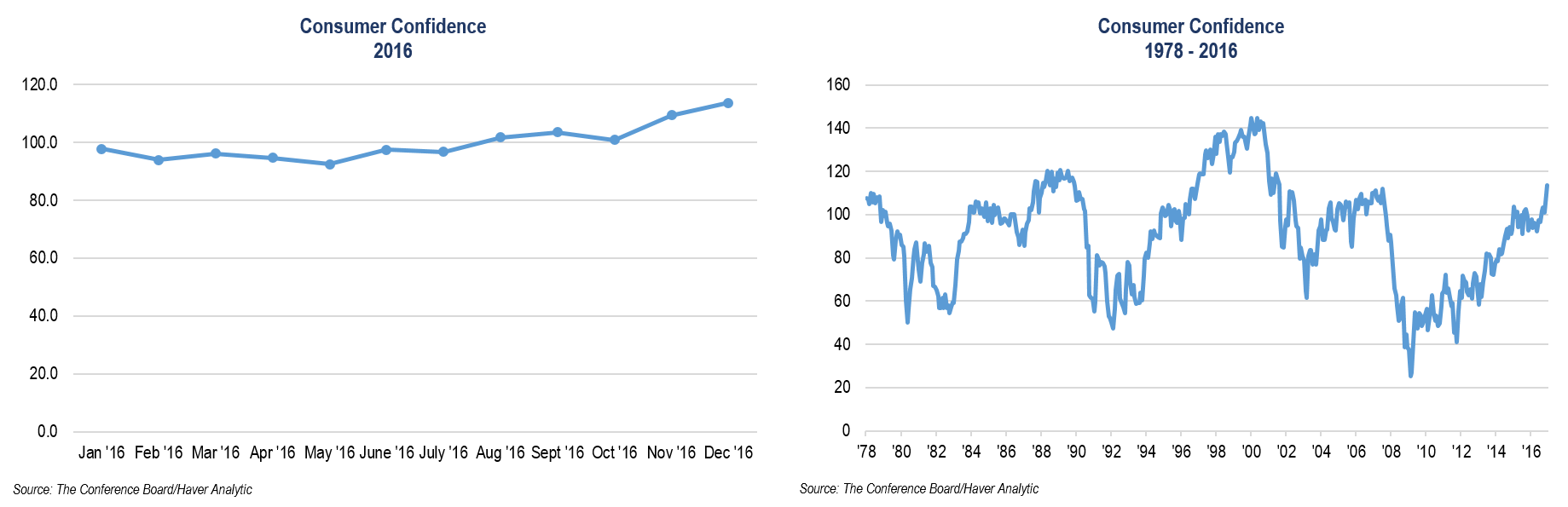
Stock market performance and consumer confidence jumped right after the election anticipating tax reform, less regulation, and the repeal or major modification of the Affordable Care Act. Notably, consumer confidence is finally at close to pre-“decession” levels.
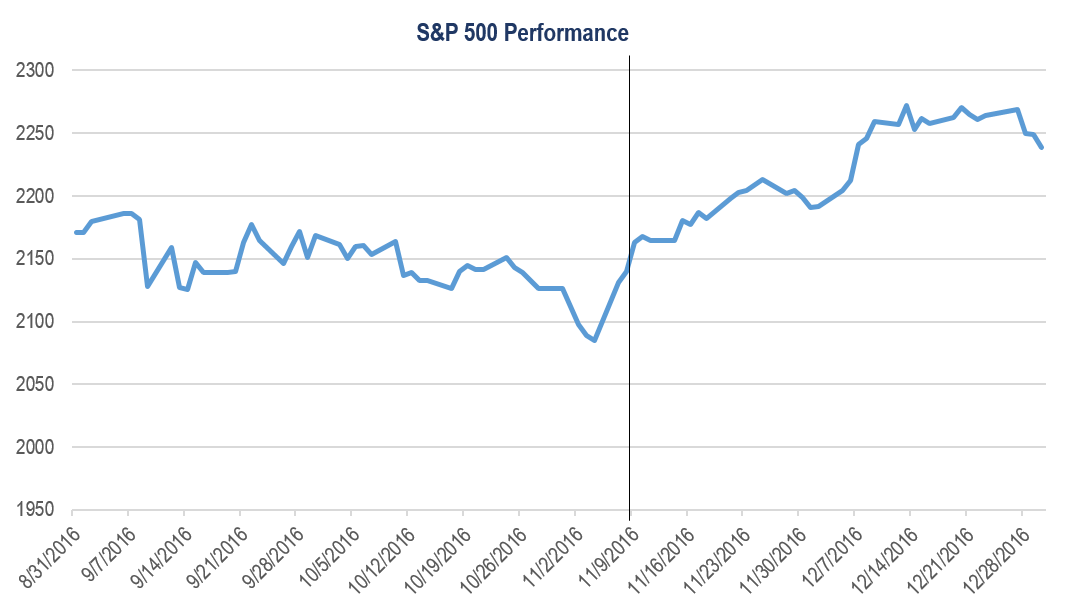
The knee jerk reaction was a very positive one. However, we believe this was driven by certain campaign promises plus the potential to reverse aspects of the Obama administration’s policies that many believe have held our economy somewhat hostage. Specifically the following promises made could provide a significantly changed domestic economic environment worthy of the current optimism:
- Major corporate tax reform with an emphasis on reducing the corporate tax rate to make the U.S. more competitive globally, along with encouraging domestic business investment should lead to productivity gains and economic expansion at a faster pace than the eight Obama years. This private sector investment has been missing and is needed.
- Individual tax reform to simplify the tax code should deliver some economic benefit to the middle class while eliminating certain loopholes for the well-to-do, which will keep the cost of reform reasonable.
- Investment in the country’s infrastructure is long overdue. This can be paid for in part through repatriation legislation that will impose a tax on corporate funds brought back from overseas. This lower rate of tax (than what has been paid previously on earnings repatriated from overseas) can be used to fund an infrastructure program, mitigating some of the cost. The balance of the infrastructure program funding will require some borrowing and an increase in the national debt.
- A reduction in the number and scope of countless unnecessary (in our opinion) regulations at every level of business, both big and small should reverse conditions that have stifled business growth and in turn lead to better paying jobs. From the financial sector to everyday small businesses, companies face overly burdensome regulations that are costly and time consuming that need to be lifted or reduced. This will stimulate growth from a more confident private sector in our opinion.
- Modification/repeal of the Affordable Care Act should recognize its costly deficiencies but maintain certain beneficial aspects of the plan. Insuring more Americans and providing for those with pre-existing conditions is absolutely necessary. However, the cost to do such must be controlled through greater efficiency, larger pools of healthy participants, increased competition, and the reduction of Medicare/ Medicaid fraud. Additionally, expansion of health savings accounts or similar vehicles can also help.
- Border control is a must to stem the tide of illegal immigrants and stop the destructive pathway for illegal/harmful drugs. This does not mean the mass deportation of people living here peacefully but without proper documentation. It means stem the illegal tide, rid the country of violent illegals, and create a better system for peaceful, constructive illegals to remain but not with guaranteed citizenship.
- The proper use of Congress in a bipartisan way is necessary so that the overuse of executive action no longer takes the place of legislation. We are not suggesting that the legislative paralysis caused by partisan politics did not lead to some of the executive actions. It probably did. This has to change for the good of all Americans.
Now, the above will take time, perhaps a lot of time, and a lot of negotiating if there is going to be some bipartisanship and therein lies the potential for disappointment and volatility in the equity markets. President Obama learned the hard way that there really were no projects for his fiscal stimulus program. President-elect Trump must be patient for well thought out national and local infrastructure projects, should spending be approved. Cooperation at all levels of government and partnership with the private sector is essential to plan and implement this much needed rebuild of our roads, trains, bridges, airports, and other aspects of our infrastructure. This will promote an expansion of better paying jobs, in our opinion.
If the tax reform and infrastructure can be coupled with repatriation and some deficit spending financed in part with debt, our economy could grow at something more than the current anemic pace of the last eight years. The following chart shows the slow recent growth despite the benefit of extremely low interest rates. Although enabled by a Federal Reserve operating on steroids, global growth supported by low interest rates as well as monetary stimuli without fiscal growth initiatives, was below that of other recoveries:
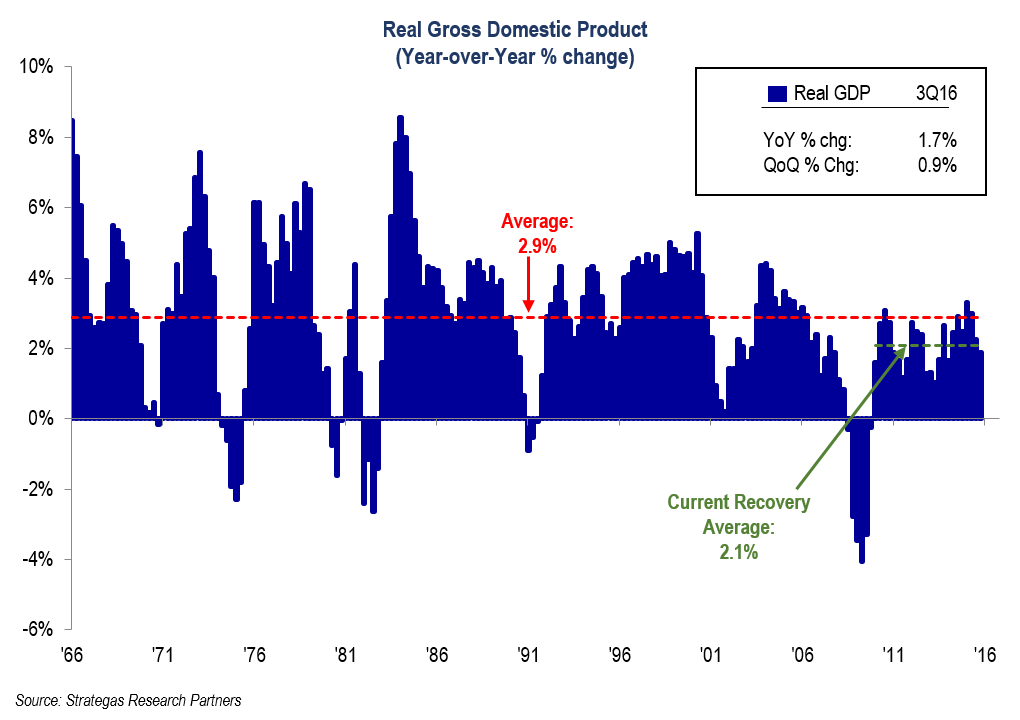
Although the above lackluster domestic growth enabled the economy to avoid recession since 2008 –2009, middle class wages in the U.S. have barely made any progress and some have been further compromised by burdens caused by the Affordable Care Act. Thus, more rapid growth as well as tax reform is needed to spur on consumers (about 70% of the domestic economy) and encourage businesses to invest in order to drive productivity and economic growth. If this does not happen in the early stages of this new administration, the result could be a very disappointed equity market.
Meanwhile, while we wait for some magic to happen in Washington, our job is to assess the valuation and prospects for the investments we make for our clients. This is complicated by a world in some turmoil. The Middle East is ablaze; Russia is acting in a predatory fashion in some areas outside their borders; China is arming all seven of the artificial islands it has built in the South China Sea; and North Korea’s dictator banned Christmas and continues to develop an aggressive nuclear capability. Special mention must be given to ISIS, which continues to plague the world with its special breed of terror aimed at Christians, Jews, and some moderate Muslims whose societies they view as infidels.
As the world struggles with cyber-attacks; half a million killed in Syria; war and massacres plaguing Yemen, Libya, and the Sudan; terrorist attacks in Germany, France, Turkey and the U.S.; the world community, as represented by the inept UN, found the time to condemn some settlements being built in disputed territories in the democratic country of Israel (its favorite punching bag).
Now, back to the foundation of what we do— investing in a prudent way driven by diversified opportunity based on reasonable valuation, quality, and always with a view towards preservation of capital. In 2016 we believe clients did reasonably well as all of our traditional equity and defensive strategies achieved positive results. In our private investments we believe progress was made in all but one of several different investment vehicles (and that one exception we believe continues to have significant upside although it continues to take more time than we envisioned). Our leading strategy in 2016, Dividend Growth, netted more than 12% on average despite being labeled defensive. Its value and dividend growth orientation outpaced growth strategies, which had been superior performers in 2014 and 2015.
For 2017, equity markets in general appear to be fairly to slightly more than fairly valued while waiting for earnings growth from the average company to reaccelerate should the general economy pickup. This, in our view, depends on the success of “Trumpenomics.” S&P earnings had stalled until the last two quarters where a slight pickup was registered/is expected. (Third quarter grew by about 3% and fourth quarter is projected to do about the same.)
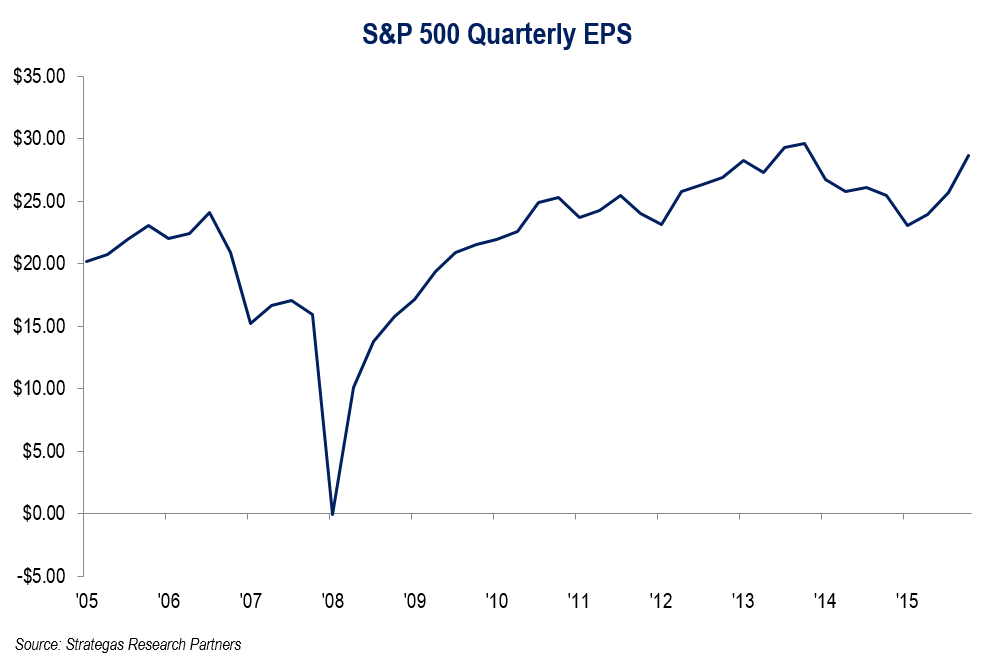
As the chart above shows, earnings growth stalled, declined a bit, and has started to grow again. As a result, price earnings multiples rose to 19x on trailing twelve month earnings and 16.9x on the consensus projected earnings for 2017. This is not terribly worrisome unless you believe a recession is imminent. We do not! The yield curve for bonds is not inverted, which when it occurs historically has been a sign of a forthcoming recession. With the Federal Reserve on the move with a forecasted three interest rate increases in 2017, one can assume that the economy and inflation are picking up somewhat along with decent employment growth. One can also make the case that those bond investors who extended maturities to garner more yield are in for some paper losses in their portfolios. This could lead to sales of bonds and bond funds by investors and a flight to equities, as occurred towards the end of 2016. We continue to be cautious about bond investing in general and have an under-weight allocation to fixed income for our clients.
Our view going forward is that it is not an easy environment to invest in and one must be cautiously opportunistic, as well as realistic, in terms of what returns to expect. I have already stated that we are under-weighting bonds because as rates increase, even slowly, longer maturity bond portfolios will not earn much if anything with the ten-year treasury at 2.5% pretax, and five-year triple A munis yielding about 1.8%. These figures are pre-fee and are not very attractive versus inflation targeted by the Fed at about 2%. Of course, if you believe that we are facing a recession or some systemic disruption, then a bond allocation should provide an anchor. Even so, we would still underweight this allocation for the long-term investor seeking better risk-adjusted returns as bonds may keep pace with inflation at best from current levels.
Given the uncertainty with the new President-elect as well as a Republican House and Senate, coupled with global unrest, we remain cautious, selective, and concentrated in the vast majority of client portfolios. This fits nicely with our three defensive strategies, which we believe provide better upside than bonds and cash over the longer term and less volatility than traditional equity markets. For example, FLI Dividend Growth is concentrated in stocks that have above average yields and consistently growing dividends (average of 23 consecutive years). We believe that concentrated portfolios will have a better chance of outperforming the averages in what could be a more volatile environment driven by changing tax policy, changes to the Affordable Care Act, and immigration policy implementation as well as possible disruptions from geopolitical events. Also, we must not leave out possible economic disruption and resulting volatility from President-elect Trump’s stance on global trade as well as possible punitive tariffs. This is a wild card where differences exist between the President-elect and both sides of the aisle in Congress.
We remain cautiously constructive on real estate as the economy improves and we will continue to seek out appropriate investment opportunities in this space. However caution is the operative word as the real estate community has to deal with both increasing interest rates (although still very low from a historical standpoint) and new supply coming to market as developers have taken advantage of low interest rates. In areas of private equity, we continue to look for high-quality opportunities. We have no opinion on commodities except that oil should be less volatile and probably be range bound between $45 and $65 per barrel. It is not an area we are comfortable in given its volatility, speculative appeal, and difficulty in evaluating based on fundamentals.
In summary, our view for 2017 is cautious optimism given the espoused economic agenda of the new administration. In particular, we believe that tax reform, infrastructure, and less regulation will unharness the productive, creative, and entrepreneurial characteristics of Americans and American business. However, the obvious lack of political experience by a group of extremely successful business people and former distinguished military leaders making up much of President-elect Trump’s cabinet, and his lack of political experience, will cause fits and starts as well as possible volatility. This, coupled with a Fed on the move with higher interest rates and a difficult geopolitical environment, leads us to underweight fixed income, overweight our three defensive strategies, somewhat underweight our traditional equity strategies, and look opportunistically at private investments that have superior return potential despite higher risk and less liquidity than our other strategies. Over the long term, fundamentals ALWAYS matter in each asset class we invest in. Our disciplined long-term approach in evaluating fundamentals is our beacon in protecting your capital and providing you with the opportunity for reasonable long-term appreciation. We believe opportunity exists in our defensive, traditional, and private investments to reap solid returns over the long term. However, selectivity and concentration are likely to be important going forward.
The above recommendations are what we suggest to our clients on a quarterly basis as we review their asset allocations. Our advice was pretty much the same last year and it worked out reasonably well despite significant volatility in the first quarter. One had to have a diversified asset allocation in 2016 as demonstrated with value equities coming into vogue, while some great growth companies lagged despite superior earnings growth for the most part. Do not let your emotions or “likes” dictate your asset allocation. Let us help guide your allocation to insure exposure to areas that, over time, have rewarded long-term prudent investors with a quality bias. Finally, as JFK’s quote suggests, change is a necessary ingredient to a successful future. We believe the political stage is now set to encourage economic change leading to better growth, entrepreneurialism, and private sector confidence in America. However, there will be bumps along the way.
We wish you all a very happy and healthy New Year. We are here to help you with your wealth management needs beyond the investment of your liquid funds. Please call upon any member of our investment team to discuss our perspective in greater detail, or if you would like to discuss your asset allocation. Additionally, we will be hosting a web seminar on February 8th at 2 p.m., EST to review our outlook for 2017 and take questions from participants. We hope you will dial in.
Best regards,
Robert D. Rosenthal
Chairman, Chief Executive Officer
and Chief Investment Officer
*The forecast provided above is based on the reasonable beliefs of First Long Island Investors, LLC and is not a guarantee of future performance. Actual results may differ materially. Past performance statistics may not be indicative of future results. Disclaimer: The views expressed are the views of Robert D. Rosenthal through the period ending January 13, 2017, and are subject to change at any time based on market and other conditions. This is not an offer or solicitation for the purchase or sale of any security and should not be construed as such.
References to specific securities and issuers are for illustrative purposes only and are not intended to be, and should not be interpreted as, recommendations to purchase or sell such securities. Content may not be reproduced, distributed, or transmitted, in whole or in portion, by any means, without written permission from First Long Island Investors, LLC. Copyright © 2016 by First Long Island Investors, LLC. All rights reserved.
First Long Island Investors, LLC is pleased to announce that Brian Gamble, Vice President, Wealth Management, and Drew Wray, Assistant Vice President, Wealth Management, have both obtained their CERTIFIED FINANCIAL PLANNERTM certification.
Brian has been part of the First Long Island Investors team for over 10 years. He is a member of the investment committee and is a member of sub-committees for many of our investment strategies. Brian is responsible for identifying and vetting potential investments and the ongoing evaluation of current investments/holdings. Brian is part of the team which develops initial and ongoing asset allocation recommendations for clients.
Drew joined First Long Island Investors in 2015. His responsibilities at the firm include research of prospective investments, ongoing evaluation of existing positions, and trading. Drew is also a member of the investment committee as well as the sub-committees for several FLI strategies. Drew has worked in the wealth management industry for four years and held an analyst role at Morgan Stanley prior to joining our team.
“We are excited to add this new set of tools and education to our team, as we develop comprehensive wealth management solutions for our clients,” said Chairman, CEO and CIO, Robert D. Rosenthal. “The education Brian and Drew have received complements their other work at FLI and brings to the table a new set of ideas and strategies for developing a customized approach for each of our clients based on their situation, risk tolerance, and goals.”
The CFP® marks identify those individuals who have met the rigorous experience and ethical requirements, have successfully completed financial planning coursework, and have passed the CFP® Certification Examination covering the following areas: the financial planning process, risk management, investments, tax planning and management, retirement and employee benefits, and estate planning. CFP® certificants also agree to meet ongoing continuing education requirements and to uphold the Certified Financial Planner Board of Standards Inc.’s Code of Ethics and Professional Responsibility, Rules of Conduct, and Financial Planning Practice Standards.