December 31, 2018
“Patience can be bitter, but its fruit is sweet.” -Aristotle
The fourth quarter witnessed a significant downturn for equity markets as well as a decline in energy prices. These downturns were in contrast to strong corporate earnings growth, estimated GDP growth of 2.7% and continued high demand for oil. The equity market downturn was widespread, however value stocks, which had trailed growth during the year, had less severe declines, but declined nonetheless. International stocks, including emerging markets, had substantial declines in the quarter contributing to full year results that significantly underperformed domestic stocks. Commercial real estate remains stable while residential real estate weakened, as mortgage rates slightly increased. This also depended on local market conditions.
For the most part, our defensive and traditional equity strategies fared well in that most met or exceeded their respective benchmarks during the quarter, despite almost all experiencing a significant drop during the quarter. For the full year, all but two of our many defensive and traditional strategies met or exceeded their benchmarks.
Quality, for the moment, did not seem to matter. Strong earnings growth, for the moment, in our portfolio companies for the most part did not matter (there were some exceptions). Better than targeted dividend growth (13.9% on average for the year) in our Dividend Growth Strategy, for the moment, did not matter as well. Overall, when looked at over the two year period of 2017 and 2018 our approach to asset allocation and investment strategies achieved solid results for our clients.
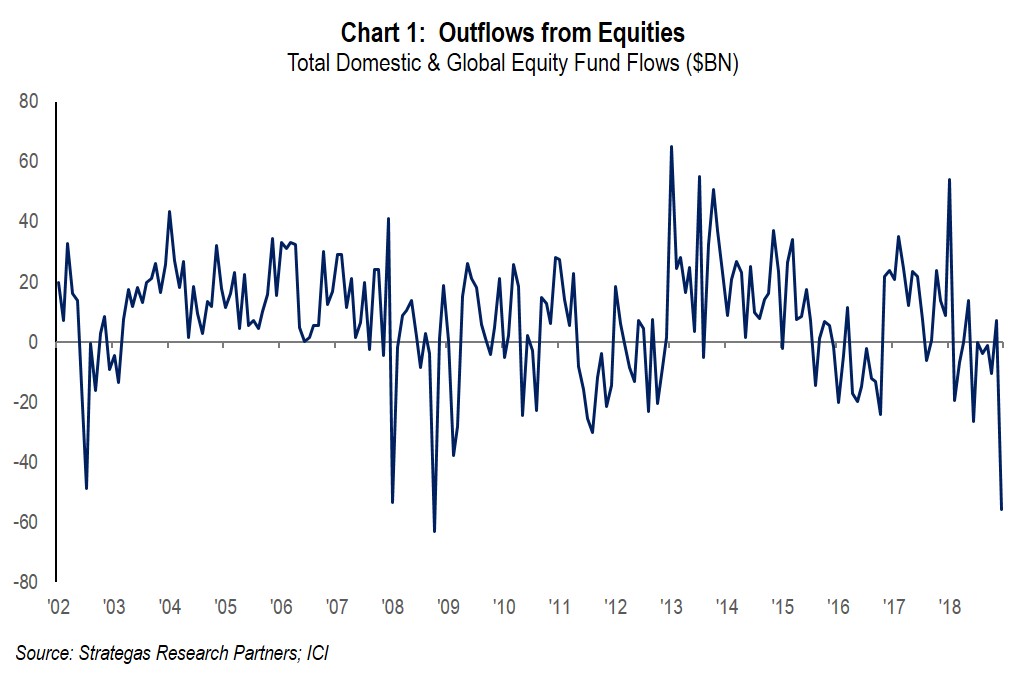
Apparently, what did matter were, in our opinion, missteps in communications by the new Fed Chair on interest rate and balance sheet policy, an attack on him by our President, a take back by the President of what seemed to be progress in talks with the Chinese, and the realization of the obvious — that corporate earnings would likely grow in 2019 but at a much slower pace. In our opinion, these factors, and probably others, led to the largest one-week outflow from equities on record, even greater than in 2008/2009! This makes no sense to us given underlying fundamentals and the strength of our banking system. We believe that withdrawals from ETFs and index funds (passive investing) is what contributed to the widespread decline irrespective of quality, earnings growth, or dividend increases.
It just seems strange to us that record outflows (See Chart 1) would occur when earnings growth is projected to continue and GDP growth also continues, albeit at a slower pace (see Charts 2 and 3).
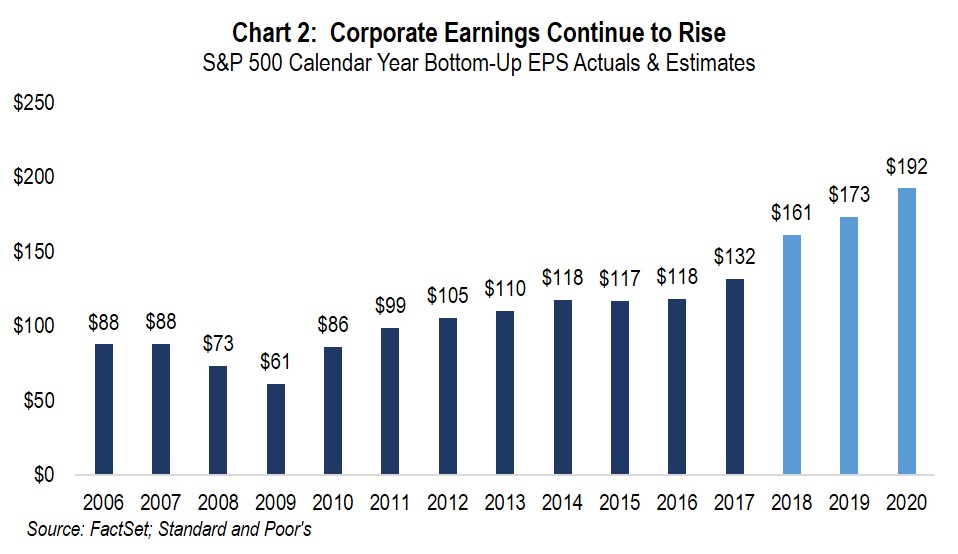
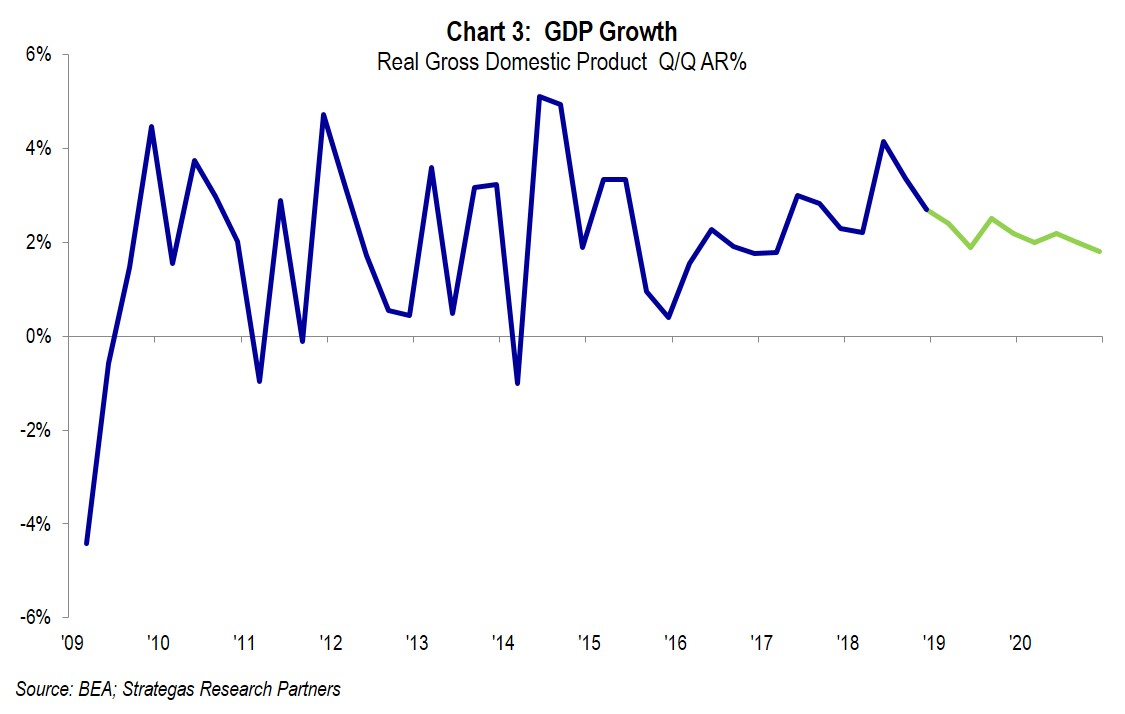
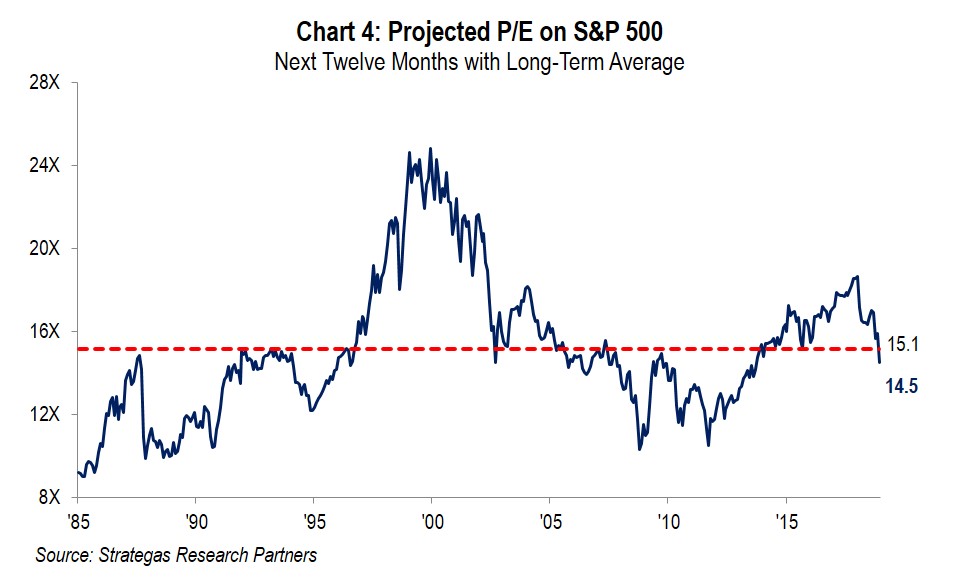
So, without repeating what we spoke of in our annual thought piece, the economy and earnings remain moderately strong while stocks were taken to the “woodshed” in the final quarter of 2018. The result being a below average P/E on 2019 projected earnings.
Additionally, volatility picked up in the fourth quarter. In numerous quarterly reports we have warned of increased volatility. Well, it is here but in Chart 5 below you can see that volatility is normal, and where we came from was abnormally low.
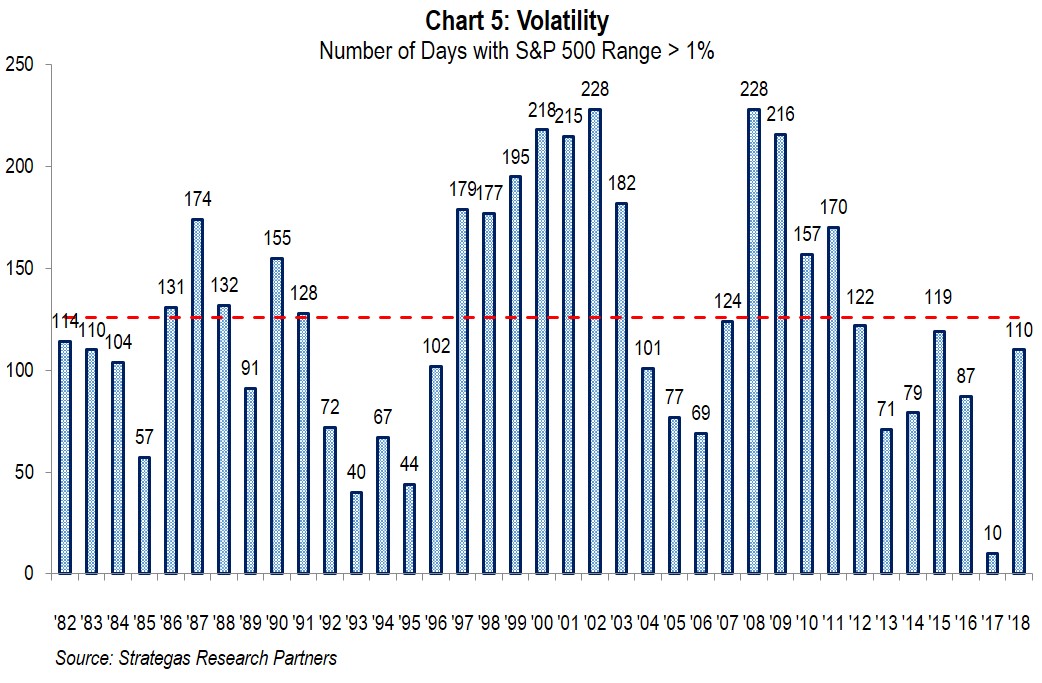
By the way, the increased volatility, if it continues, should help one of our defensive equity strategies.
What does it all mean?
The fourth quarter was very difficult for most investors. Equities sharply declined wiping out three quarters of gains for the S&P 500 and then some while short-term interest rates increased while longer-term bond yields declined. Oil prices declined, we believe because of oversupply, which will help consumers and many businesses (acts like a tax decrease). Valuations are now far more reasonable going forward; some would argue cheap when considering where interest rates are.
However, looking forward we now have a split government, a President and his campaign under investigation, key cabinet members departing, a partial government shutdown, and a Chinese trade war still evolving. This is a prescription for more volatility while economic fundamentals remain quite reasonable, for now. We as a firm still do not see a recession for 2019. That is a positive in our opinion.
We will be watching the fundamentals which we continue to believe will reward us as long-term and PATIENT investors. Just think about the impact of we or you having panicked the day or so before the Dow appreciated by over 1,000 points. Prudent asset allocation is our path to withstanding these periods of extreme volatility while prospering over the long term (the last several years have been good to us), and being patient to achieve the sweetness of the bitter environment we have just endured.
We hope you will join us on Thursday, February 7th at 2 PM EST for our web seminar where we will discuss our overall outlook for 2019 and how we are recommending clients portfolios be allocated for long-term results.
The start of the New Year is always a good time to reevaluate your asset allocation and ensure it is aligned to meet your goals. We would be happy to sit down and discuss your individual situation.
Best regards,

Robert D. Rosenthal
Chairman, Chief Executive Officer,
and Chief Investment Officer
*The forecast provided above is based on the reasonable beliefs of First Long Island Investors, LLC and is not a guarantee of future performance. Actual results may differ materially. Past performance statistics may not be indicative of future results. Partnership returns are estimated and are subject to change without notice. Performance information for Dividend Growth, FLI Core and AB Concentrated US Growth strategies represent the performance of their respective composites. FLI average performance figures are dollar weighted based on assets.
The views expressed are the views of Robert D. Rosenthal through the period ending January 25, 2019, and are subject to change at any time based on market and other conditions. This is not an offer or solicitation for the purchase or sale of any security and should not be construed as such.
References to specific securities and issuers are for illustrative purposes only and are not intended to be, and should not be interpreted as, recommendations to purchase or sell such securities. Content may not be reproduced, distributed, or transmitted, in whole or in portion, by any means, without written permission from First Long Island Investors, LLC. Copyright © 2019 by First Long Island Investors, LLC. All rights reserved.
2019 and Beyond
“Patience can be bitter, but its fruit is sweet.” – Aristotle
As we focus on the outlook and issues confronting us as long-term investors, it is appropriate to first say thank you. We at FLI have just celebrated our 35th anniversary in representing you, our clients, some of whom have been with us from our very inception. Without you, we would not be writing this note. I mention this because during that period we have been through much and have gained invaluable experience from many good and some perilous periods for our clients (where patience was always required). We now seem to be confronted by a sharply declining and volatile market with some predicting an imminent recession (we are not). Thus after a nine year period of positive results have we either hit a big bump in the road or worse are in a bear market, where many still remember and are influenced by the “decession” of 2008/2009; where many are fretting over the current occupant of the White House and our government in general; where we have a new Fed Chair seemingly mechanically intent on raising short-term interest rates while unwinding its balance sheet; and where the likes of China, Iran, and Russia threaten our way of life and that of many allies? We have a big “wall of worry” to understand and overcome! We must determine how much, if any, of this market decline is based on fundamentals versus investor fear from this imposing wall of worry. Is this a correction, or a transition to a bear market? In either case, we must be patient investors.
For many years FLI held annual seminars where I presented a yearly outlook leading off with the current and seemingly insurmountable wall of worry (now instead I write this thought piece and we hold a web seminar in February). In every outlook and web seminar I have always listed major worries AND the other side of the coin. The flip side being some positives which always included the resourcefulness of American business and American workers, as well as our free enterprise way of life supported by the best, but not perfect, form of government in the world. Our situation seems very much the same today.
I have listed many of the elements contributing to today’s wall of worry in the first paragraph above. A quickly and fiercely declining stock market signifies something, but the real economic factors suggest a disconnect with the recent market volatility (mostly declining).
– Corporate earnings continue to rise (See Chart 1)
– Unemployment is incredibly low (See Chart 2)
– Inflation is under control (See Chart 3)
– Consumer confidence is quite high (See Chart 4)
– Consumer debt is more manageable (See Chart 5)
– Oil prices have declined, giving both consumers and businesses a boost (See Chart 6)
– Wages are growing (See Chart 7)
– And interest rates, despite recent increases, remain historically low (See Chart 8)
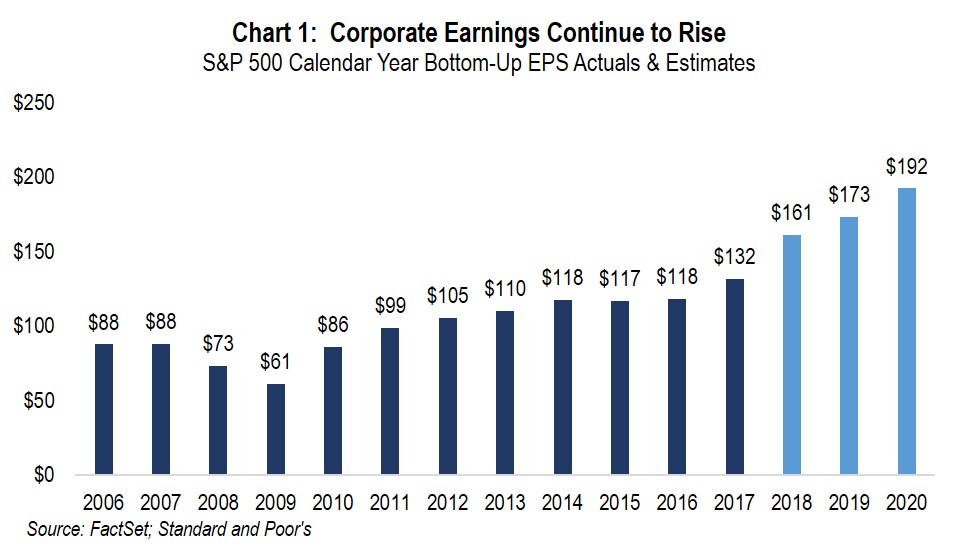
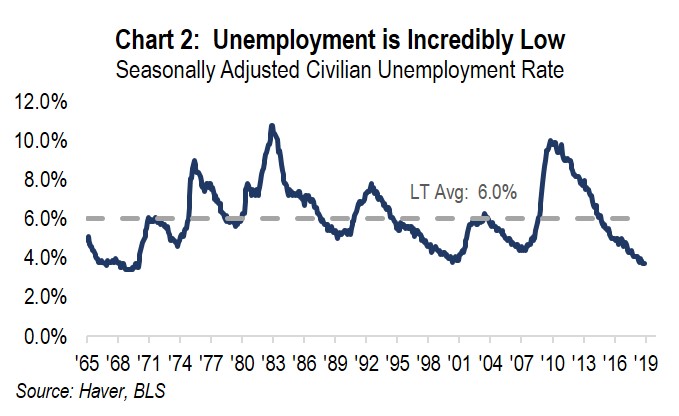
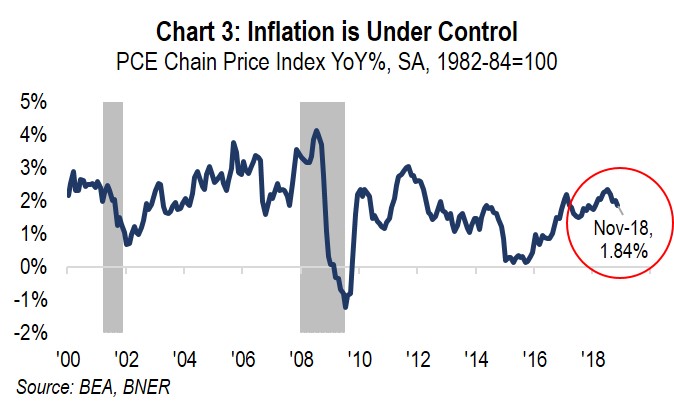
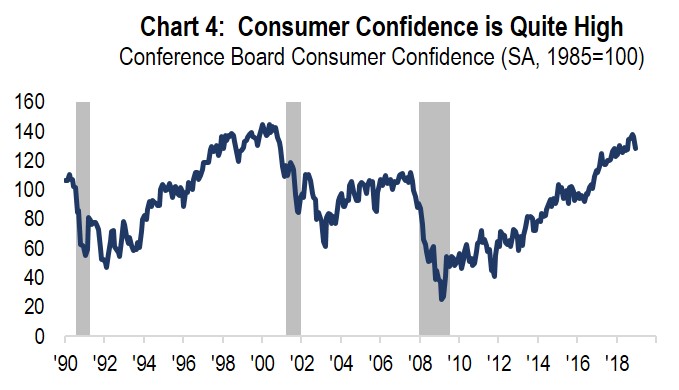
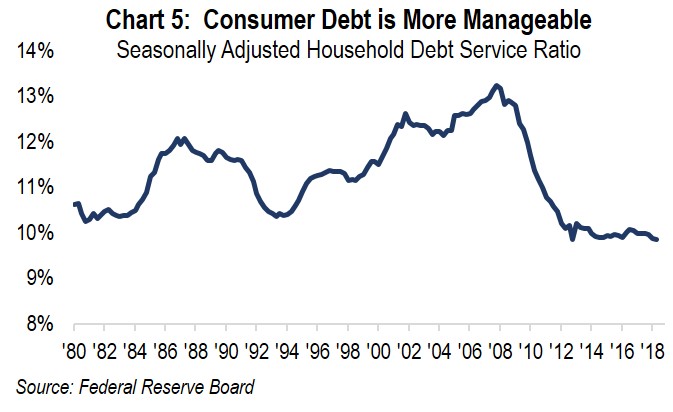
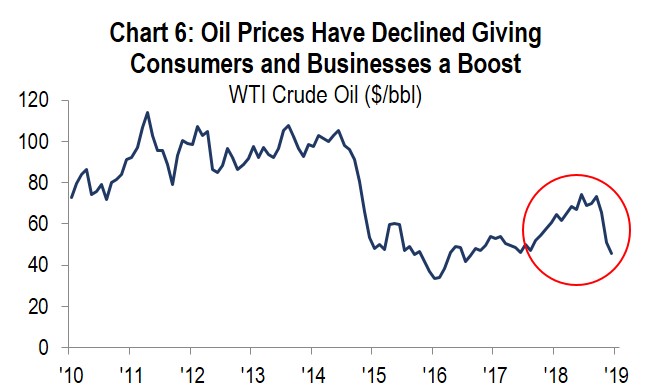
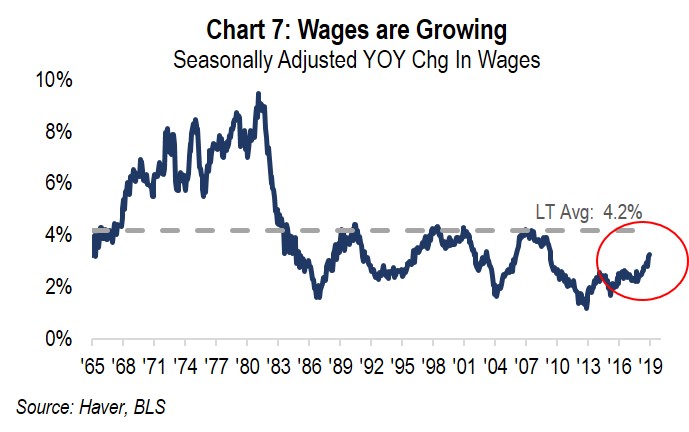

Therefore, unless some exogenous event occurs, our domestic economy appears to be reasonably strong. The many charts shown above mostly describe our current fundamentals and characteristics.
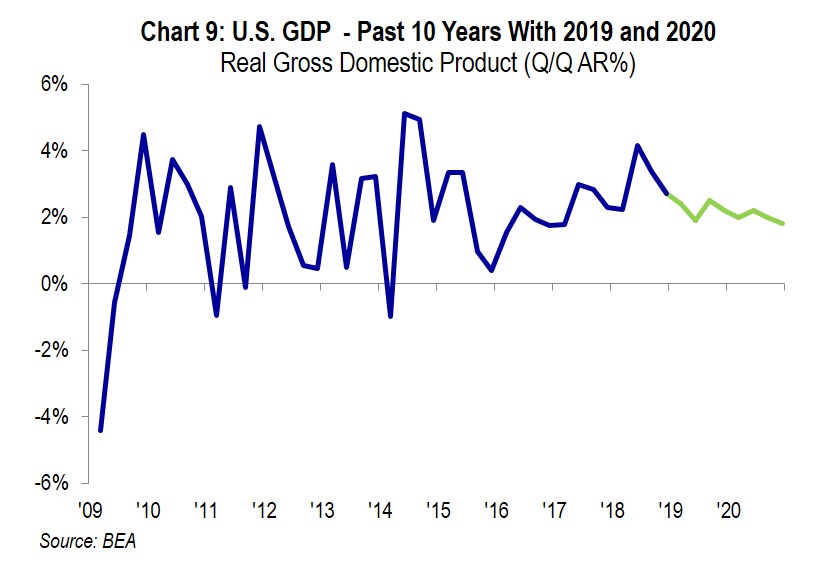
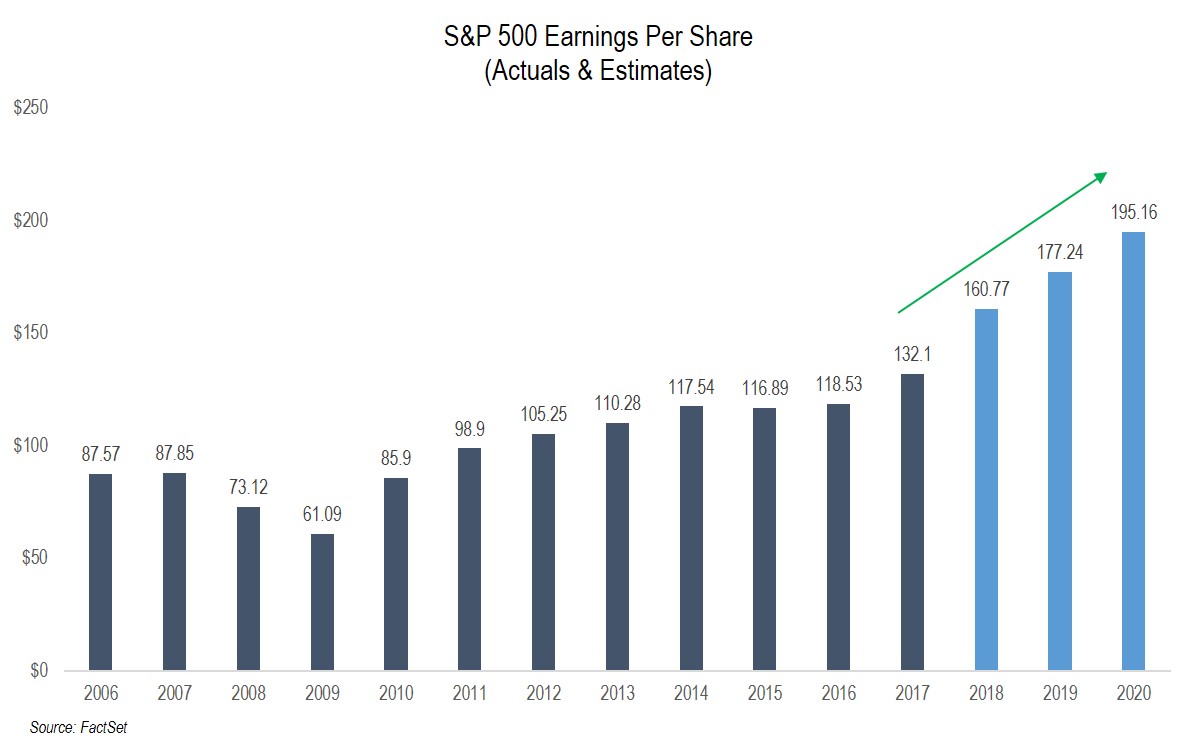
U.S. corporate earnings grew in 2018, in part from the change in tax law as well as from growth in gross domestic product. Looking forward to 2019, U.S. corporate earnings and gross domestic product are both projected to grow (See Chart 1 and Chart 9) although slower than they did in 2018. Notwithstanding this somewhat slower GDP growth, the political uncertainty across the globe and a strengthening dollar leads us to continue to underweight foreign stocks.
But can we be sure these positive economic and fundamental factors will remain in 2019?
In the last six weeks we have spoken with fourteen outside, among best-of-breed, equity investment managers, our partners in our real estate mezzanine loan strategy ,and two highly regarded economic consultants. Generally, their opinions remain positive as to the continuing but slowing growth of the U.S. economy, while the vast majority of companies in which they invest appear to be poised for continued success in 2019 and in many cases beyond.
So, what gives? Certainly earnings growth will slow and eventually we will face a recession (as defined by two consecutive quarters of negative GDP growth). We do not see that for at least the next eighteen months and in our opinion, it should not resemble the “decession” of 2008/2009, which is still fresh in the minds of many investors. The fear of a repeat drove their outflows from equity markets in the past two months. As a matter of fact, these outflows are at record levels, which makes no sense to us given the current positive state of our economy. By the way, we as professional investors, where we have managed wealth for the past 35 years, have weathered many recessions. For now, we do not see significant asset bubbles or an overstretched banking system, the main drivers of the pain and near disaster in 2008/2009. Today’s landscape is quite to the contrary, and we believe the overall contraction in price-earnings multiples, for the most part, is overdone.
However, our national debt continues to increase and that is a concern down the road that must be dealt with by our elected Federal officials. This growing debt is not stalling our economy at this time and with interest rates reasonably low now and for the immediate future, it is not an issue at this point. Inflation, which caused severe economic distress in the late 70’s and early 80’s is below 2% and there do not appear to be signs of increasing inflation. Thus, hyper-inflation which caused poor equity markets in the late 70’s and early 80’s is not in our view. As a matter of fact, until mid-2018 there was more concern about deflation than inflation.
History tells us that bull markets do not typically die of old age, but rather usually end when valuations become too stretched or meet a recession, amongst other factors. Today, in part based on the recent sharp equity decline, equities are somewhat cheap at roughly 14.5 times 2019’s growing earnings. GDP growth for the third quarter of 2018 was 3.4% and the fourth quarter is projected at 2.7% growth. Not even close to a recession. Additionally, the consumer remains buoyant as evidenced by holiday sales increasing by a robust 5.1% over the prior year according to Mastercard. That same consumer is now also benefitting from a significant drop in the price of oil (seems to be supply-driven and not from a decrease in demand). This will give consumers more dollars to spend, save, and/or de-lever.
So what gives and how should we act as investors? BE PATIENT!
Selling into a panicked market where the exits are crowded (record outflows) makes no sense to us especially since there are some pretty positive economic indicators and strong company fundamentals.
We would suggest plain old-fashioned patience and reflection on one’s asset allocation. From our perspective we believe fear and uncertainty have gripped investors who still remember the pain of 2008/2009. We have a new dynamic adding to this pain — the current erratic state in Washington D.C. With the mid-terms resulting in the Democrats taking the House and Republicans remaining in control of the Senate, we have a split government. In addition, we have a President whose policies and demeanor are giving no comfort to many on either side of the aisle. Despite a pro-growth tax bill, deregulation, and criminal justice reform as positives (although some rightfully are concerned about growing deficits), our President has lost several key cabinet members (including Haley and Mattis) and has become inconsistent, in my opinion, on trade with China as well as policy in Syria, while he, his campaign, and other entities remain under serious investigation. These are legitimate worries with little end in sight that could add to greater volatility.
In our opinion, the uncertainty about our President, his trade war with China (yes, both sides of the aisle agree they engage in unfair trade practices), a partial government shutdown, and a Fed Chair who is new in his role (and has not made many investor friends with his statements and increased interest rates) have driven many investors into fear mode irrespective of the many economic and company-specific positives listed above. This negative sentiment is a real worry but should the growing economy and improved company fundamentals prevail (which we believe will be the case), the tug of war should favor patient long-term investors.
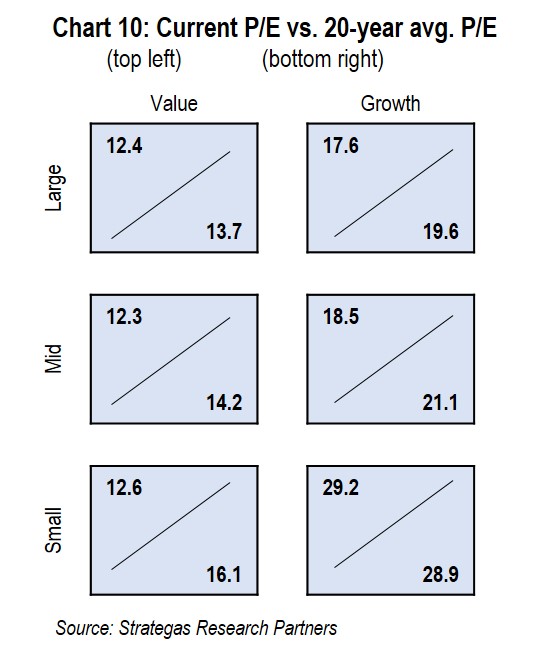
In our view, we still seem to have growing earnings and historically cheap to reasonable valuations (See Chart 10) in a period of stubbornly low interest rates with a modestly growing economy, which would normally suggest higher asset prices for quality companies and quality real estate.
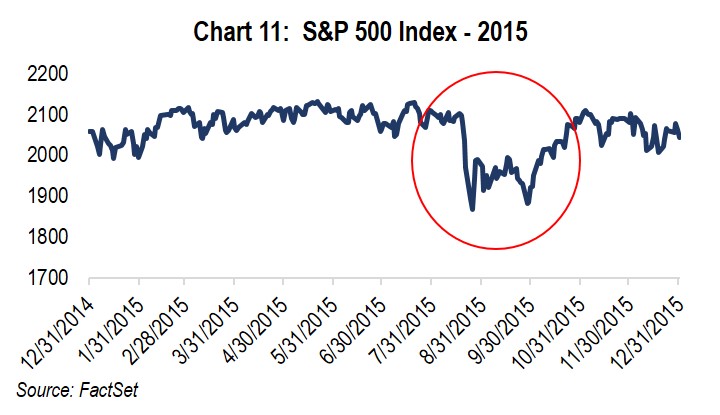
In 2015 we faced a similar conundrum of steep equity losses which turned out to be a correction, and NOT a bear market (See Chart 11). Recently, further steep declines had us at the classic definition of a bear market having dropped 20% from recently achieved highs until a record 1,000 point advance in the Dow and 116.6 point advance in the S&P 500 snatched us from the jaws of the bear.
Summary
None of us have a crystal ball, so we must evaluate all of the above. Relatively strong fundamentals go unnoticed by many investors who are panicked. Could the panic and uncertainty cripple consumer confidence (consumers make up almost 70% of our economy)? Maybe, but we do not think so based on recent holiday sales and dropping oil prices (along with many benefitting from the tax reform). Is the uncertainty enough to completely derail business growth despite pro-growth tax reform and deregulation helping many businesses? Again, we do not think so. Can our erratic government drive investors to more than temporarily accept low cash and bond returns? Again, we do not think so especially as Americans can change the makeup of two branches of government in less than two years.
We think the selling is overdone and equity valuations, in most cases, have gotten more attractive, creating opportunity. Furthermore, we believe that growing passive investing (through ETFs and index funds) which does not differentiate between high-quality and lesser-quality companies has exacerbated the decline. Will we face a recession at some point? Yes, but we do not believe it will be in 2019.
So, stay the course with a prudent asset allocation. We continue to urge our clients to take a defensive posture which overweights our defensive basket while still underweighting fixed income and modestly underweighting traditional equities. Private investments make sense for those qualified.
A defensive asset allocation (including a modest amount of cash to weather this uncertainty) can still provide some appreciation while better weathering the ultimate recession or exogenous event no one can predict. We should all consider rebalancing our asset allocations to take into account the current volatility which has made the valuations of even traditional equities more attractive. We are here to help with all of this and any other wealth management needs of you and your family.
Most of all, be patient. As the quote suggests, the fruit of that patience is an opportunity to earn an overall better return than that of bonds or cash and that better return compounds over time. But we must be patient and endure the bitterness of both corrections and bear markets. It is the price we pay for better returns over long periods of time.
As always, we welcome your questions. We hope you will join us on Thursday, February 7th at 2 PM EST for our web seminar where we will discuss the topics mentioned here in more detail and answer your questions.
Best regards,
Robert D. Rosenthal
Chairman, Chief Executive Officer,
and Chief Investment Officer
The forecast provided above is based on the reasonable beliefs of First Long Island Investors, LLC and is not a guarantee of future performance. Actual results may differ materially. Past performance statistics may not be indicative of future results. The views expressed are the views of Robert D. Rosenthal through the period ending January 8, 2019, and are subject to change at any time based on market and other conditions. This is not an offer or solicitation for the purchase or sale of any security and should not be construed as such. References to specific securities and issuers are for illustrative purposes only and are not intended to be, and should not be interpreted as, recommendations to purchase or sell such securities. Content may not be reproduced, distributed, or transmitted, in whole or in portion, by any means, without written permission from First Long Island Investors, LLC.
FLI average performance figures are dollar weighted based on assets.
All performance data presented throughout this communication is net of fees, expenses, and incentive allocation through or as of December 31, 2018, as the case may be, unless otherwise noted.
FLI believes the information contained herein to be reliable as of the date hereof, but does not warrant its accuracy or completeness. This communication is subject to modification, change, or supplement without prior notice to you. Some of the data presented in and relied upon in this document are based upon data and information provided by unaffiliated third-parties and is subject to change without notice.
NO ASSURANCE CAN BE MADE THAT PROFITS WILL BE ACHIEVED OR THAT SUBSTANTIAL LOSSES WILL NOT BE INCURRED.
Copyright © 2019 by First Long Island Investors, LLC. All rights reserved.
The Tax Cuts and Jobs Act of 2017 limited itemized deductions which impacts the deductibility of charitable contributions. As part of a recent Family Wealth Roundtable discussion that FLI held for clients, we discussed ways that philanthropic clients can adjust how and when they make charitable contributions to reduce their Federal income taxes.
“All investment returns are not created with equal risk. Investors should recognize this, and evaluate each investment they make to determine the risk undertaken to achieve the gain they made.” Robert D. Rosenthal, CEO and CIO of First Long Island Investors
A strong economy characterized by accelerated corporate earnings growth as well as robust consumer and business confidence led to record highs for the S&P 500, Dow Jones Industrial Average, and NASDAQ during the quarter.
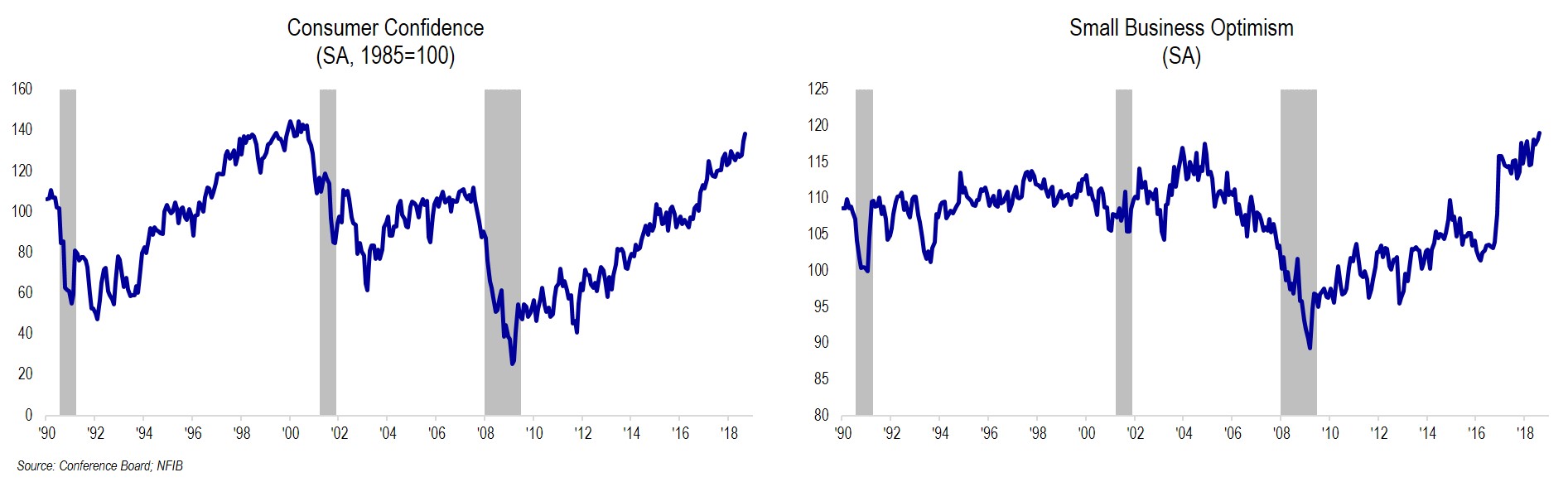
This was in spite of significant political acrimony over the confirmation of Judge Kavanaugh for the Supreme Court seat vacated by Justice Kennedy, as well as the approaching mid-term elections. The continued headlines regarding Special Counsel Robert Mueller’s investigation into Russian interference with the 2016 Presidential Election also continued to weigh on Washington as well as the general population.
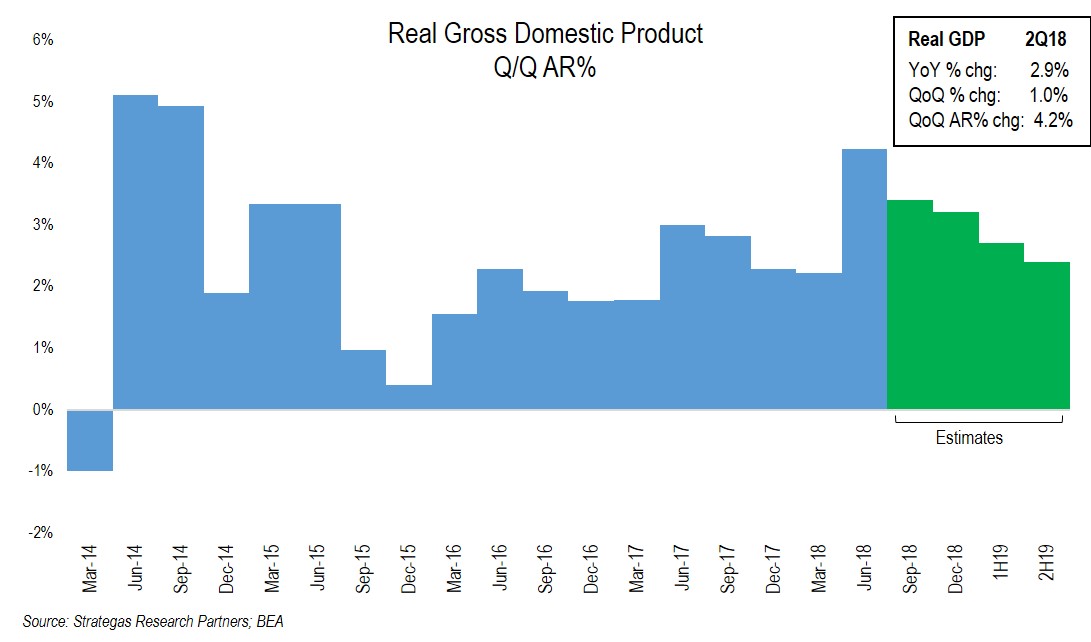
Meanwhile, the gross domestic product for the U.S. grew at an accelerating rate of 4.2% for the second quarter (see chart below) reflecting in part the fiscal growth initiatives recently enacted in the Tax Cuts and Jobs Act of 2017, as well as the current Administration’s efforts to eliminate certain regulations it viewed as hindering business growth.
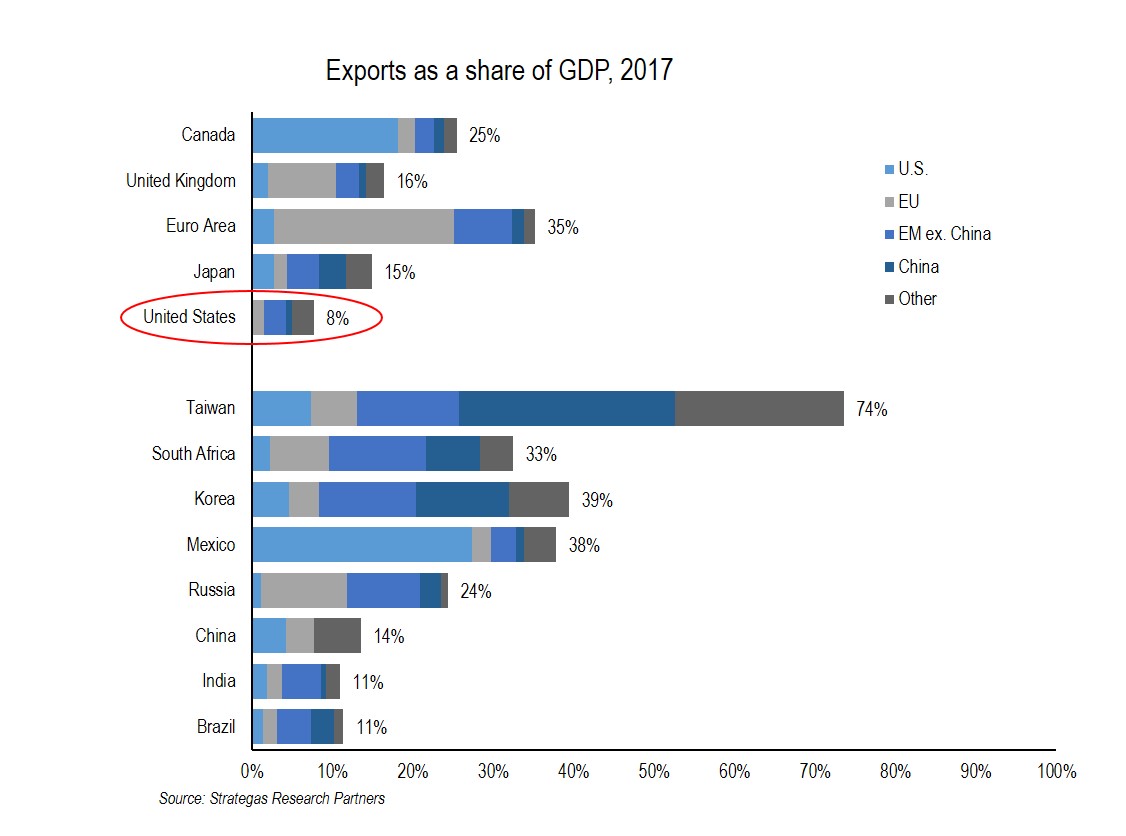
Despite this significant economic growth, fears of the growing trade war with China and to a lesser extent with Mexico, Canada and Europe, were also headline grabbing. It remains to be seen the extent to which these escalating trade skirmishes (or wars) will impact our economy. (The Administration has now been successful in renegotiating trade agreements with both Mexico and Canada.) The next chart shows the relative importance of exports for the U.S. and our trading partners. It suggests that the U.S. has the least to be concerned with as compared to our trading partners as foreign exports represent only 8% of our GDP. However, an all out trade war, in our opinion, could possibly crimp GDP growth. In addition, new and increased tariffs put on imports by the U.S. could also result in somewhat higher domestic inflation.
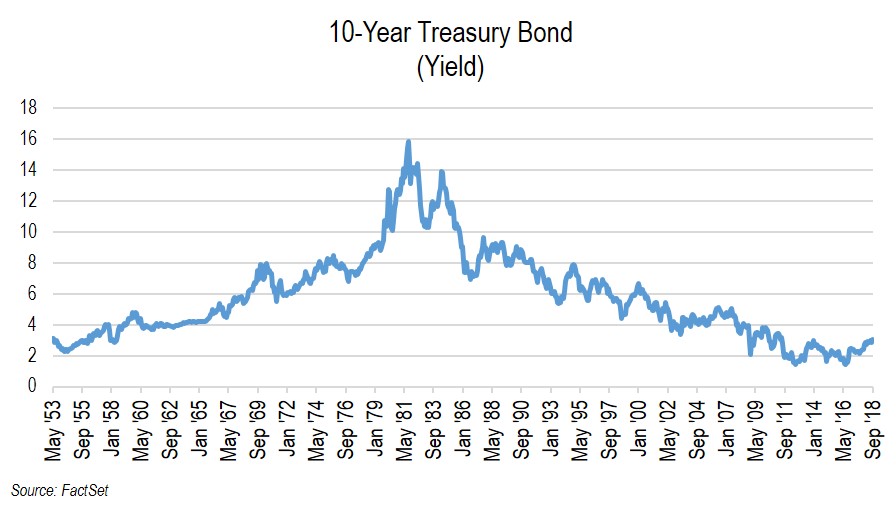
This higher rate of domestic economic activity and the beginning of higher wage growth has allowed the Federal Reserve to continue its policy of normalizing interest rates by raising the short-term rate by another 25 basis points in September. This has led the 10-year Treasury to break the 3% barrier and was 3.1% as of the end of the quarter. The following chart shows the yield on 10-year Treasury beginning to rise, but history suggests this is not anything near an alarming rate:
Additionally, investors should not be fearful that the stock market cannot continue to prosper when interest rates are rising. The chart below suggests just the opposite.
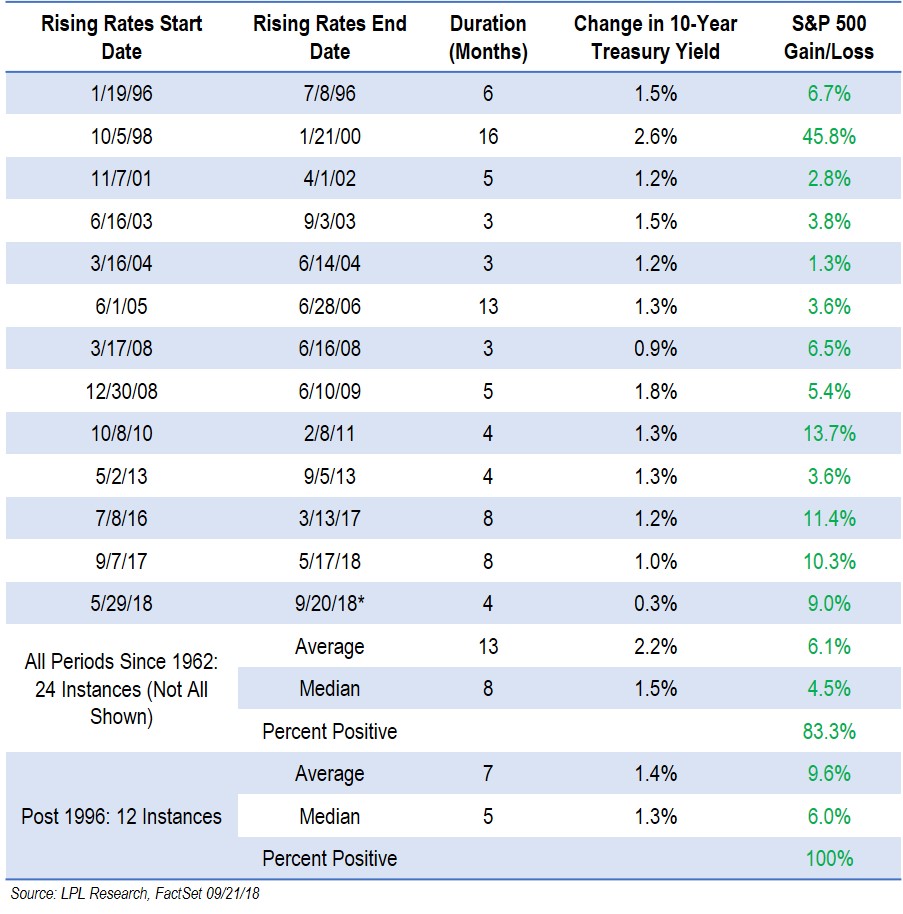
In fact, slightly higher interest rates, higher wage growth, and the threat of a trade war has not yet slowed the investment activity of U.S. businesses. Capital expenditures are at a very high level as you can see from the chart below. This suggests, in our opinion, potential productivity gains, as well as a continuation of economic growth:
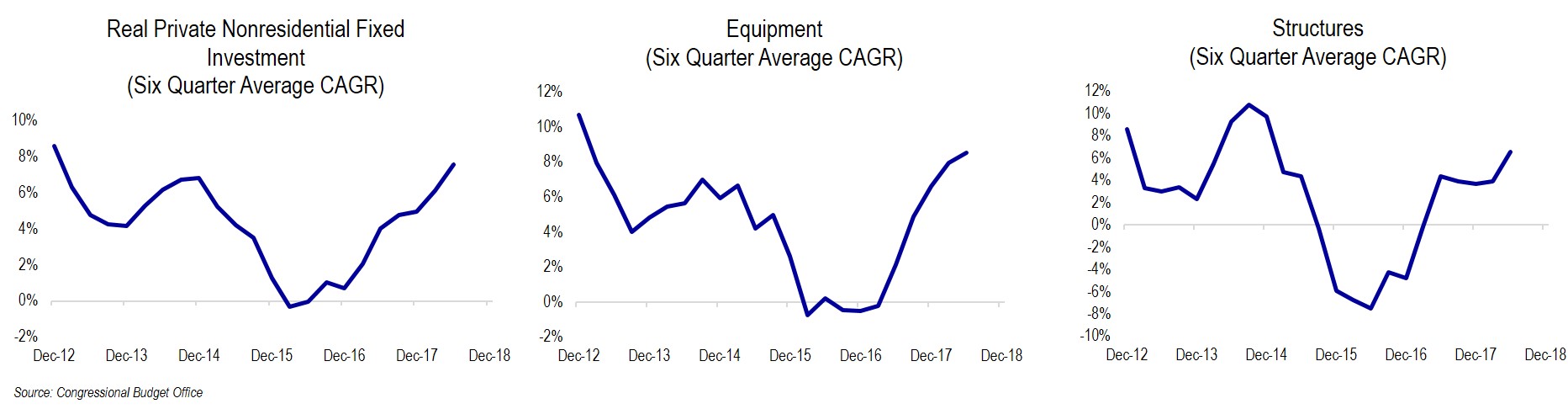
From an equity market standpoint, despite the concerns of some about valuation, U.S. equity indices continue to appreciate. So far this year, growth-oriented shares continue to outpace value-oriented shares by a wide margin.
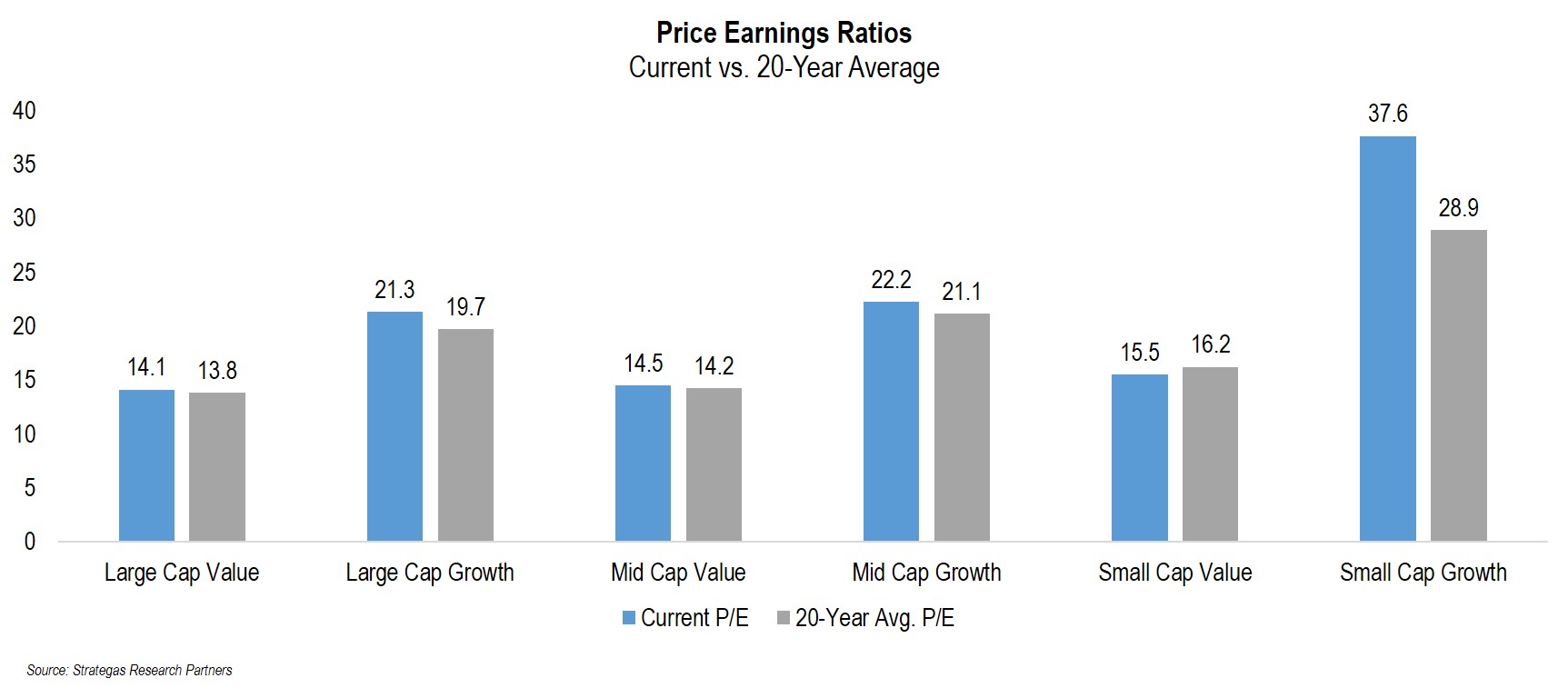
Our clients have benefitted so far this year from such outperformance as we have maintained our bias to growth shares. Our view is based on the actual and multi-year projected earnings growth of growth companies. This remained the case in the third quarter although our Dividend Growth strategy (which is more value-oriented) had an outsized gain of 9.5% net during the quarter, as it played catch up from earlier lackluster results this year. In fact, all of our equity strategies, both defensive and traditional, appreciated for the quarter and are performing well year-to-date. Furthermore, domestic equity markets continue to dramatically outpace foreign markets (as seen when you compare the blue lines to the green lines in the chart below).
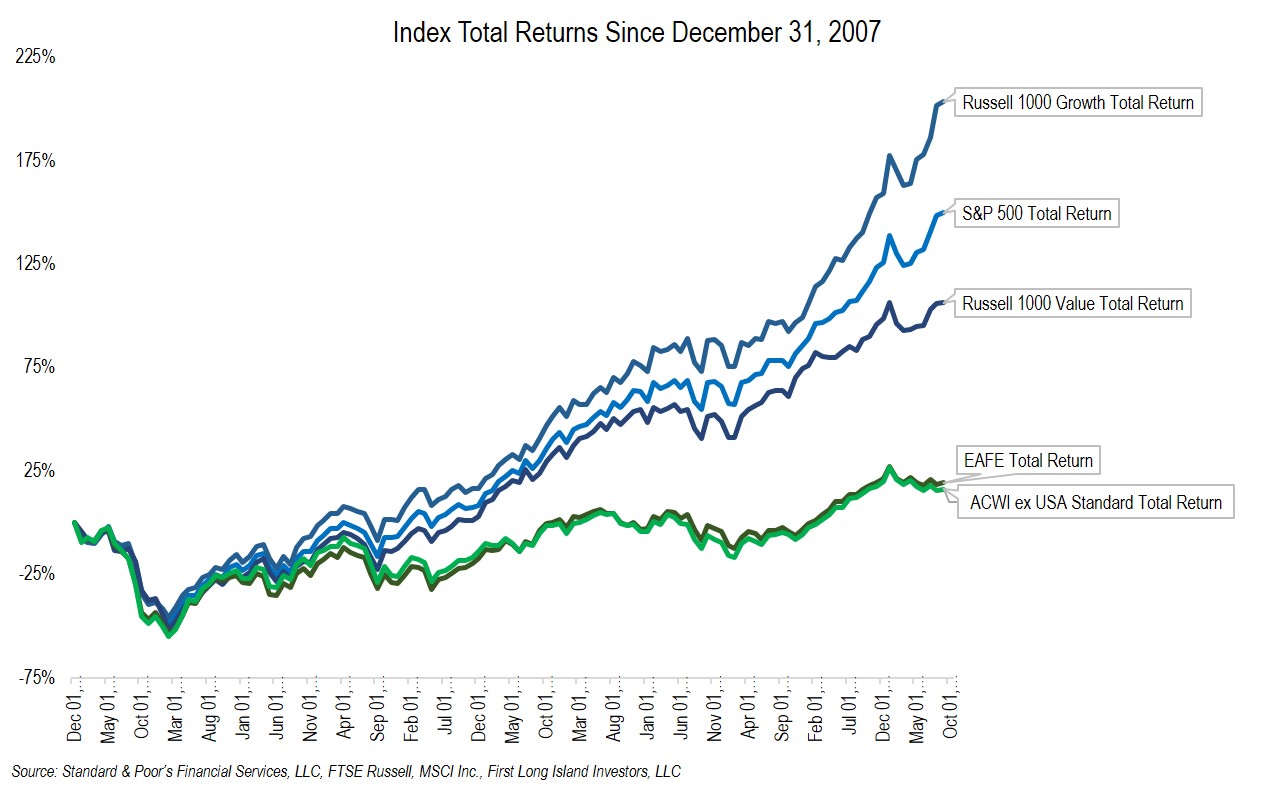
Many pundits continue to argue the valuation case for foreign equities, particularly emerging markets. However, we have continued to underweight foreign equities for years now and this has proven to be beneficial for our clients. At some point this may change, but for now we continue to favor domestic equities based on the strength of the U.S. economy and the pro-growth fiscal policies recently put in place.
So where does this all leave us as investors? Without question, there are strong economic fundamentals reflected in GDP growth, a very low level of unemployment, increased capital spending by business, consumer and business optimism, reasonable inflation, and continued below average interest rates. However, the following weigh on investors: the ongoing investigations, trade issues, the age of this bull market, and concerns about rising interest rates as well as equity valuations. These represent the “wall of worry.” Let us not forget the upcoming mid-term elections, which could possibly see the House and Senate flip to the Democrats while the President is a Republican. This is a formula for potentially even greater gridlock.
The above could result in some increased volatility, however, we continue to believe that the policies that have led to our economic strength will continue for a while at least and push off a potential recession into 2020 at the earliest. Corporate earnings are projected to increase next year and we believe that corporate spending will also continue to increase given the increased after-tax earnings from the new tax law as well as continued repatriation of offshore cash from that same law. We expect a tug of war between these two sides with economic optimism built upon earnings growth, low unemployment, wage growth, and business and consumer optimism versus the wall of worry outlined above. Accordingly, we continue to underweight fixed income, overweight our defensive strategies (where robust dividend growth and above average earnings growth have led to strong gains for our clients), and modestly underweight traditional equities. We will also look for opportunistic real-estate-type investments as we still believe that space will benefit from the improved economic activity. This somewhat defensive posture might result in us leaving some gains on the table but should insulate us from the worries that seem to be piling up. It should be noted that one is able to now get a bit over 2% (pre-tax) from rolling over short term U.S. Treasury Bills which we do for many clients. This is an improvement from where we were a year ago when short-term rates were even lower.
Risk seems to be growing with the “wall of worry.” Accordingly, we as investors must always carefully measure the gains we are achieving, and evaluate those gains based on the risks we are taking. At FLI we do not use leverage in any of our fixed-income or equity strategies. Our quality bias and annual growth in dividends (13.3% so far in 2018) in our Dividend Growth strategy makes it stand out from other similar strategies. The below average beta (measure of risk) in some of our strategies means they should be less prone to swings from volatility. In other words, we believe that we have taken less risk for our clients (and for ourselves, as we invest side-by-side) to generate the positive results in our strategies and for that we are very proud.
The third quarter and year-to-date have had greater volatility as compared to last year (do not forget the 10% drop this past February), but thus far we continue to make gains this year in our defensive and traditional equity strategies. We would expect this to continue in the fourth quarter if earnings continue to grow as expected and the Fed raises short-term interest rates in December, as expected. This could at some point in the future cool down equity markets, but we still feel it is too early for that. Additionally, real-estate valuations in many markets have yet to be significantly impacted by the somewhat higher interest rates.
We recommend staying the course as investors with a diversified asset allocation tilted to our defensive strategies given potential volatility in the months to come as well as the potential that earnings growth will moderate in 2019.
Please call us with any questions you might have regarding your asset allocation or wealth management matters. On Tuesday, October 30th we will be hosting our next Thought Leadership Breakfast with Lawrence Levy, Executive Dean, National Center for Suburban Studies at Hofstra University. We hope you can join us. For those of you who could not join us for our inaugural Family Wealth Roundtable, we will be posting aspects of it on our website in the very near future.
Best regards,
Robert D. Rosenthal
Chairman, Chief Executive Officer,
and Chief Investment Officer
*The forecast provided above is based on the reasonable beliefs of First Long Island Investors, LLC and is not a guarantee of future performance. Actual results may differ materially. Past performance statistics may not be indicative of future results. Partnership returns are estimated and are subject to change without notice. Performance information for Dividend Growth, FLI Core and AB Concentrated US Growth strategies represent the performance of their respective composites. FLI average performance figures are dollar weighted based on assets.
The views expressed are the views of Robert D. Rosenthal through the period ending October 18, 2018, and are subject to change at any time based on market and other conditions. This is not an offer or solicitation for the purchase or sale of any security and should not be construed as such.
References to specific securities and issuers are for illustrative purposes only and are not intended to be, and should not be interpreted as, recommendations to purchase or sell such securities. Content may not be reproduced, distributed, or transmitted, in whole or in portion, by any means, without written permission from First Long Island Investors, LLC. Copyright © 2018 by First Long Island Investors, LLC. All rights reserved.
On September 6, 2018, members of the First Long Island Investors Investment Committee held a web seminar where they shared with clients and business colleagues of First Long Island Investors our perspective on the key market drivers and things to watch for the future. The event also covered our current approach to asset allocation for long-term growth.